


Llandudno 2026: The Complete Guide to Wales’s Finest Victorian Seaside Resort
Llandudno is unlike any other seaside resort in Wales. It is arguably unlike any other in Britain.
It was planned and built as a single unified development in the 1850s. Located on the limestone peninsula between the Great Orme and the Little Orme, it retains its Victorian streetscape almost entirely intact.
The town features a sweeping crescent of hotels and guesthouses behind the promenade. You will find tree-lined streets of Victorian terraces and an ornate pier.
There is a cable tram and a tramway to the summit. The shopping street still carries more character than most British high streets.
It is the largest resort in Wales. It has held this title since the Victorians first built it.
The town wears its heritage with confidence rather than nostalgia.
The Great Orme headland rises 207 metres directly above the town. It is one of the most remarkable natural and archaeological landscapes in North Wales. It is a Site of Special Scientific Interest and a Country Park.
The headland features a Bronze Age copper mine open to the public. It is also a habitat for the rare Kashmir goat herd.
These goats have grazed the headland for over a century.
Conwy is four miles away. It is one of the greatest medieval walled towns in Europe.
Snowdonia begins at the horizon. The town’s food scene, pier, and conference hotel offer a year-round resort experience.
This extends well beyond the traditional summer season.
Colwyn Bay is 4 miles east and has the Welsh Mountain Zoo.
This guide covers everything you need to know for the perfect Llandudno break in 2026.
The Great Orme: Headland, Tramway and Bronze Age Mines
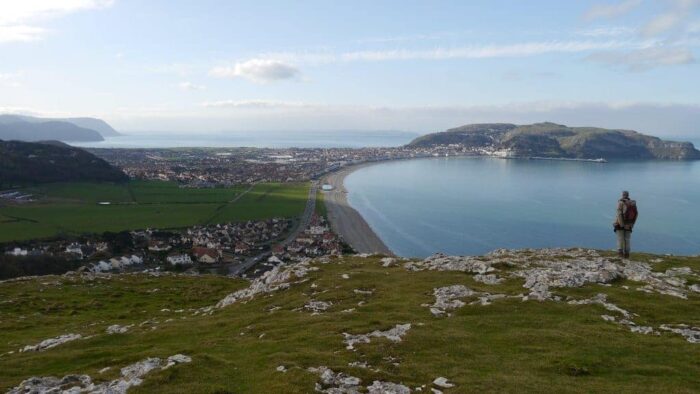
The Great Orme (Pen y Gogarth) is the defining feature of Llandudno — a massive limestone headland rising 207 metres from the sea, forming the western arm of the bay and dominating the town’s skyline.
It is designated a Site of Special Scientific Interest for its rare limestone flora, home to several species found nowhere else in Britain, and a Country Park freely accessible on foot from the town.
The summit plateau offers outstanding views across the Conwy Estuary, Anglesey and — on clear days — you can see the peaks of Snowdonia and the Isle of Man.
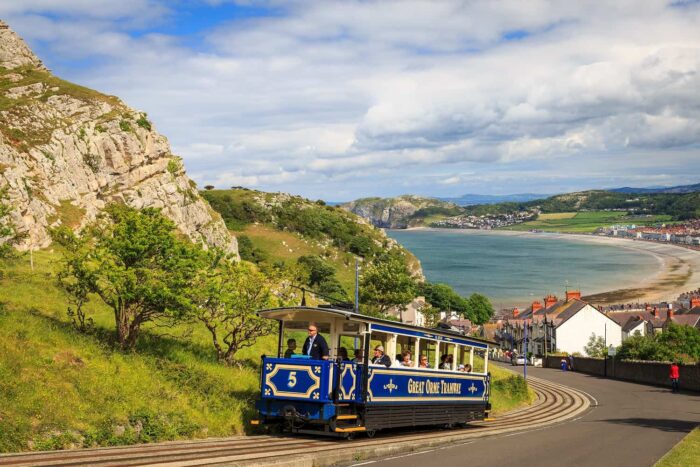
There are two exceptional ways to reach the summit beyond walking. The Great Orme Tramway (LL30 2NB) is the only cable-operated tramway still running on public roads in Britain, dating from 1902.
The upper section from the halfway house to the summit is very dramatic.
The Great Orme Cable Car offers a different perspective — a gondola lift from Happy Valley near the pier to the summit.
At the summit itself, the Great Orme Country Park Visitor Centre provides information on the headland’s geology and wildlife.
The Great Orme Bronze Age Copper Mines (LL30 2XG) are the most significant and best-preserved Bronze Age copper mines in Europe — a network of tunnels dug over 3,500 years ago that produced enough copper to supply much of Bronze Age Europe.
Guided tours take visitors underground into the original workings; the story of how prehistoric people identified, mined and processed copper ore here from around 1700 BC is very interesting.
Llandudno Pier and the Victorian Promenade
Llandudno Pier, extending 700 metres into the bay, is the longest pier in Wales and one of the finest Victorian pleasure piers surviving in Britain. Built in 1877, it retains its original cast-iron structure, a theatre at the seaward end, amusements and the sense of unhurried seaside pleasure that characterises the town.
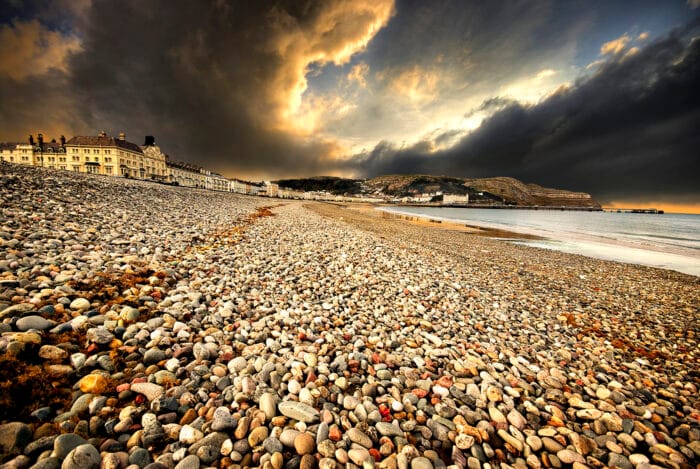
Walking the pier at dusk with the Great Orme to the west and the Little Orme to the east is one of the classic Llandudno experiences. The North Shore promenade, sweeping in a perfect arc for nearly two miles from the Great Orme to the Little Orme, is flanked by the largest concentration of Victorian seafront hotels in Wales and one of the finest in Britain.
The hotels themselves — many still in operation and well maintained give the seafront a grandeur that few British resorts retain. Alongside the pier, the North Shore beach is the main family beach — a wide, gently sloping sand strand that is safe for swimming in calm conditions.
West Shore, on the Conwy Estuary side of the peninsula, is far quieter, backed by sand dunes and the Deganwy estuary flats — excellent for birdwatching and sunset views across the mountains, and the spot where Alice in Wonderland author Lewis Carroll is said to have first told his stories to Alice Liddell, whose family holidayed here in the 1860s.
The Alice in Wonderland connection is formally commemorated by a statue on the West Shore promenade — one of several Alice-themed landmarks in the town.
Conwy: A Medieval Walled Town Four Miles Away
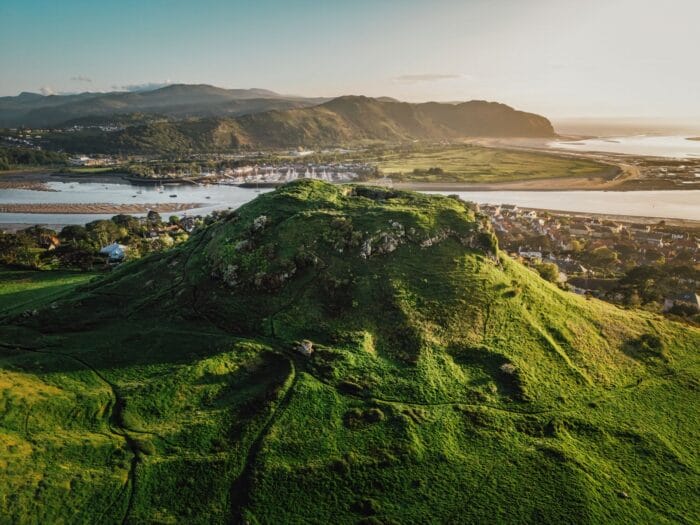
Conwy is four miles from Llandudno along the A546 and is one of the great day trips in North Wales — arguably the finest medieval walled town in Britain.
Conwy Castle (UNESCO World Heritage Site) is one of Edward I’s Iron Ring fortresses and offers outstanding views from its towers across the estuary, the mountains and the medieval town below.
The town walls, stretching 1.3 kilometres with 21 towers and three original gateways, are almost entirely intact and walkable for much of their length — the wall walk gives a remarkable sense of medieval urban defence in a living town.
Plas Mawr is the finest Elizabethan townhouse in Wales and sits within the walls and is open for tours.
Aberconwy House is the oldest house in Conwy, dating from the 14th century, and gives an intimate view into medieval merchant life.
The quayside at Conwy, with its fishing boats, mussel beds and estuary views, is one of the most atmospheric in North Wales.
Conwy is connected to Llandudno by regular bus service (route 5); the journey takes approximately 20 minutes.
See the full castle guide: castles in Wales.
Llandudno as a Gateway: Snowdonia and the North Wales Coast
Llandudno’s position at the northern edge of the Conwy Valley makes it an outstanding base for day trips throughout the region.
Snowdonia (Eryri) is directly accessible — Betws-y-Coed is 16 miles south via the A470 through the Conwy Valley, and from there the full national park opens up: Yr Wyddfa, Zip World, the narrow-gauge railways, Beddgelert and Portmeirion all within comfortable driving distance.
The Conwy Valley itself, between Llandudno and Betws-y-Coed, is one of the finest scenic drives in North Wales — the river, woodland, and increasingly dramatic mountain scenery as you head south make it well worth the journey even without a specific destination.
Anglesey is 20 minutes from Llandudno via the A55 — Beaumaris Castle, South Stack and Newborough Beach are all easily done as day trips
. Caernarfon (the finest of Edward I’s castles and the largest in Wales) is 30 minutes by car.
Llandudno Junction, the nearest mainline station (5 minutes by taxi or bus), is on the North Wales main line with direct services to Chester, Manchester and London Euston, making Llandudno easily accessible by rail for visitors from across Britain.
The Great Orme Kashmiri Goats: Llandudno’s Wild Residents
One of the more extraordinary aspects of Llandudno is its resident herd of wild Kashmiri goats — a feral herd of approximately 200 animals that roam freely across the Great Orme headland and periodically descend into the town itself.
The herd’s origin is uncertain but is believed to trace back to a gift of Kashmir goats to Queen Victoria from the Shah of Persia in the 1840s; the animals were housed at Windsor Castle, and a number were given to Lord Mostyn of Llandudno whose family owned much of the town.
They have roamed the Great Orme ever since, and during the 2020 lockdowns — when the town was entirely free of human visitors — the goats famously descended en masse onto the empty shopping streets, creating one of the memorable images of that strange period.
Seeing the goats on the headland, grazing on the limestone grassland above the town and sea, is a reliably delightful part of any Great Orme visit.
They are wild and should not be fed or approached closely.
See: wildlife in Wales.
Where to Stay in Llandudno
Llandudno has the largest concentration of hotels and guesthouses in Wales — a legacy of its Victorian development as a planned resort.
The North Shore promenade hotels range from large traditional seafront establishments to smaller boutique guesthouses.
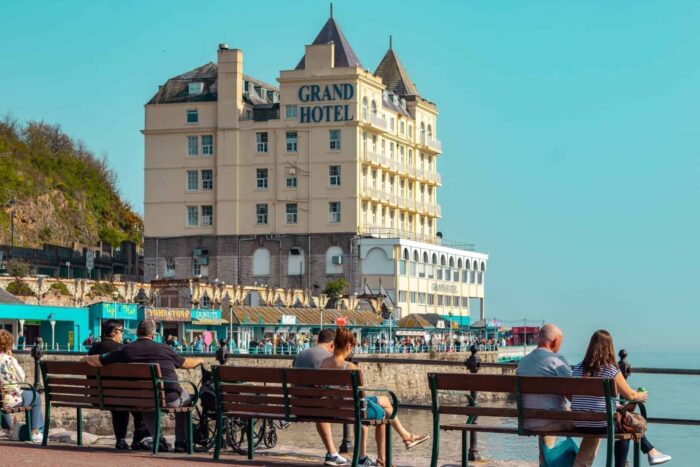
The Grand Hotel on the promenade is the grandest of the surviving Victorian seafront hotels — the largest hotel in Wales at the time of its construction.
The town also has a strong bed-and-breakfast and self-catering offer away from the seafront.
Self-catering apartments in the Victorian town centre are well suited to longer stays.
For visitors who want more space and rural quiet, holiday cottages in the Conwy Valley between Llandudno and Betws-y-Coed give easy access to both the resort and Snowdonia.
Use the map below to browse all property types.
See also: best hotels in Wales | holiday cottages in Wales.
Frequently Asked Questions: Llandudno
What is Llandudno known for?
Llandudno is known as Wales’s finest Victorian seaside resort — an almost entirely intact 19th-century planned town with a sweeping promenade, ornate pier, cable tramway to the Great Orme, and Britain’s only cable-operated public road tramway. It is also known for its proximity to Conwy Castle, the Great Orme’s Bronze Age copper mines (the largest and best-preserved in Europe), its feral Kashmiri goat herd, and its connection to Alice Liddell and Lewis Carroll. The resort is consistently rated among the best-preserved Victorian seaside destinations in Britain.
How do you get to Llandudno?
By rail: Llandudno station (LL30 2AF) is on the branch line from Llandudno Junction, which is itself served by the North Wales main line with direct trains from Chester (approximately 40 minutes), Manchester Piccadilly (approximately 1 hour 45 minutes) and London Euston (approximately 3 hours 15 minutes, change at Crewe). By car: the A55 North Wales Expressway connects Llandudno to Chester (approximately 45 minutes), the Britannia Bridge to Anglesey (approximately 25 minutes), and the A470 leads south into Snowdonia. Llandudno is approximately 4 hours from London by car without traffic.
Is Llandudno good for families?
Yes — Llandudno is one of the most family-friendly resorts in Wales. The safe North Shore beach, the pier, the Great Orme Cable Car and Tramway, the Bronze Age Copper Mines underground tour, and the feral Kashmiri goat herd on the headland all appeal strongly to families with children. Conwy Castle, four miles away, is among the finest castle day trips in North Wales. The resort also has a strong range of family accommodation options across hotels, guesthouses and self-catering. See: family days out in Wales.
Explore all Llandudno and North Wales guides:
Snowdonia (Eryri) — complete guide
Planning a trip to Wales?
Find the perfect holiday cottage for your Welsh adventure.