


North East Wales 2026: Llangollen, Pontcysyllte Aqueduct & the Clwydian Hills
North East Wales is the most accessible part of Wales from England — yet one of the least visited by those who don’t know it.
That is a genuine opportunity for those who do!
The region has a remarkable range of things to offer. Llangollen is one of Wales’s most characterful towns, sitting in a river valley of exceptional beauty beneath a ruined hilltop fortress.
Above it, the Pontcysyllte Aqueduct carries the Llangollen Canal 38 metres above the Dee Valley on a slender iron trough — a UNESCO World Heritage Site and one of the most extraordinary feats of canal engineering in the world.
To the north, the Clwydian Range AONB rolls through heather moorland and Iron Age hillforts.
The market town of Ruthin holds one of the finest medieval streetscapes in Wales.
Erddig near Wrexham is one of the National Trust’s most compelling historic houses in Britain.
This guide covers everything for 2026.
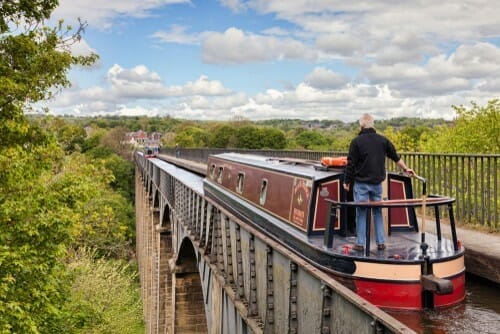
Pontcysyllte Aqueduct: UNESCO World Heritage and Engineering Wonder
Pontcysyllte Aqueduct (LL20 7TY) is the most remarkable piece of canal infrastructure in Britain.
Completed in 1805 by Thomas Telford and William Jessop, it carries the Llangollen Canal across the River Dee on 19 masonry piers — 307 metres long and 38 metres above the valley floor.
Designated a UNESCO World Heritage Site in 2009 as part of the Pontcysyllte Aqueduct and Canal World Heritage Site, it remains in active use as a navigable waterway.
Narrowboats cross daily — the experience of piloting a boat across the iron trough with no towpath rail on one side and a 38-metre drop on the other is genuinely vertiginous.
Walking across is free and takes approximately 10 minutes each way from the Trevor Basin car park (LL20 7TY).
The view from the aqueduct across the Dee Valley and toward Llangollen is outstanding.
Canal boat hire and day trips on the aqueduct operate from Trevor Basin — book in advance during summer.
The aqueduct visitor centre at Trevor Basin provides context on the engineering achievement and the canal’s history.
See our full heritage guide: attractions in Wales.
Llangollen: River Town, Ruins and the International Eisteddfod
Llangollen is one of the most satisfying small towns in Wales.
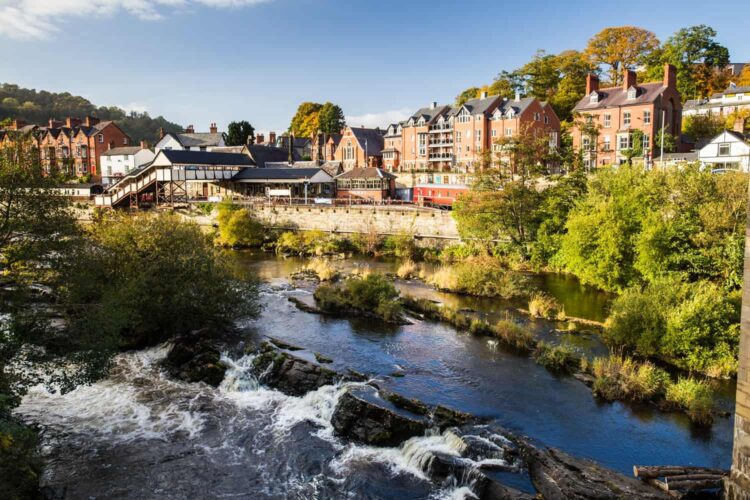
The River Dee rushes through its centre over natural rapids — fast, loud and visible from the medieval bridge that frames every photograph of the town.
The surrounding valley walls rise steeply on both sides, heavily wooded and dramatic.
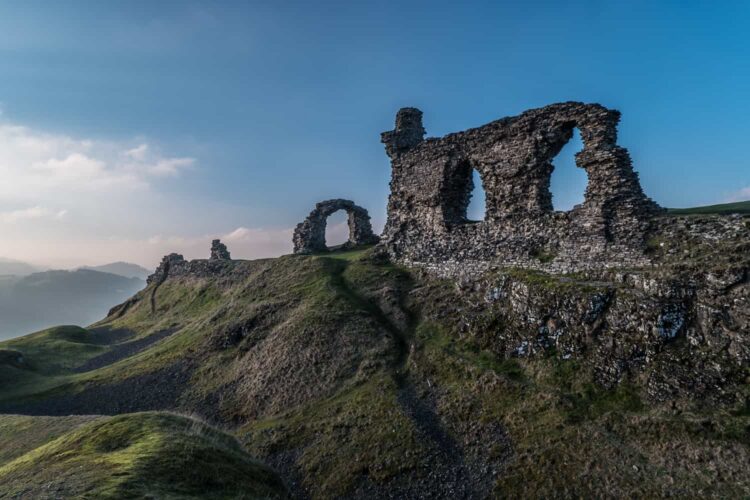
Above the town, on a commanding ridge, stand the ruins of Castell Dinas Brân — a 13th-century Welsh fortress with arguably the most dramatic hilltop setting of any castle in North East Wales.
The ascent from the town takes approximately 45 minutes and rewards with panoramic views of the Dee Valley in all directions.
Plas Newydd (LL20 8AW) was home to the eccentric Ladies of Llangollen — Lady Eleanor Butler and Miss Sarah Ponsonby — who eloped here together in 1780 and created a salon that attracted the most celebrated visitors of the Romantic era.
The Gothic cottage ornée they created is one of the most distinctive historic interiors in North Wales.
Each July, Llangollen hosts the International Musical Eisteddfod — a festival of world folk music and dance drawing competitors from over 50 countries, one of the finest cultural events in Wales.
Adventure Sports in Llangollen: White Water, Canoeing & Outdoor Activities
Llangollen has one of the most concentrated adventure sport scenes of any small town in Wales.
The River Dee runs fast and clear through the town centre — and the natural rapids that make the river so dramatic to look at also make it one of the best white water venues in North Wales.
White water kayaking and canoeing on the Dee is the headline activity.
The town-centre rapids (Grade 2–3) are challenging enough to be exhilarating but accessible to beginners on a guided session.
Multiple operators run half-day and full-day kayaking experiences from the river bank — no previous experience required for introductory sessions.
Llangollen also hosted the 1981 Canoe Slalom World Championships on this stretch of the Dee — which shows how seriously the river is regarded in the paddlesport world.
The legacy is a strong local coaching infrastructure and well-established hire operations.
River tubing has become increasingly popular in recent years — riding the Dee rapids on an inflatable tube is a lower-skill, higher-laugh alternative to kayaking, and is available through several Llangollen operators during the summer season.
Rock climbing and abseiling on the limestone crags of the Eglwyseg Escarpment above the town is well-established — the escarpment runs for several miles north of Llangollen with routes at all grades.
Guided climbing sessions for beginners are available through local instructors.
Mountain biking in the surrounding hills — particularly the trails above the Dee Valley and around the Horseshoe Pass — is an increasingly popular activity.
Llandegla Forest trail centre (LL11 3AA) has purpose-built trails for all abilities including a well-regarded red-grade cross-country loop.
For walking, the Dee Valley Way long-distance route follows the river through the town and beyond — combining water-level walking with the dramatic valley scenery that surrounds Llangollen on all sides.
Llangollen Steam Railway and the Horseshoe Pass
The Llangollen Railway is one of the most scenic heritage steam railways in Wales.
It runs 10 miles from Llangollen station (LL20 8SN) along the Dee Valley through Berwyn, Glyndyfrdwy and Carrog to Corwen — a route that follows the river through increasingly dramatic valley scenery.
Services run most weekends year-round and daily during school holidays. Return tickets approximately £2 adult — you can book at llangollen-railway.co.uk.
Steam hauled throughout; diesel on some services out of season.
The Horseshoe Pass (A542) climbs from Llangollen to 417 metres through a dramatic glacial valley — one of the finest mountain road drives in North Wales.
The Ponderosa Café at the summit (LL11 3DD) is a popular biker and walker meeting point with outstanding views across the Vale of Llangollen below.
The pass descends into the Vale of Clwyd at Llandegla — from where the Llandegla Forest mountain bike trail centre (LL11 3AA) is 2 miles west, one of the best beginner and intermediate MTB venues in North Wales.
See: mountain biking in Wales.
Erddig: The National Trust’s Most Compelling Welsh House
Erddig (LL13 0YT) near Wrexham is unlike almost any other country house open to the public in Britain.
Built in the late 17th century and passed through the Yorke family for 250 years, it was bequeathed to the National Trust in 1973 in a state of dilapidation.
The Trust restored it meticulously, preserving the sense of faded grandeur rather than imposing a sanitised stately-home aesthetic.
What makes Erddig genuinely exceptional is its below-stairs content.
The servants’ quarters, kitchens, laundry, blacksmith’s shop and carpenter’s workshop survive largely intact.
The Yorke family’s unusual habit of commissioning portraits and verses about their servants gives Erddig one of the most complete and human records of domestic service life in Britain.
The formal walled garden is one of the finest restored 18th-century gardens in Wales.
Allow at least 3 hours — it rewards slow exploration!
Chirk Castle and the Border Country
Chirk Castle (LL14 5AF) is one of the finest border castles in Wales — and uniquely among Edward I’s fortresses, it has been continuously inhabited since its completion in 1310.
The result is a castle that tells 700 years of living history rather than presenting a single period.
The state rooms contain outstanding furniture and tapestries from the 17th to 19th centuries.
The medieval dungeons beneath are one of the most atmospheric spaces in any Welsh castle.
The formal gardens and parkland are exceptional — the ornate 18th-century iron gates at the entrance are among the finest wrought-iron gates in Britain.
Wrexham (Wrecsam) is the largest town in North Wales and the region’s commercial and sporting centre.
Wrexham AFC, the world’s oldest international football club, drew global attention following its Hollywood takeover by Ryan Reynolds and Rob McElhenney in 2020 and subsequent rise through the Football League
Racecourse Ground (LL11 2AH) fixtures are now among the most sought-after sports tickets in Wales.
Check wrexhamafc.co.uk for the 2026/27 fixture list.
St Giles’ Church in Wrexham town centre is one of the Seven Wonders of Wales — a 16th-century tower of exceptional quality and one of the finest Gothic church towers in Britain.
Elihu Yale, founder of Yale University in the United States, is buried in the churchyard.
See: castles in Wales.
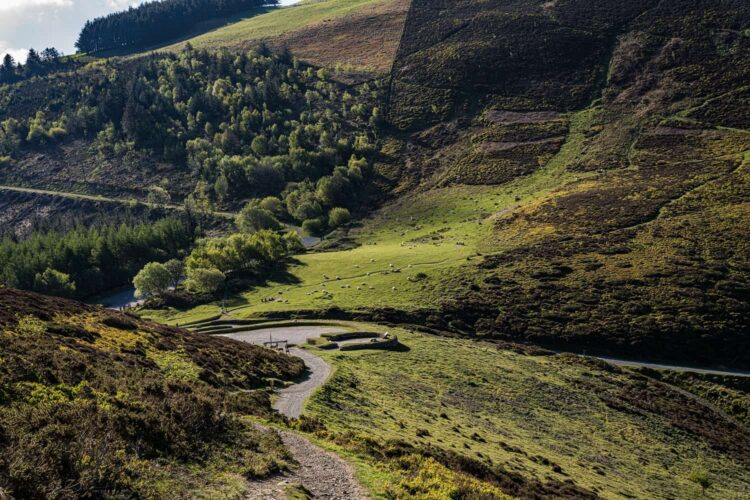
The Clwydian Range: AONB Walking and the Offa’s Dyke Path
The Clwydian Range — designated an Area of Outstanding Natural Beauty runs for 20 miles through North East Wales, a ridge of heather moorland and grass summits punctuated by a sequence of Iron Age hillforts.
Moel Famau (554 metres) is the highest point.
The ascent from the Bwlch Penbarra car park (CH7 4HN) takes approximately one hour and reaches the remains of the Jubilee Tower — built to mark George III’s jubilee, never completed, and now a striking ruin on the windswept summit plateau.
Views span from Snowdonia to the Pennines on clear days.
The Offa’s Dyke Path national trail runs along the Clwydian ridge between Prestatyn and Llangollen.
The northern section of this 177-mile trail offers outstanding ridge walking with the added historical significance of following the 8th-century earthwork boundary commissioned by King Offa of Mercia.
The Vale of Clwyd below the range contains some of the most attractive market towns in North East Wales.
Ruthin (Rhuthun) in particular has a medieval core of considerable quality, a hilltop castle now operating as a hotel and a lively independent food and arts scene.
See: hiking in Wales.
Where to Stay in North East Wales
Holiday cottages in the Llangollen Valley and the Dee Valley are particularly well-suited to the region. Converted stone barns and farmhouses on the steep valley sides with outstanding views. The Ceiriog Valley west of Chirk is especially rewarding for quiet, rural cottage stays.
Hotels in Llangollen include the hand Hotel (LL20 8PL) on the riverbank — one of the most pleasantly situated small hotels in North Wales, with the Dee rapids directly outside. Ruthin Castle Hotel is North East Wales’s most distinctive country house option.
Canal boat hire from Trevor Basin or Llangollen Wharf offers a uniquely different way to stay in the region — a narrowboat moored below the aqueduct or in the Dee Valley is a genuinely memorable experience.
Use the map below to browse all property types.
See also: holiday cottages in Wales | glamping in Wales.
Frequently Asked Questions: North East Wales
Is Pontcysyllte Aqueduct a UNESCO World Heritage Site?
Yes. Pontcysyllte Aqueduct and the associated Llangollen Canal were designated a UNESCO World Heritage Site in 2009. The designation covers an 11-mile stretch of canal including the aqueduct and original canal infrastructure. Walking across the aqueduct is free — start from the Trevor Basin car park (LL20 7TY). Canal boat trips operate from Trevor Basin and Llangollen Wharf.
Can you go white water kayaking in Llangollen?
Yes — Llangollen is one of the best white water kayaking destinations in North Wales. The River Dee runs Grade 2–3 rapids through the town centre, and multiple operators offer guided half-day and full-day kayaking and canoeing sessions with no previous experience required. Llangollen hosted the 1981 Canoe Slalom World Championships on this stretch of the Dee. River tubing, rock climbing on the Eglwyseg Escarpment and mountain biking in the surrounding hills are also available through local activity operators.
What is there to do in Llangollen?
Llangollen offers white water kayaking and river tubing on the Dee rapids, the Pontcysyllte Aqueduct UNESCO site (6 miles east), the steam railway along the Dee Valley, the ruins of Castell Dinas Brân above the town, Plas Newydd (home of the Ladies of Llangollen), rock climbing on the Eglwyseg Escarpment, and the International Musical Eisteddfod each July. It is also a good base for the Horseshoe Pass, the Clwydian Range walks and Erddig near Wrexham.
How far is North East Wales from England?
North East Wales borders England directly. Wrexham is 12 miles from Chester, Llangollen is 20 miles from Shrewsbury, and the A55 from Chester reaches Llangollen in under 30 minutes. It is one of the most accessible parts of Wales from the English Midlands and North West England. Chester is 40 minutes by rail from Liverpool and 1 hour from Manchester.
See accommodation: holiday cottages in Wales.
Explore all North East Wales and North Wales guides:
Snowdonia (Eryri) — complete guide
Planning a trip to Wales?
Find the perfect holiday cottage for your Welsh adventure.