


Swansea Bay & the Gower Peninsula 2026: The Complete Travel Guide
Swansea is Wales’s second city — a post-industrial port city rebuilt and reimagined since the Second World War, with a maritime quarter, a transformed waterfront, the birthplace of Dylan Thomas, and direct access to one of the most outstanding pieces of coastal scenery in Britain.
The Gower Peninsula, attached to Swansea’s western edge, that makes this corner of South Wales so remarkable: a 70-square-mile peninsula of limestone cliffs, ancient common land, wild moorland, hidden bays and some of the finest beaches in Britain
It was designated as the UK’s first Area of Outstanding Natural Beauty back in 1956.
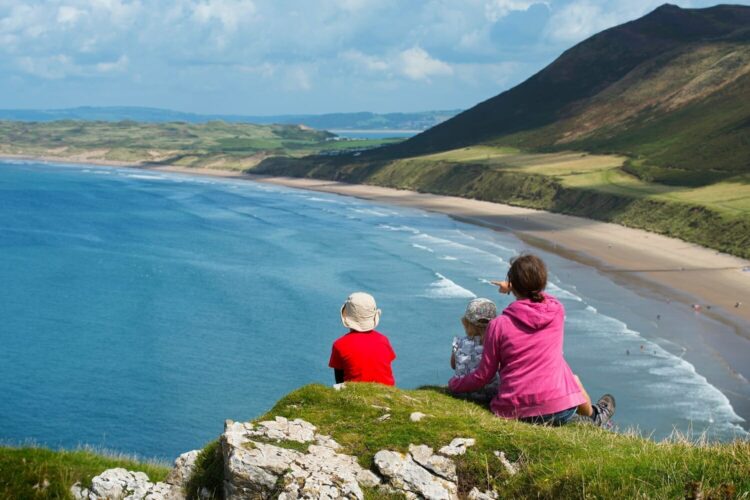
Rhossili Bay at the Gower’s western tip is a three-mile arc of Atlantic-facing sand backed by the moorland plateau of Rhossili Down and is consistently voted one of the top 10 beaches in Europe.
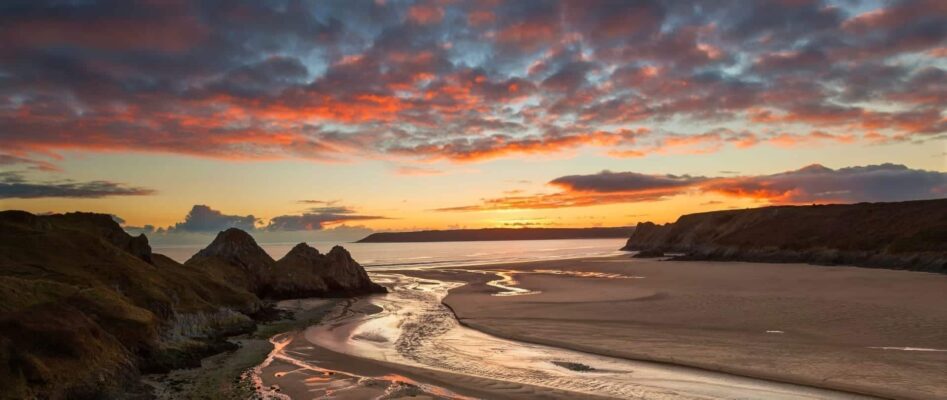
Three Cliffs Bay, accessible only on foot, is photographed more than almost any other Welsh landscape.
The Gower’s south coast delivers headland after headland of limestone scenery above secret bays, each accessible on the Wales Coast Path that runs the full perimeter of the peninsula.
Swansea has been steadily reinventing itself as a city worth visiting in its own right — the Dylan Thomas connection is celebrated, the food market is one of the best in Wales, and the Swansea waterfront continues to develop.
This guide covers both city and peninsula for 2026.
Rhossili Bay and Worm’s Head: Britain’s Most Iconic Beach
Rhossili Bay needs little introduction to those who know the Gower — a three-mile sweep of hard Atlantic sand at the western tip of the peninsula, backed by the long grassy ridge of Rhossili Down (193 metres), with the tidal island of Worm’s Head projecting into the sea at the southern end.
It has been voted one of Europe’s top 10 beaches repeatedly over the past decade, and on a clear day with surf rolling in from the Atlantic it’s one of the most beautiful beach settings in Britain.
Parking in Rhossili village (SA3 1PL – National Trust car park, charged) — the beach is a short walk down a path from the village and car park.
The beach is entirely undeveloped: no cafés, no facilities directly on the sand, which is a significant part of its appeal.
Worm’s Head — a narrow tidal causeway and rocky headland extending 1.5km into the Bristol Channel is accessible for roughly 2.5 hours either side of low tide.
Crossing to the outermost head and back takes 1–2 hours on rough but well-worn paths; the tide tables are posted at the National Trust Visitor Centre in Rhossili village.
Being cut off by the tide on the outer head is a real risk — check carefully before crossing and do not linger.
The view back to Rhossili Bay from Worm’s Head is one of the great coastal vistas in Wales.
Rhossili Down above the bay is National Trust common land — a ridge walk of approximately 4 miles return from the village giving outstanding views over the full Gower peninsula, the Bristol Channel and on clear days to Pembrokeshire.
Three Cliffs Bay: Gower’s Most Photographed Cove
Three Cliffs Bay on the south Gower coast is among the most photographed beaches in Wales.
A small, east-facing cove enclosed by three limestone promontories on the eastern side, with the ruins of Pennard Castle on the dune ridge above and the Pennard Pill stream cutting through the sand to the sea.
It is accessible only on foot, with no road access and no facilities, making it one of the least commercialised beautiful beaches in Britain.
The most popular approach is from the National Trust car park at Southgate (SA3 2DH) — approximately 30 minutes’ walk via the coast path.
The beach is tidal and the stream can be knee-deep at high water; low to mid-tide is the best time to visit.
The walk along the south Gower coast path from Pennard Cliff to Three Cliffs and on to Oxwich Bay (approximately 4 miles) is one of the finest coastal walks in Wales with limestone grassland above, natural arches and sea stacks at the cliff base below.
Oxwich Bay, at the eastern end of this walk, is a 2-mile National Nature Reserve beach with a café and car park (SA3 1LS) — the most family-friendly beach on the south Gower coast.
See the full beach guide: beaches in Wales.
Gower Surfing and Water Sports
The Gower Peninsula’s Atlantic-facing coast is the heartland of Welsh surfing — a sequence of west-facing beaches that catch consistent swell from the Bristol Channel and Atlantic and have supported a surf culture since the 1960s.
Llangennith on the northwest coast (SA3 1JH) is the most popular surf beach in Wales — a long, south-facing beach break with consistent swell suitable for all levels, surf school provision, board hire and a reliable summer scene.
PJ’s Surf Shop at Llangennith is one of the most established surf shops in Wales.
Langland Bay on the south Gower coast is the closest surf beach to Swansea city centre — a point break that works at mid-tide on south-westerly swells, with a surf school and seafront café popular with the Swansea surf community.
Caswell Bay adjacent to Langland is the best family beach on the south Gower — sheltered, Blue Flag, with a café and toilets in a wooded setting.
For sea kayaking and coasteering, the south Gower coast between Mumbles and Rhossili offers outstanding natural sea cave and cliff environments — multiple operators in the Mumbles area offer guided sessions.
Dylan Thomas and Swansea City
Swansea is the birthplace of Dylan Thomas — Wales’s most internationally celebrated poet and writer, born at 5 Cwmdonkin Drive (SA2 0RA) in 1914.
The birthplace is open for tours (check dylanthomasbirthplace.com for 2026 opening times; admission approximately £5).
Cwmdonkin Park, a short walk from the house, features a memorial stone inscribed with lines from his poetry and was the playground of his childhood — described in his short stories and in the semi-autobiographical broadcasts that became Return Journey.
The Dylan Thomas Centre (SA1 1RR, free entry) in Swansea’s maritime quarter houses the permanent Dylan Thomas exhibition, the largest and most significant collection of material relating to his life and work.
It also hosts the annual Dylan Thomas Festival each October/November — the most comprehensive celebration of his work in Wales, with readings, theatre, film and debate.
Swansea Market (SA1 3PF), one of the largest indoor markets in Wales and open Monday to Saturday, is where Dylan Thomas’s mother regularly shopped — and where the cockle stalls, laverbread sellers and Welsh cheese counter give an authentic taste of South Wales food culture.
It is one of the finest food markets in Wales and reason alone to visit the city centre.
See: food and drink in Wales.
Mumbles: Swansea’s Seaside Village
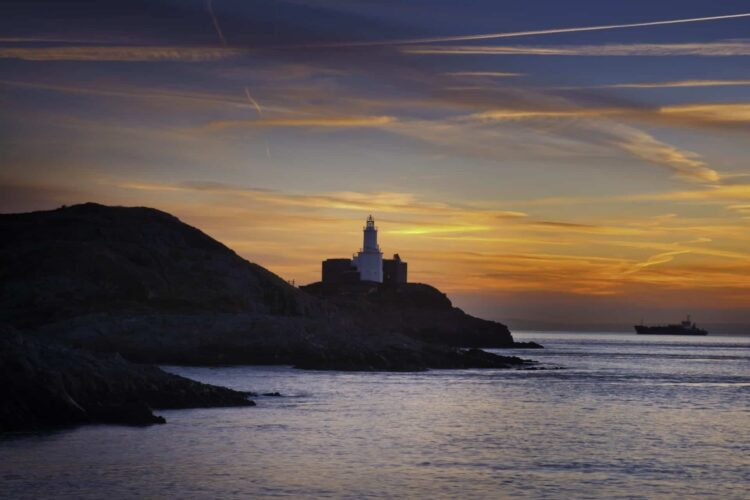
Mumbles (Mwmbwls) at the western end of Swansea Bay is the most characterful part of the wider Swansea seafront — a former fishing village that has evolved into a vibrant strip of independent cafés, restaurants, bars and boutique shops along Mumbles Road.
The Mumbles Pier (rebuilt and reopened 2021) gives access to a Victorian lifeboat station and views back across the full sweep of Swansea Bay.
Oystermouth Castle (SA3 4BA, Cadw members get free entry) on the hill above Mumbles is a well-preserved Norman castle with an unusual late-medieval chapel decorated with original medieval windows.
It’s one of the most atmospheric smaller castles in South Wales and consistently overlooked in favour of more famous sites.
Ice cream is taken seriously in Mumbles — Joe’s Ice Cream Parlour on Mumbles Road has been serving its own-made ice cream from the same family recipe since 1922 and is a Swansea institution.
The Wales Coast Path from Mumbles westward into the Gower is one of the most rewarding sections of the entire 870-mile route — the first few miles to Langland and Caswell Bay are manageable in a half-day and give immediate access to the finest south Gower scenery.
See: castles in Wales | walking in Wales.
Where to Stay in Swansea Bay and the Gower
Swansea Bay and the Gower offer genuinely different accommodation experiences depending on whether your priority is city convenience or coastal immersion.
Gower holiday cottages — in the villages of Rhossili, Llangennith, Port Eynon and Oxwich — put you within walking distance of the peninsula’s finest beaches and are the most sought-after properties on the Gower.
Book early: the best Gower cottages fill six to nine months in advance for peak summer.
Mumbles guesthouses and small hotels offer the best combination of city access and coastal atmosphere — within walking distance of the seafront and coast path, yet a 20-minute bus ride from Swansea city centre.
Swansea city hotels are well-suited to city break visitors, business travellers and visitors attending events at the Swansea.com Stadium or the Grand Theatre.
Glamping on the Gower has grown significantly — bell tents and shepherd’s huts within the AONB, often with sea views, are an exceptional way to experience the peninsula.
Use the map below to browse all property types.
See also: holiday cottages in Wales | glamping in Wales.
Frequently Asked Questions: Swansea Bay & the Gower
Is the Gower Peninsula worth visiting?
The Gower Peninsula is absolutely worth visiting — it is one of the finest pieces of coastal scenery in Britain and offers a remarkable variety of beaches, coastal walks, surfing, wildlife and historical sites within a compact and easily navigable area. Rhossili Bay is consistently rated among Europe’s top beaches. Three Cliffs Bay, Oxwich Bay and the Gower’s south coast limestone cliffs are extraordinary. It is accessible from Swansea city centre in under 30 minutes by car, making it an easy half-day excursion from the city or an ideal destination for a self-contained Gower cottage holiday.
What is Swansea famous for?
Swansea is famous as the birthplace of Dylan Thomas — Wales’s most celebrated poet and writer. It is also known for Swansea Market (one of the finest indoor food markets in Wales, selling laverbread, cockles and Welsh produce), its position as gateway to the Gower Peninsula (the UK’s first AONB), its maritime heritage as a former copper-smelting and industrial port, and as the home of Swansea City Football Club. The nearby Gower Peninsula, with Rhossili Bay and Three Cliffs Bay, is the principal reason most leisure visitors choose the Swansea area for a holiday.
How far is the Gower from Swansea city centre?
The Gower Peninsula begins at Mumbles, approximately 6 miles (20 minutes by car or 40 minutes by bus) from Swansea city centre. Rhossili at the far western tip is 18 miles from the city centre — approximately 40 minutes by car. There is no direct bus to Rhossili from Swansea city centre; First Cymru operate services to Gower villages (check firstgroup.com/cymru for current timetables). Hiring a bicycle in Swansea or Mumbles and cycling to the Gower is feasible on quiet lanes for confident cyclists — the Sustrans Gower route covers much of the peninsula on low-traffic roads. See: cycling in Wales.
Explore all Swansea Bay, Gower and West Wales guides:
Planning a trip to Wales?
Find the perfect holiday cottage for your Welsh adventure.