

12 Welsh recipes to cook at home
Welsh Recipes 2026: 12 Traditional Dishes to Cook at Home
These 12 traditional Welsh recipes use ingredients that are easy to source anywhere in the UK — and each one tells you something real about where the dish comes from and why it matters.
Wales has a cooking tradition built on lamb, leeks, cheese, oats and the sea.
From the national dish of cawl to Welsh cakes fried on a bakestone, this guide covers the essential recipes of the Welsh kitchen.

Cawl: The National Dish of Wales
Cawl (pronounced “cowl”) is a slow-cooked broth of lamb, leeks, swede and potatoes.
It has been the everyday dish of Welsh farming families for at least 700 years — first recorded in a Welsh text dated around 1390.
Every Welsh family has their own version. The one below is the most traditional.
Serves: 6 | Cook time: 3 hours
Ingredients: 1kg Welsh lamb shoulder (bone in), 2 large leeks, 3 medium carrots, 1 swede, 4 medium potatoes, 1 onion, fresh thyme, bay leaves, salt and pepper, 1.5 litres water or light stock.
Method: Place the lamb in a large pot with the water, onion, thyme and bay leaves. Bring to the boil, skim the surface, then reduce to a low simmer for 90 minutes. Remove the lamb and allow to cool slightly. Strip the meat from the bone in large pieces and return to the pot. Add the carrots, swede and potatoes. Simmer for 30 minutes. Add the leeks in the final 10 minutes — they should be soft but not falling apart. Season well. Serve in deep bowls with crusty bread and a wedge of Caerphilly cheese on the side.
Welsh tip: Cawl is always better the next day. Make it the evening before and reheat slowly — the fat sets on the surface overnight and can be skimmed off for a cleaner broth.
For the full history and variations of cawl, see our dedicated cawl recipe guide.

Welsh Rarebit: The Real Recipe (Not Just Cheese on Toast)
Welsh Rarebit is a hot cheese sauce served on thick toasted bread.
It is not cheese on toast. The sauce is made with Welsh ale, mustard, Worcestershire sauce and mature Caerphilly or Cheddar — it is cooked separately, then grilled over the bread until golden and bubbling.
Serves: 4 | Cook time: 20 minutes
Ingredients: 250g mature Caerphilly cheese (or strong Cheddar), 50ml Welsh ale (a dark ale works well), 1 tsp English mustard, 1 tsp Worcestershire sauce, 1 egg yolk, black pepper, 4 thick slices of sourdough or white tin loaf.
Method: Melt the cheese slowly in a small saucepan with the ale, stirring constantly. Do not overheat — keep the temperature low. Once melted and smooth, remove from the heat and beat in the mustard, Worcestershire sauce, egg yolk and pepper. Toast the bread on one side only under the grill. Spread the cheese mixture thickly onto the untoasted side. Return to the grill for 3–4 minutes until deeply golden and just starting to blister. Serve immediately.
Variations: Buck Rarebit — add a poached egg on top. Glamorgan Rarebit — replace ale with milk and omit the Worcestershire sauce for a lighter version.
Caerphilly cheese is produced around Caerphilly in South Wales — the town has a weekly market where the original cheese is still sold.
Welsh Cakes: Cooked on a Bakestone, Not in the Oven
Welsh cakes are small, flat, sweet scones cooked directly on a cast-iron bakestone or heavy griddle pan.
They are a baked good that requires no oven — a feature of Welsh farmhouse kitchens where the bakestone sat permanently over the fire.
Makes: 18–20 cakes | Cook time: 25 minutes
Ingredients: 225g self-raising flour, 100g cold butter (diced), 75g caster sugar, 75g currants or sultanas, 1 tsp mixed spice, pinch of salt, 1 egg (beaten), 2–3 tbsp milk.
Method: Rub the butter into the flour until the mixture resembles fine breadcrumbs. Stir in the sugar, dried fruit, spice and salt. Add the egg and enough milk to bring it together into a soft but not sticky dough. Roll out to 5mm thickness on a floured surface. Cut into rounds using a 6cm cutter. Heat a bakestone or heavy griddle over a medium-low heat — no oil or butter needed. Cook in batches for 3–4 minutes each side until golden brown with a cooked-through centre. Dust with caster sugar while still warm.
Storage: Welsh cakes keep for 4–5 days in a tin. They are traditionally eaten at room temperature, though many prefer them warmed in a low oven for 5 minutes before serving.
Cardiff Market in the city centre sells freshly cooked Welsh cakes daily — the stall has been there for decades and is one of the most photographed spots in the market.
Bara Brith: Welsh Speckled Bread Made with Cold Tea
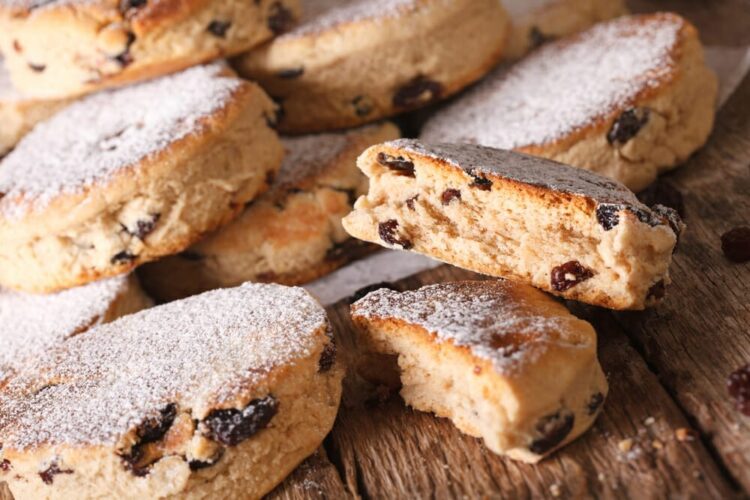
Bara brith translates from Welsh as “speckled bread.”
It is a rich, dense fruit loaf made by soaking dried fruit overnight in cold tea — the tea replaces most of the fat in a conventional fruit cake, giving the loaf a slightly sticky, dense texture and a deep flavour from the tannins.
Serves: 10–12 slices | Cook time: 75 minutes (plus overnight soak)
Ingredients: 450g mixed dried fruit (raisins, sultanas, currants, mixed peel), 300ml strong cold tea, 175g self-raising flour, 175g wholemeal self-raising flour, 1 tsp mixed spice, 175g soft dark brown sugar, 2 eggs (beaten), 2 tbsp marmalade.
Method: The night before, combine the dried fruit, sugar and cold tea in a large bowl. Stir, cover, and leave to soak for 8–12 hours. The next day, preheat the oven to 160°C (fan 140°C). Line a 900g loaf tin. Beat the eggs and marmalade into the soaked fruit mixture. Fold in the flours and spice until combined — do not overmix. Spoon into the tin and bake for 70–75 minutes until a skewer comes out clean. Cool in the tin for 15 minutes before turning out.
Serving: Bara brith is always sliced thick and spread with salted Welsh butter. It keeps for up to a week wrapped in foil.
Glamorgan Sausages: Wales’s Vegetarian Sausage Since the 1800s
Glamorgan sausages are vegetarian sausages made from Caerphilly cheese, leeks and breadcrumbs.
They have been made in the Vale of Glamorgan — the flat farmland south of Cardiff — since at least the 1820s, when writer George Borrow described them in his account of travelling through Wales.
Makes: 8 sausages | Cook time: 25 minutes
Ingredients: 150g Caerphilly cheese (crumbled), 100g white breadcrumbs (fresh), 1 large leek (white and pale green part only, very finely chopped), 1 tsp dry mustard powder, 1 tbsp fresh thyme leaves, 2 eggs (1 whole, 1 separated), salt and pepper, extra breadcrumbs for coating, vegetable oil for frying.
Method: Mix together the cheese, breadcrumbs, leek, mustard, thyme and the whole egg. Season well. The mixture should hold together when pressed — if it’s too dry, add a splash of milk. Shape into 8 sausages. Dip each into the reserved egg white (lightly beaten), then roll in the extra breadcrumbs. Chill for 30 minutes in the fridge. Fry in a little oil over a medium heat for 8–10 minutes, turning regularly, until golden on all sides and hot through. Serve with mustard and a green salad, or as part of a Welsh breakfast.
Oven method: Brush with oil and bake at 200°C for 20–25 minutes, turning once halfway.
Laverbread and Cockles: Wales’s Coastal Breakfast Ingredient
Laverbread is made from laver seaweed (Porphyra umbilicalis) that has been washed, boiled for several hours and puréed into a smooth dark paste.
It has an intense, iodine-forward flavour and a silky texture. Richard Burton called it “the Welshman’s caviar.” It is rich in protein, iron and iodine.
Where to buy it: Laverbread is sold ready-made in tins or fresh in Welsh butchers and supermarkets. Making it from scratch requires foraging laver from rocks at low tide — it grows on the Gower Peninsula and around the Pembrokeshire coast.
Classic laverbread and cockles: Mix ready-made laverbread with fine oatmeal (1:1 ratio). Shape into small patties. Fry in bacon fat or butter over a medium-high heat for 3–4 minutes each side until crisp on the outside and hot through. Serve alongside fried cockles (tossed in a hot pan with butter and a little vinegar for 2 minutes), bacon and eggs.
Cockles: Penclawdd on the Gower Peninsula has been harvesting cockles commercially since the 1800s. Freshly cooked Penclawdd cockles are sold in Swansea Market — one of the oldest covered markets in Wales, at SA1 3PF.
Modern laverbread uses: Stir through scrambled eggs, spread on toast with butter, mix into pasta with cream and garlic, or use as a base sauce for a fish pie.
Welsh Lamb and Leek Pie: Shortcrust Pastry, Slow-Cooked Filling
Wales produces some of the finest lamb in Europe — PGI-protected Welsh lamb comes from animals raised on the mountain and upland pastures that cover much of the country.
This pie combines slow-cooked Welsh lamb shoulder with leeks and a thyme gravy, topped with a shortcrust pastry lid.
Serves: 6 | Cook time: 2 hours 30 minutes
Ingredients — filling: 800g Welsh lamb shoulder (diced), 3 large leeks (sliced), 2 carrots (diced), 1 onion (diced), 2 garlic cloves, 400ml lamb or chicken stock, 1 tbsp plain flour, fresh thyme, bay leaf, salt and pepper, 2 tbsp oil.
Ingredients — pastry: 300g plain flour, 150g cold butter (diced), pinch of salt, 1 egg (beaten), 4–5 tbsp cold water.
Method: Brown the lamb in batches in hot oil, then set aside. Soften the onion, garlic and carrots in the same pan. Stir in the flour, then add the stock, thyme and bay leaf. Return the lamb to the pan. Cover and simmer on a very low heat for 90 minutes until the lamb is tender. Add the leeks in the final 20 minutes. Season, then transfer to a deep 23cm pie dish and allow to cool. Make the pastry by rubbing the butter into the flour until it resembles breadcrumbs, then adding enough cold water to bring together into a smooth dough. Chill for 30 minutes. Roll out and cover the pie. Brush with beaten egg. Cut a small steam vent. Bake at 200°C for 30–35 minutes until golden.
Lobscows: North Wales’s Answer to Cawl
Lobscows is a thick beef and vegetable stew, associated with North Wales and with Welsh sailors and port communities.
It is related to the Scandinavian dish “lapskaus” — both came to Wales through trade connections with northern European ports. Liverpool’s “scouse” is a cousin of the same dish.
Serves: 6 | Cook time: 2 hours 30 minutes
Ingredients: 700g braising beef (shin or chuck, diced), 400g potatoes (peeled, large dice), 2 carrots (diced), 2 onions (diced), 1 small turnip (diced), 1.2 litres beef stock, 1 tbsp Worcestershire sauce, bay leaves, thyme, salt and pepper.
Method: Brown the beef in a heavy casserole in batches. Return all the beef to the pot with the stock, onions, herbs and Worcestershire sauce. Bring to the boil, then reduce to a low simmer with the lid on for 60 minutes. Add the carrots and turnip, cook for 30 minutes more. Add the potatoes and cook for a further 40 minutes until the potatoes begin to break down and thicken the stew naturally. Remove the bay leaves. Season generously. The stew should be thick, almost like a very dense soup.
Serving: Traditionally eaten with thick slices of bread and butter, with a bowl of pickled red cabbage on the side.
Teisen Lap: Wales’s Moist Farmhouse Plate Cake
Teisen lap translates as “moist cake” — and it is exactly that.
It is a flat, large cake traditionally baked on a plate in the oven rather than in a tin — the wide shallow shape gives a high surface-to-depth ratio, meaning more of the cake browns and caramelises against the plate as it bakes.
Serves: 10 | Cook time: 40 minutes
Ingredients: 225g self-raising flour, 110g butter (cold, diced), 110g caster sugar, 110g currants, 1 tsp mixed spice, 2 eggs, 4 tbsp buttermilk (or regular milk with 1 tsp lemon juice), pinch of salt.
Method: Preheat oven to 180°C (fan 160°C). Grease a large flat ovenproof plate or a shallow 25cm flan dish. Rub the butter into the flour until crumbly. Stir in the sugar, currants, spice and salt. Beat the eggs with the buttermilk, then stir into the dry ingredients to form a thick, sticky batter — softer than a scone dough. Spread onto the greased plate to a depth of about 2cm. Bake for 35–40 minutes until golden and set. It should feel slightly soft when pressed but not wet. Cool on the plate. Serve cut into wedges, spread with butter.

Crempog: Thick Welsh Pancakes Stacked with Butter
Crempog (krem-og) are thick Welsh pancakes — closer to American-style pancakes than French crêpes.
They are traditionally served stacked in a pile with butter melting between each layer. In North Wales, crempog are served at harvest celebrations and at Shrove Tuesday — the tradition predates the spread of the thin English pancake.
Makes: 16–18 pancakes | Cook time: 30 minutes
Ingredients: 225g plain flour, 1 tsp bicarbonate of soda, 1 tsp cream of tartar, 1 tbsp caster sugar, pinch of salt, 2 eggs (beaten), 250ml buttermilk (or milk with 1 tbsp lemon juice, left to curdle for 10 minutes), 25g butter (melted), extra butter for frying.
Method: Sift together the flour, bicarb, cream of tartar, sugar and salt. Make a well and add the eggs, buttermilk and melted butter. Whisk to a smooth, thick batter. Leave to rest for 10 minutes. Heat a bakestone or non-stick pan over a medium heat. Add a small knob of butter. Drop heaped tablespoons of batter onto the surface — they should be about 8cm across. Cook until bubbles appear on the surface and the edges look set (about 2–3 minutes), then flip and cook for 1–2 minutes more. Stack and serve with Welsh salted butter and honey or jam.
Roast Welsh Lamb: How to Cook a Welsh Leg of Lamb
Welsh lamb carries PGI (Protected Geographical Indication) status — only lamb raised in Wales can be labelled “Welsh Lamb.”
The distinctive flavour comes from the herbs — particularly wild thyme and heather — that sheep graze on across the upland pastures of Eryri (Snowdonia), Bannau Brycheiniog (Brecon Beacons) and the Welsh hills. A leg of Welsh lamb needs very little help from the cook.
Serves: 6–8 | Cook time: 1 hour 45 minutes plus resting
Ingredients: 2–2.2kg leg of Welsh lamb, 4 garlic cloves (sliced into slivers), 4 rosemary sprigs, 2 tbsp olive oil, juice of 1 lemon, 200ml white wine or water, sea salt and black pepper.
Method: Remove the lamb from the fridge 1 hour before cooking. Preheat the oven to 220°C (fan 200°C). Use a small knife to cut 20 small slits across the surface of the leg. Push a sliver of garlic and a small sprig of rosemary into each slit. Rub all over with olive oil, lemon juice, salt and pepper. Place in a roasting tin. Pour the wine or water into the bottom of the tin. Roast at 220°C for 20 minutes, then reduce to 180°C (fan 160°C). Cook for a further 60–70 minutes for medium-pink (internal temperature 60–65°C). Rest uncovered for at least 20 minutes before carving. The resting juices make an excellent gravy base.
Side dishes: Serve with roasted leeks, mint sauce made with fresh Welsh mint, and roast potatoes cooked in the lamb fat.
Welsh lamb is available from most major supermarkets year-round and from Welsh butchers direct — look for the red dragon PGI label on the packaging.
Explore More Welsh Food and Drink
Welsh food is far broader than these 12 dishes.
Wales has 3 Michelin-starred restaurants (2026) and 14 Michelin Bib Gourmand listings — see our Michelin Restaurants Wales guide for the full list.
For the complete picture of Welsh cuisine — from traditional markets to modern Welsh chefs — visit our Welsh Food Guide.
To eat these dishes in Wales rather than cook them yourself, see the food sections of our destination pages for Caerdydd (Cardiff), Abertawe (Swansea) and Eryri (Snowdonia).
Frequently Asked Questions: Welsh Recipes
What is the national dish of Wales?
Cawl is widely regarded as the national dish of Wales. It is a slow-cooked broth of lamb, leeks, swede and root vegetables, first recorded in Welsh texts around 1390. Every region and family has a slightly different version — some use beef, some add more vegetables — but lamb and leek cawl is the most traditional.
What are the most famous Welsh foods?
The most well-known Welsh foods are: cawl, Welsh rarebit, Welsh cakes, bara brith, laverbread, Caerphilly cheese, Glamorgan sausages and Welsh lamb. Wales also produces cockles from the Gower Peninsula, leeks (the national vegetable), and a growing range of Welsh ales, gins and whiskies.
What is laverbread made from?
Laverbread is made from laver seaweed (Porphyra umbilicalis), which grows on rocks along the Welsh coast, particularly on the Gower Peninsula and in Pembrokeshire. The seaweed is washed thoroughly, boiled for several hours until very soft, then puréed into a smooth dark paste. It has a strong, savoury, sea flavour and is rich in protein, iron and iodine.
What is the difference between Welsh cakes and scones?
Welsh cakes are cooked on a dry bakestone or griddle pan — no oven is used. Scones are baked in the oven. Welsh cakes are also flatter and denser than scones, and the dough contains dried fruit and mixed spice. The cooking method gives Welsh cakes a slightly crisp exterior and a soft, slightly chewy interior that scones do not have.
Is bara brith Welsh for something?
Yes. Bara brith translates from Welsh as “speckled bread” — bara means bread, and brith means speckled or mottled, referring to the dried fruit throughout the loaf. It is one of a family of similar fruit breads found across Britain and Ireland, including Irish barmbrack and Yorkshire tea loaf, though the Welsh version is distinctive for its use of cold tea as the main soaking liquid.
Where can I buy Welsh ingredients in the UK?
Welsh lamb is stocked in most UK supermarkets year-round — look for the PGI red dragon label. Caerphilly cheese is available in specialist cheese shops and some supermarkets. Laverbread is available in tins from Welsh food suppliers online, and fresh from Welsh butchers and supermarkets. Welsh cakes are sold fresh in Cardiff Market (SA1 3PF) and online from several Welsh producers who ship across the UK.

Nick, your trusted guide to Wales travel and exploration, shares a deep passion for this enchanting land. With years of exploration, Nick offers expert insights into the best of Wales. Join him on a journey through its captivating history, culture, and hidden gems, as he inspires you to create unforgettable Welsh travel experiences.
Planning a trip to Wales?
Find the perfect holiday cottage for your Welsh adventure.