


How Many Castles in Wales?
How Many Castles Are There in Wales?
Wales has over 600 castles — more per square mile than any other country in the world.
The precise figure depends on what you count. Cadw, the Welsh Government’s historic environment service, manages approximately 130 in state care. The 600+ total includes ruins, earthworks, fortified manor houses, and mottes where no stone remains above ground.
This post explains the numbers, what counts, and why Wales ended up with more castles than anywhere else on Earth.
The Official Count: How 600+ Castles Are Recorded
No single organisation holds the definitive list of all Welsh castles. Three separate bodies maintain records covering different categories.
Cadw manages approximately 130 sites in state care. These include the most significant fortresses — fully excavated, interpreted, and staffed.
The four Welsh Archaeological Trusts — Gwynedd, Clwyd-Powys, Dyfed, and Glamorgan-Gwent — maintain the Historic Environment Records (HERs). These regional databases document every known fortification, including ruins, earthworks, and sites now covered by later buildings.
Coflein, the national database of architectural and archaeological sites, holds records for over 700 castle-related sites when earthwork remains are included. The number you see cited — 600+ — is the commonly agreed figure for sites where a castle of some form once stood.
What Counts as a Castle? Why the Number Varies
The 600+ figure is only as useful as the definition you use to reach it.
At one end: Caernarfon (LL55 2AY) — a fully standing fortress with polygonal towers, coloured stone banding, and 800 metres of intact curtain wall. Unambiguously a castle.
At the other end: a Norman motte — a raised earthwork mound — in a farmer’s field in Powys, with no stone structure remaining above ground. Also counted in the 600+.
The categories that make up the full 600+ figure are:
Major standing fortresses — Caernarfon, Conwy, Harlech, Beaumaris, Caerphilly, Cardiff, Pembroke, Chepstow. These are the headline sites.
Significant ruins — towers and walls standing to partial height, clearly identifiable as castle remains. Most Cadw sites fall here.
Earthwork remains — Norman mottes, ringworks, and baileys where the wooden or stone superstructure has gone. Many are on private farmland and have no public access.
Fortified manor houses — buildings that operated as defensible residences without the full military specification of a castle. Powis Castle near Welshpool (SY21 8RF) is the most famous example still standing.
Lost or buried sites — castles documented in medieval records or aerial photography but with nothing visible at ground level. Some are under housing estates, car parks, or town centres.
Why Does Wales Have More Castles Per Square Mile Than Anywhere Else?
Wales covers 20,778 square kilometres. That is smaller than Wales’s neighbour England by a factor of seven. Yet Wales has more castles.
The answer is 350 years of almost continuous conflict — and the Norman military doctrine that said every captured mile needed a fortification to hold it.
The process started in 1067, just one year after the Norman conquest of England. Norman lords pushed west into Wales and built castles as they went. Every Welsh counter-attack was answered with another fort. Every recovered territory was held by another tower.
Welsh princes built castles too. Llywelyn the Great — who controlled most of Wales from around 1216 until his death in 1240 — maintained a network of native fortresses across Gwynedd and Powys. His castles were less elaborately built than Norman ones but served the same territorial function.
The most intensive period was 1277 to 1295. Edward I of England built eight major castles in eighteen years to encircle the remaining Welsh principality of Gwynedd.
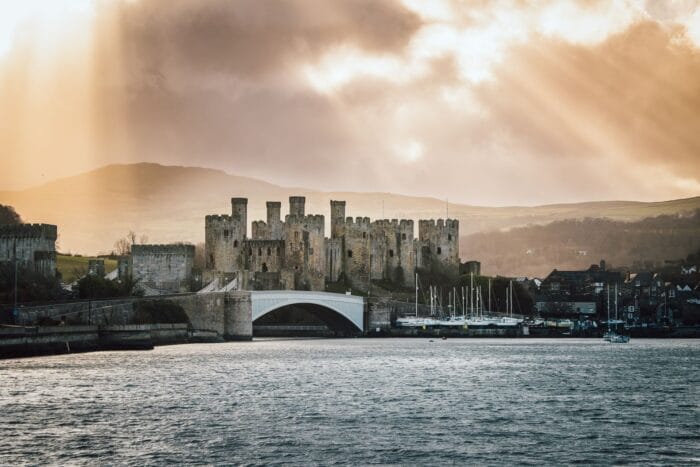
Beaumaris (LL58 8AP), Caernarfon (LL55 2AY), Conwy (LL32 8AY), Harlech (LL46 2YH), Rhuddlan (LL18 5AD), Flint (CH6 5PH), Aberystwyth (SY23 2AG), and Builth Wells.
It was the largest castle-building programme in medieval European history.
The conflict continued into the 15th century. Owain Glyndŵr’s rebellion (1400–1415) involved the capture and recapture of dozens of fortresses. By the time it ended, Wales had been building castles for 350 years without a significant pause.
No other territory of comparable size experienced this density and duration of fortification. The result is 600+ sites in an area smaller than the state of New Jersey.

Welsh vs Norman vs English Castles: Who Built What
Not all 600+ Welsh castles were built by the same people or for the same reasons. There are three distinct building traditions within the total.
Norman and Marcher Lord castles were built by Anglo-Norman lords who controlled the borderlands between England and Wales. These are concentrated in South Wales, the Valleys, and the eastern borders — areas where Norman influence penetrated earliest. Chepstow (NP16 5EY), started 1067, is the oldest surviving example in Britain.
Native Welsh castles were built by Welsh princes using local materials and different architectural conventions — typically cruder masonry than Norman work but adapted to the mountain terrain. Dolwyddelan (LL25 0JD), said to be the birthplace of Llywelyn the Great, is a well-preserved example.
Edwardian castles were the eight fortresses of Edward I’s conquest — a separate and more technically advanced category than anything built before them. Four of these (Beaumaris, Caernarfon, Conwy, Harlech) are UNESCO World Heritage Sites.
The majority of the 600+ total are Norman or Marcher Lord foundations — many of them earthwork mottes built rapidly during the advance into Wales and never upgraded to stone.
Castle Records: The Numbers Behind the 600+
600+ — total sites where a castle of some form once stood, per the Historic Environment Records
130 — sites in Cadw state care, open to visitors
4 — UNESCO World Heritage Sites (Beaumaris, Caernarfon, Conwy, Harlech)
1 — largest castle in Wales: Caerphilly (CF83 1JD), covering 12 hectares
1 — oldest surviving post-Roman stone fortification in Britain: Chepstow, started 1067
1 — the castle Edward I considered most technically perfect but never finished: Beaumaris (started 1295, building halted 1330)
8 — castles in Edward I’s Iron Ring, built 1277–1295
3,000 — workers on site at Beaumaris in 1295 at peak construction, sourced from across England
£250,000 — estimated total cost of Caernarfon Castle in medieval currency; equivalent to several years of the English Crown’s entire annual income
How Many Welsh Castles Can You Actually Visit?
Of the 600+, around 130 are managed by Cadw and open to the public. Entry prices range from free (Rhuddlan, Montgomery) to approximately £14 adults (Caernarfon). Verify current prices at cadw.gov.wales before visiting.
Beyond the Cadw network, a small number of privately owned castles are open to visitors — including Powis Castle near Welshpool (SY21 8RF), managed by the National Trust, and Pembroke Castle (SA71 4LA), independently managed with its own ticketing.
The remainder of the 600+ are either on private land with no public access, reduced to earthworks in fields, or buried beneath later buildings. Some of the earthwork mottes are on public footpaths and can be walked to freely — they are just not interpreted or staffed.
For a full regional breakdown of the best Welsh castles to visit — with postcodes, prices, opening times, and what to expect — see the complete guide on castles in Wales
Guided castle tours Wales including Caernarfon, Conwy and Caerphilly
Frequently Asked Questions: How Many Castles in Wales
How many castles are there in Wales?
Wales has over 600 castles of all types. Cadw manages approximately 130 in state care, open to visitors. The full figure includes earthwork mottes, significant ruins, fortified manor houses, and major standing fortresses. Wales has more castles per square mile than any country on Earth.
Why does Wales have so many castles?
Wales accumulated its 600+ castles through 350 years of almost continuous conflict — from the Norman advance of 1067 through to the end of Owain Glyndŵr’s rebellion in 1415. Every wave of conquest and resistance produced more fortifications. Edward I’s Iron Ring of eight castles (1277–1295) was the most intense single phase.
Which is the most castle-dense country in the world?
Wales. With over 600 castles in an area of 20,778 square kilometres, no other country has a comparable density of fortifications. The concentration in North Wales — where the Edwardian Iron Ring overlaps with earlier native Welsh and Norman fortresses — is particularly dense.
How many Welsh castles are UNESCO World Heritage Sites?
Four: Beaumaris, Caernarfon, Conwy, and Harlech. They were inscribed together in 1986 under the title “Castles and Town Walls of King Edward in Gwynedd.” They represent the most complete surviving example of late 13th-century military architecture anywhere in Europe.
Were all Welsh castles built by the English?
No. Welsh princes built castles too. Llywelyn the Great and his successors maintained a network of native Welsh fortresses across Gwynedd and Powys. The majority of the 600+ total are Norman or Marcher Lord foundations — but Welsh-built castles make up a significant portion, particularly in the north and west.
Read next:
The Complete Guide to Castles in Wales — best to visit, by region, with tickets and tips
Sleep Inside a Welsh Castle — overnight castle stays

Nick, your trusted guide to Wales travel and exploration, shares a deep passion for this enchanting land. With years of exploration, Nick offers expert insights into the best of Wales. Join him on a journey through its captivating history, culture, and hidden gems, as he inspires you to create unforgettable Welsh travel experiences.
Planning a trip to Wales?
Find the perfect holiday cottage for your Welsh adventure.