By Wales.org | Nicholas Barrett, Founder & Editor | Updated November 2026 | 11 min read

Wales is a land of enchanting landscapes and deep history, and its myths and legends have shaped Welsh culture for centuries. This guide works through thirteen of the best-known tales, from the medieval Mabinogion to the Red Dragon on the national flag, with the real places you can visit to see where each story is set.
The Mabinogion: Wales’s Mythical Manuscript
Much of Wales’s deep-rooted mythology survives because of the Mabinogion, a collection of medieval Welsh tales preserved in two 14th-century manuscripts, the White Book of Rhydderch and the Red Book of Hergest, though the stories themselves draw on a much older oral tradition. The eleven tales include the Four Branches of the Mabinogi proper, several independent native tales, and three Arthurian romances. Passed down through generations of storytellers before being written down, they offer a direct window into the beliefs, values and humour of medieval Wales.
King Arthur: A Legendary Welsh King?

One of the most famous legends associated with Wales is that of King Arthur. Stories of Arthur are popular throughout Britain, but it was the 12th-century Welsh cleric Geoffrey of Monmouth who first wrote Arthur into history in his Historia Regum Britanniae (c.1136), naming Caerleon in South Wales as the site of Arthur’s court and coronation, drawing on the town’s genuinely impressive Roman ruins for his description.
The name “Camelot” doesn’t actually appear in Geoffrey’s account at all; it was introduced decades later by the French poet Chrétien de Troyes, who also placed Arthur’s “chief court” at Caerleon but added Camelot as a separate location for a single feast. Over the following centuries, French romance tradition gradually let Camelot eclipse Caerleon in the popular imagination, though Caerleon’s Roman amphitheatre is still popularly linked to the Round Table today. The mystical sword Excalibur, given to Arthur by the Lady of the Lake, remains the story’s most enduring symbol of his right to rule.
The Red Dragon: Symbol of Wales

No exploration of Welsh myths would be complete without the dragon. The red dragon, Y Ddraig Goch, is the national symbol of Wales and features on the Welsh flag. Its origin story is set at Dinas Emrys, a wooded hillfort in Snowdonia overlooking Llyn Dinas near Beddgelert, where the tyrant king Vortigern tried and repeatedly failed to build a fortress, its walls collapsing every night.
A boy prophet named Emrys explained why: beneath the hill, a red dragon and a white dragon lay locked in eternal combat. When Vortigern’s men dug down and released them, the two dragons fought fiercely through the night; the red dragon eventually drove out the white. Emrys interpreted the red dragon as the native Britons and the white as the invading Saxons, foretelling their eventual triumph. For his insight, the druids gave the boy a new name: Myrddin, known today as Merlin. The hill is still called Dinas Emrys in his honour, and can be visited via a short woodland walk near Beddgelert.
Tylwyth Teg: The Fair Folk
Wales is also known for its mystical tales of fairies. In Welsh folklore, the Tylwyth Teg (“the fair family”) are enchanting beings said to live in hidden underground realms, lakes or ancient woodland. They’re often depicted as beautiful and mischievous, sometimes helping humans but just as often playing tricks on them.
One of the most famous tales involves fairy rings: circles of mushrooms that appear to spring up overnight in fields and woodland. Welsh tradition holds that these rings mark the fairies’ dance floors, and that anyone who steps inside one while the Tylwyth Teg are dancing might be drawn into the otherworld, sometimes for what feels like a single night but turns out to be years in the human world.
The Lady of Llyn y Fan Fach

Many of Wales’s myths involve its lakes, and one of the most captivating is the story of the Lady of Llyn y Fan Fach, a remote glacial lake below the Black Mountain in what’s now Bannau Brycheiniog (Brecon Beacons) National Park. According to legend, a young shepherd fell in love with a beautiful woman who emerged from the lake’s waters. She agreed to marry him on one condition: he must never strike her three times, even playfully or by accident.
Years later, after three unintentional blows, she returned to the lake, calling her magical cattle to follow her but leaving her three sons behind. The boys often walked the lakeshore hoping to see her again, and she did reappear, to teach her eldest son Rhiwallon the secrets of herbal and medical knowledge. Rhiwallon and his own sons became the Physicians of Myddfai, a real family of physicians whose skill was proverbial in medieval Wales, with their medical writings recorded in Welsh manuscripts from the 13th century onwards.
The Giants of Snowdonia: Rhitta Gawr

The mountains of Eryri (Snowdonia) are steeped in myth, and none more so than the tale of Rhitta Gawr, a giant who terrorised the kingdoms of Britain and stitched a cloak from the beards of the kings he defeated. Having humbled twenty-eight rivals, Rhitta sent word to King Arthur demanding his beard to finish the garment. Arthur refused, marched north into Gwynedd, and killed the giant in single combat on the mountain now called Yr Wyddfa.
Arthur’s men are said to have raised a great cairn over Rhitta’s body, and that cairn gives the mountain its Welsh name: Yr Wyddfa means “the tumulus” or “the tomb”. The English name Snowdon comes from a different, later tradition, but Welsh speakers still climb “the tomb” to this day.
Blodeuwedd: The Woman Made of Flowers
One of the most haunting tales in the Mabinogion comes from its Fourth Branch, Math fab Mathonwy. Lleu Llaw Gyffes had been cursed by his own mother never to marry a woman born of human parents, so the magicians Math and Gwydion conjured him a wife from the flowers of oak, broom and meadowsweet, naming her Blodeuwedd, meaning “flower-face”.
Blodeuwedd later fell in love with a lord named Gronw Pebr, and together they plotted to kill Lleu, who could only be killed under a near-impossible set of conditions: not indoors or outdoors, not on foot or on horseback, not clothed or unclothed, and not by any weapon lawfully made. Tricked into demonstrating the exact pose in which he was vulnerable, Lleu was struck and transformed into an eagle rather than dying outright. Gwydion eventually found and restored him, and as punishment turned Blodeuwedd into an owl, the bird the Welsh language still associates with her name, forever shunned by the other birds of the day.
Taliesin and the Cauldron of Inspiration
Taliesin is Wales’s legendary chief bard, likely based on a real 6th-century poet whose work survives in the Book of Taliesin, but it’s his mythical origin story, Hanes Taliesin, that’s best known. A boy named Gwion Bach was set to stir a cauldron of inspiration and knowledge brewed by the sorceress Ceridwen for her son; three drops of the liquid splashed onto his thumb, and in sucking it clean he gained all the wisdom intended for someone else.
Furious, Ceridwen chased him through a sequence of shapeshifting transformations, hare to greyhound, fish to otter, bird to hawk, until Gwion turned himself into a single grain of wheat and Ceridwen, as a hen, swallowed him whole. Nine months later she gave birth to him again, and unable to bring herself to kill so beautiful a child, set him adrift on the sea in a leather bag instead. He was found in a fish weir on the River Dyfi by a nobleman named Elffin, and as the baby was unwrapped he began reciting poetry: Elffin named him Taliesin, “radiant brow”, and he grew to become the most celebrated poet in Welsh tradition.
Branwen, Daughter of Llŷr

The Second Branch of the Mabinogi tells the tragic story of Branwen, sister of the giant-king Bendigeidfran (Brân the Blessed), who is married off to Matholwch, King of Ireland, to cement an alliance between the two lands. When the marriage turns sour and Branwen is mistreated at the Irish court, she trains a starling to carry a message for help across the Irish Sea to her brother.
Brân wades the sea to Ireland with his army, so enormous that he himself becomes a bridge for his men to cross a river. The resulting war devastates both sides and leaves only seven men alive on the Welsh side, along with Brân’s own severed head, which (by his own instruction) continues to talk and keep his companions company for decades afterwards. Branwen herself dies of grief on the voyage home, and is said to be buried on the banks of the River Alaw on Anglesey, where a Bronze Age burial mound known as Bedd Branwen (“Branwen’s Grave”) still stands.
Ancient Standing Stones
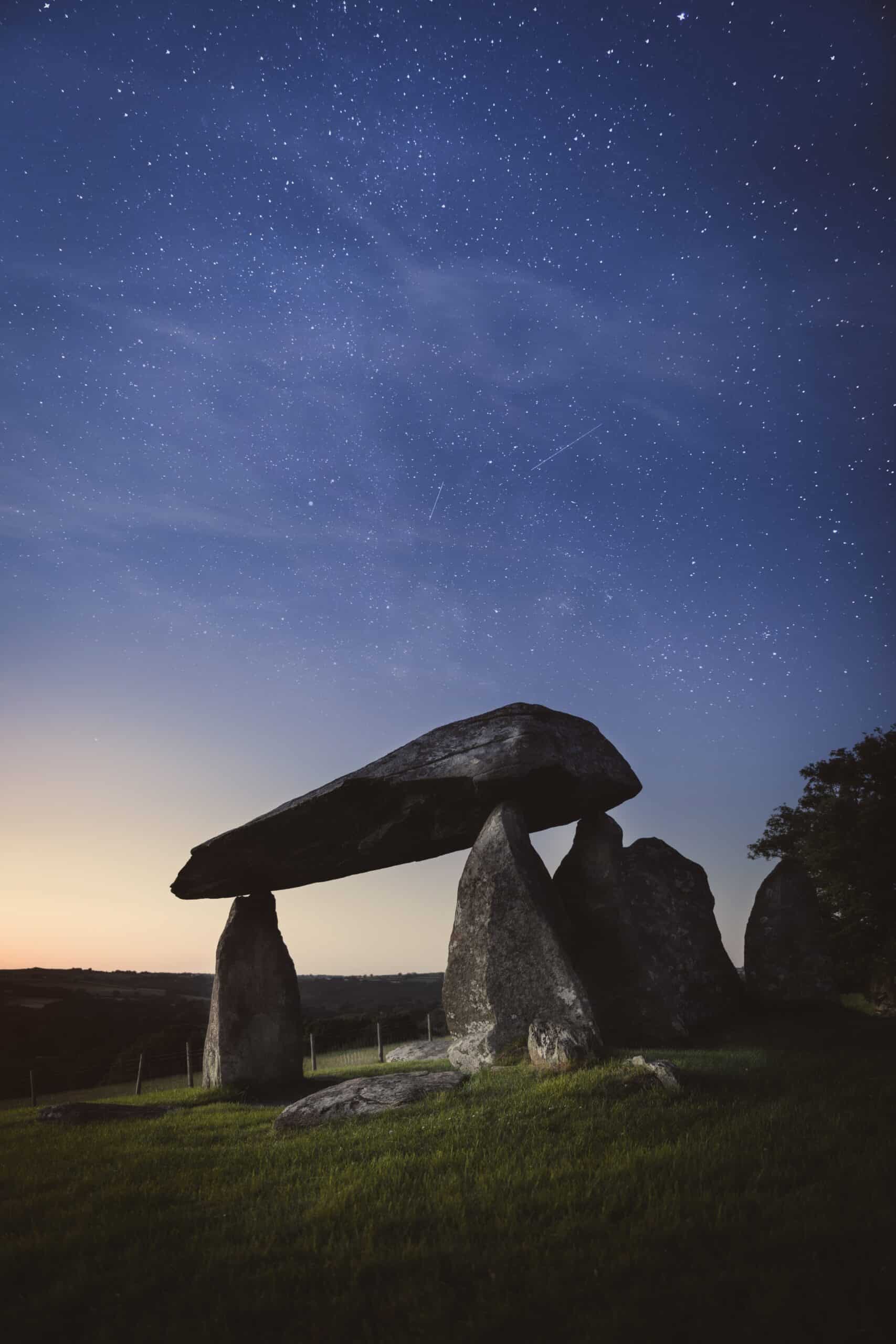
Wales is dotted with Neolithic and Bronze Age standing stones and burial chambers, many wrapped in later mystical tales. Pentre Ifan in Pembrokeshire, pictured above, is one of the finest surviving examples: a huge capstone balanced delicately on three uprights, built around 3500 BC. On Anglesey, the passage tomb of Bryn Celli Ddu is aligned so that the rising sun on the summer solstice shines directly down its entrance passage, and local tradition has long linked the site to the otherworld and to guardian spirits. These megalithic sites are a reminder of just how much older the Welsh landscape’s spiritual associations are than even its earliest written myths.
Gelert: The Faithful Hound

Beyond the famous myths, countless local legends thrive in Welsh villages, and few are more poignant than the tale of Gelert, the loyal hound of the medieval prince Llywelyn the Great. Returning from a hunt to find his baby’s cradle overturned and Gelert’s muzzle covered in blood, Llywelyn feared the worst and killed the dog on the spot, only to then discover his son safe nearby and the body of a wolf that Gelert had in fact fought off and killed to protect the child.
Stricken with grief, Llywelyn is said to have buried Gelert with full honours, and the village of Beddgelert (“Gelert’s grave”) in Eryri takes its name from the story. A grave-shaped monument in a riverside meadow there still marks the traditional burial spot, though the tale itself appears to be a much older, widespread folk motif attached to Beddgelert by an 18th-century innkeeper keen to draw visitors; the village and its woodland setting are real and well worth the walk regardless.
Cantre’r Gwaelod: The Sunken Kingdom
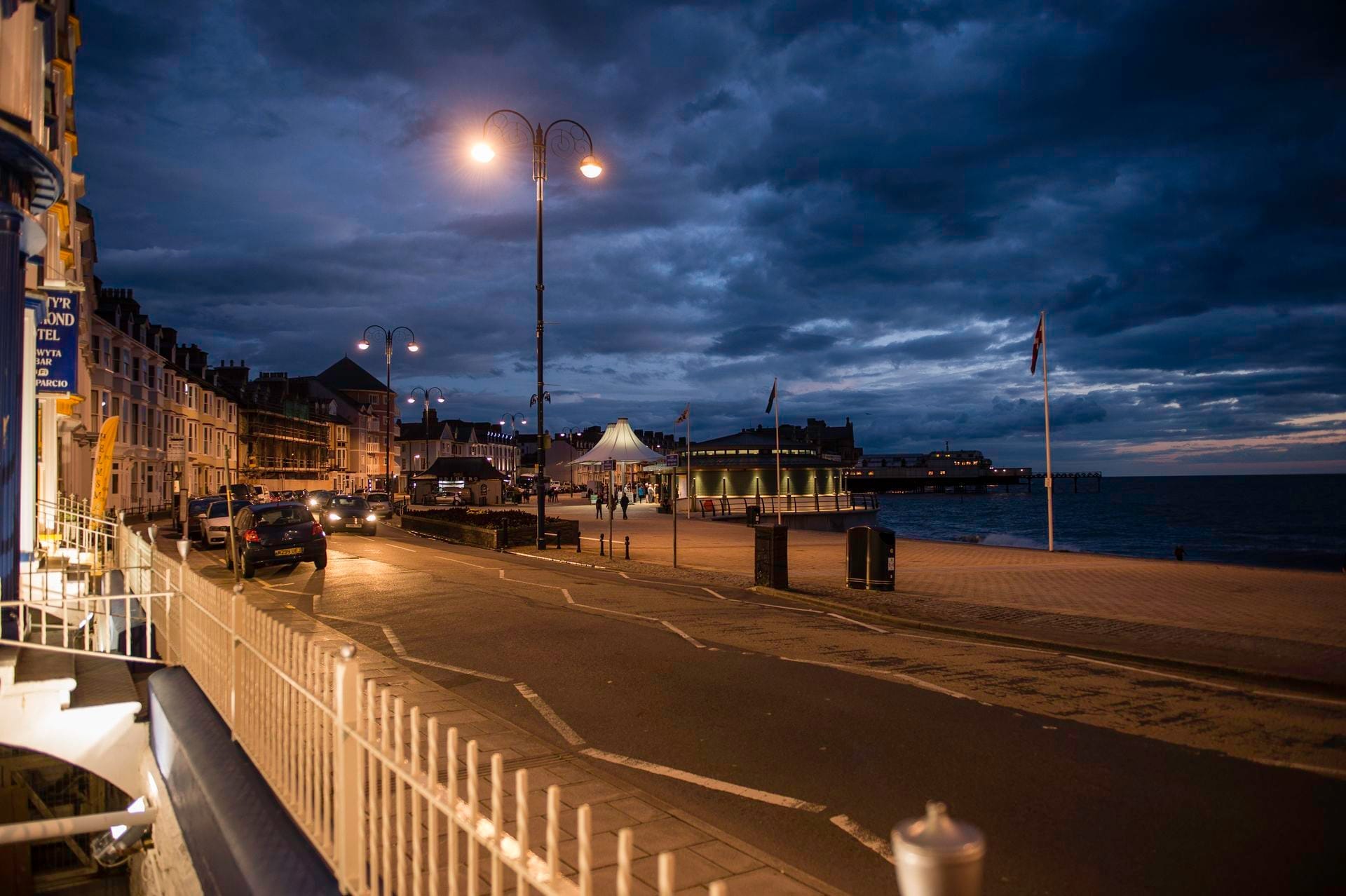
The rugged coastline of Cardigan Bay is the backdrop for one of Wales’s most atmospheric legends: Cantre’r Gwaelod, a fertile lowland kingdom said to lie beneath the waves. According to the tale, the land was protected from the sea by an embankment and a system of sluice gates, maintained by a watchman named Seithenyn. One stormy night, whether through drunkenness or simple negligence, Seithenyn failed to close the gates, and the sea rushed in and drowned the kingdom for good.
Locals still say that on a calm night you can hear the bells of the kingdom’s submerged churches ringing beneath the waves. The legend likely reflects a real folk memory of rising sea levels and coastal change in Cardigan Bay over thousands of years, long after the last ice age reshaped this stretch of coast.
The Hirlas Horn
Wales’s rich tapestry of myth and literature also includes real ceremonial objects that have taken on a legendary life of their own. The Hirlas Horn (“the long blue horn”) is best known from Hirlas Owain, a 12th-century poem by Owain Cyfeiliog, prince-poet of southern Powys, considered one of the finest works of medieval Welsh court poetry. In it, Owain calls for the drinking horn to be passed around his warband after a successful raid, offering each warrior in turn a toast of praise, and pausing to grieve for two companions who didn’t return.
The Legacy of Welsh Myths and Legends
These stories are more than entertainment; they’re a vital part of Welsh identity, connecting people to their past and imbuing the landscape with a sense of wonder. As you explore Wales, these are the tales that have been told for centuries, and the real places behind them are still there to visit.
Frequently Asked Questions: Myths and Legends of Wales
What is the most famous Welsh myth?
King Arthur is probably the best-known legend associated with Wales internationally, with Caerleon named by Geoffrey of Monmouth as his court as early as 1136. Within Wales itself, the Mabinogion’s tales, including Blodeuwedd and Branwen, and the Red Dragon’s origin story at Dinas Emrys are just as central to national identity.
Is the Mabinogion the same as Welsh mythology?
Not quite. The Mabinogion is the single most important written source for Welsh mythology, a collection of eleven medieval tales, but plenty of well-known Welsh legends, including Cantre’r Gwaelod, the story of Gelert and the Rhitta Gawr giant tale, come from separate oral and written traditions rather than the Mabinogion itself.
Where can I visit sites linked to Welsh legends?
Dinas Emrys near Beddgelert (the Red Dragon prophecy), Caerleon in South Wales (King Arthur’s court), Llyn y Fan Fach in Bannau Brycheiniog (the Lady of the Lake), Pentre Ifan in Pembrokeshire and Bryn Celli Ddu on Anglesey (standing stones), and Beddgelert itself (Gelert’s grave) are all real, visitable places tied directly to these stories.
Why is the dragon Wales’s national symbol?
The Red Dragon’s association with Wales dates back to the Dinas Emrys prophecy recorded by Geoffrey of Monmouth around 1136, in which a red dragon representing the native Britons defeats a white dragon representing the Saxons. It was formally adopted as the central image on the Welsh national flag in 1959, though the dragon had been used as a Welsh symbol for centuries before that.
More Welsh Culture and History Guides on Wales.org
Keep exploring