

AI Search Visibility for Tourism: What the 2026 Data Actually Shows
AI Search Is Rewriting How Visitors Find Wales — Is Your Destination Still Visible?
Something fundamental has changed in how people plan a trip, and most tourism organisations in the UK haven’t caught up with it yet. Nearly half of all Google searches now return an AI-generated answer before a single traditional result appears. ChatGPT cites a source in travel answers more often than in any other category it covers. And the destinations, hotels and attractions that show up inside those AI answers are starting to pull measurably ahead of the ones that don’t.
This isn’t a future problem to plan for. It’s already reshaping visitor numbers for destinations that were household names in search just two years ago. This piece covers what’s actually happening in 2026, what Wales.org’s own results show about what works, what 2027 is likely to bring, and what tourism boards, hospitality businesses, DMOs and local authorities across the UK can do about it right now.
What’s actually changed in 2026
For twenty years, digital visibility for a destination meant one thing: ranking in the traditional ten blue links. A visitor searched, scanned a results page, clicked through to a handful of sites, and compared what they found. The organisations that invested in SEO showed up; the ones that didn’t, largely didn’t.
Planning this trip? Ask Branwen, our free AI trip planner →
That model is breaking down quickly. Independent studies from Ahrefs, Pew Research Center and Semrush all converge on a similar picture: when an AI Overview appears above the traditional results, click-through to the page ranked first drops by somewhere between 30% and 60%, depending on the query and the study. Some measurements put the decline as high as 65% for certain query types. Pew’s research, based on tracking 68,000 real searches, found that only around 8% of users click a traditional result when an AI Overview is present, compared with 15% when it isn’t.
The practical effect is that a huge share of searches now end without a click at all. Across all query types, roughly 58% of Google searches currently end with no click to any website. For Google’s fully conversational AI Mode, that figure climbs to around 93% of sessions. The visitor gets their answer, and moves on, without ever seeing a results page in the way search worked for the past two decades.
This matters enormously for tourism content specifically, because so much of what a visitor searches for — opening times, ticket prices, how long a walk takes, whether a site is dog friendly — is exactly the kind of direct, factual question an AI system is built to answer immediately.
Google’s AI Overviews: the current picture
Google’s own AI Overviews have gone from an experimental feature to a default part of search in under two years. They launched narrowly in the US in May 2024, expanded to over 100 countries by late 2024, and by early 2026 independent tracking consistently puts their prevalence at roughly 48–50% of all US searches, with some studies measuring figures as high as 60% during peak periods. That’s up from approximately 6.5% in January 2025 — close to an eightfold increase in little over a year.
Coverage isn’t even across query types. Informational queries — the “how,” “what,” and “how long” questions that dominate travel planning — trigger an AI Overview far more often than commercial or transactional searches. Longer, more specific queries are especially likely to trigger one: searches of eight words or more are around seven times more likely to generate an AI Overview than short, generic ones. A search like “how long does it take to climb Snowdon from the Pyg Track” is a near-perfect match for the kind of query AI Overviews were built to answer.
The upside for destinations that do get cited is real, even though it looks different from a traditional click. Pages cited inside an AI Overview see roughly 18% fewer organic clicks on that specific query on average — but cited domains also see a corresponding rise of around 12% in direct traffic and 9% in branded search, as users who saw the brand named in the answer return to it by typing the name directly rather than searching again. In effect, visibility inside the answer itself is becoming a trust signal in its own right, whether or not it generates an immediate click.
ChatGPT and the rise of travel as an AI-search category
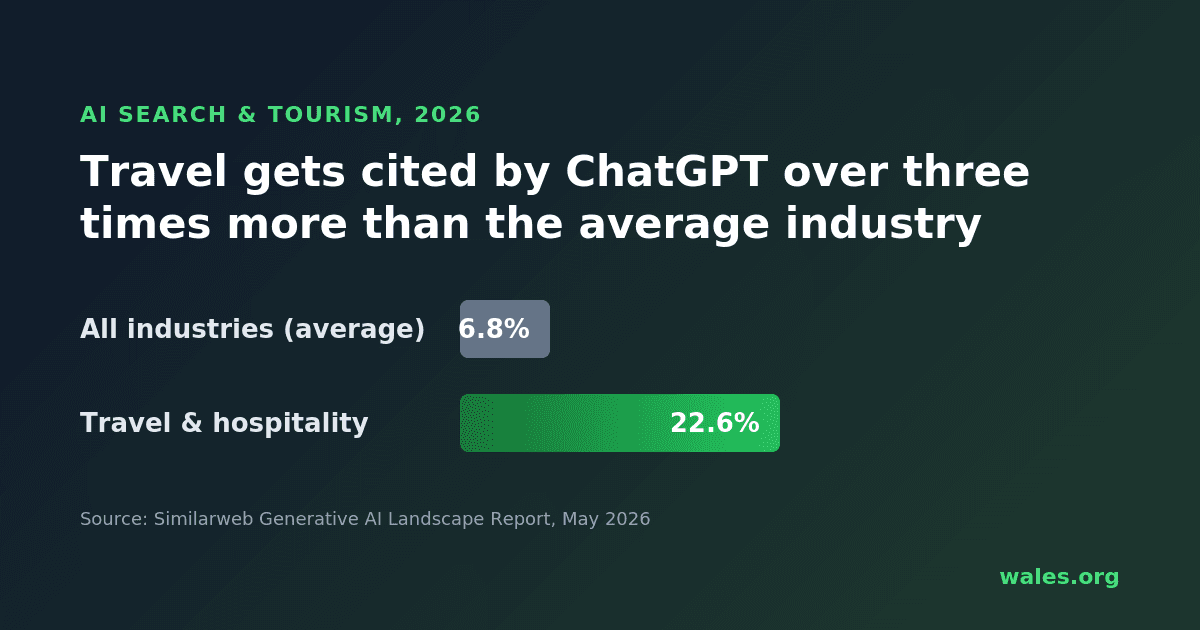
Google isn’t the only part of this shift, and for tourism specifically, it may not even be the most important one. ChatGPT’s own citation behaviour has changed dramatically through 2026: the proportion of US prompts that include a clickable source rose from around 1.6% in June 2025 to roughly 6.8% by May 2026, more than a fivefold increase in under a year, according to Similarweb’s Generative AI Landscape report.
What stands out within that data is exactly which category benefits most. Travel and hospitality has the highest citation rate of any topic ChatGPT tracks — around 22–23% of travel answers include a source link, more than three times the cross-category average. Automotive is the next closest category, and most other sectors, including professional services and education, sit well below 10%.
This isn’t a coincidence. Travel questions are exactly the kind of query where ChatGPT’s own training data goes stale quickly — prices change, opening hours shift seasonally, new attractions open — so the model is far more likely to reach for a live web search and cite what it finds, rather than answer from memory alone. For any destination, attraction or hospitality business, that single fact changes the calculation considerably: travel content has an outsized opportunity to be cited, precisely because AI systems trust their own general knowledge least in this category.
Consumer behaviour backs this up. Around 40% of travellers globally now use AI tools somewhere in their trip planning, rising to as much as 60% among Gen Z and Millennial travellers. Travel and hospitality is consistently the top or near-top sector for ChatGPT usage during a purchase journey, ahead of retail, IT services and most other consumer categories.
What this looks like in practice: Wales.org’s own results
It’s one thing to cite industry-wide statistics. It’s another to show what actually happens for a real destination site competing in this environment — so here’s what we can show directly from our own results.
A direct-answer query, head to head with the official tourism board. Search “best castles to visit in Wales” and Wales.org’s own castle hub and UNESCO castles guide currently appear in the results directly alongside VisitWales, the Welsh Government’s own official tourism site, as well as Tripadvisor and established travel publishers. For an independent site with no government backing, competing for visibility against the nation’s official tourism body on its own flagship topic is a meaningful result.
A conversational, direct-answer query — exactly the shape AI systems favour. Search “how long does it take to climb Mount Snowdon” and Wales.org’s dedicated guide to that exact question currently ranks above long-established UK hiking and travel blogs, several of which have been publishing on this topic for years longer. This is precisely the query format most likely to trigger an AI Overview or a cited ChatGPT answer: short, factual, conversational, and answerable in a single clear paragraph.
Neither result happened by accident. Both pages are built the same way: a direct answer near the top, specific numbers rather than vague ranges, content organised under question-shaped headings, and structured data marking up the factual claims so a machine can parse them as cleanly as a human reader can. That’s not a coincidence, and it’s not unique to Wales.org — it’s the same pattern GEO researchers point to across every industry they’ve studied: if a page can’t rank in ordinary search, it can’t be retrieved by an AI system either, since generative answers are built by fetching and reading real ranked pages, not by inventing answers from nothing.
The gap most DMOs and councils haven’t closed yet
Industry survey data suggests most UK and international destination marketing organisations recognise the problem but haven’t yet acted on it. In Sojern’s 2026 survey of more than 350 DMOs, 51% said they were concerned about AI-driven search disruption — but only 31% believed their own website was positioned to become the “source of truth” an AI assistant would actually cite. That’s a 20-point gap between awareness and readiness, across an industry sample large enough to be meaningful.
The pattern shows up in real organisations too. New York City Tourism + Conventions has reported noticeable fluctuations in website traffic tied directly to AI search activity, particularly during quieter periods between major publicity campaigns — a sign that AI-driven discovery is already a measurable part of a major destination’s traffic, not a future consideration.
For Welsh and wider UK tourism organisations, local authorities and DMOs, this gap represents a genuine opportunity rather than only a threat. Because so many destination websites remain thin, generic or infrequently updated, the bar for becoming the cited source in your category is often lower than it would be in a more mature digital category. One widely cited case saw a single destination capture 40% of informational search traffic for its region within 18 months of building a proper content strategy around named entities and direct-answer content — a scale of result that’s very difficult to achieve in almost any other kind of digital marketing.
What 2027 is shaping up to look like
The trajectory for 2027 is consistent across most of the serious industry analysis available right now, even though exact figures vary by source:
- AI-driven search traffic is projected to overtake traditional organic search during 2027, with the point where AI-referred revenue exceeds organic search revenue expected by late 2027, according to Semrush’s modelling.
- Zero-click search is expected to climb further still, with some forecasts putting the overall zero-click rate as high as 85% by the end of 2027.
- Roughly one in five search queries is projected to be LLM-based by 2027, according to Adobe and Incisiv’s joint research, up from a small fraction of total search volume today.
- The number of Americans using AI specifically for search is projected to reach around 90 million by 2027, up from roughly 13 million in 2023 — a near sevenfold increase in four years.
- Generative Engine Optimization (GEO) and Answer Engine Optimization (AEO) are expected to become formal, named disciplines within marketing teams, rather than a side responsibility bolted onto traditional SEO.
Three technical shifts are likely to matter most for tourism specifically. First, entity consistency, meaning the same facts about a destination, attraction or event stated identically across every page and platform, is worth getting right, because AI tools draw on many sources and conflicting details make wrong answers more likely. There is no published evidence yet that it directly lifts citations, so treat it as good practice rather than a proven tactic. Second, AI crawler access is becoming a genuine technical risk area: a single misconfigured robots.txt rule can block an AI system from reading a site entirely, silently erasing a destination from AI-generated answers without any visible warning in normal analytics. Third, question-shaped content structure, organising pages so that headings mirror the questions a visitor would actually ask, makes pages easier for people to scan, and it is the format we use throughout our own destination and attraction guides. Google’s guidance says you do not need to write differently for AI systems, so we treat this as good page design rather than an AI-specific technique.
What actually gets a destination cited
Based on what’s performing well across Wales.org’s own content and what the wider GEO research consistently points to, a handful of principles show up again and again:
Specific numbers beat vague claims
“Around £10” is less useful to an AI system, and less trustworthy, than “£10.40 for an adult ticket, booked online.” Precision reads as credibility to both a human reader and a language model synthesising an answer from several sources.
Direct-answer structure
Content organised so that every major heading is phrased as the question a visitor would actually ask — “how long does it take,” “is it dog friendly,” “where can I park” — gives an AI system a clean, extractable passage to cite, rather than forcing it to infer an answer from narrative prose.
Structured data
Google says structured data is not required for its AI features and that there is no special markup to add. It is still worth using, since FAQ, event and local business markup help search engines understand a page and can earn rich results, but we would not treat it as a shortcut to being cited by AI systems.
Genuine freshness, not just a changed date
AI systems increasingly favour content that’s been meaningfully updated, not just republished with a new byline. Prices, opening hours and seasonal detail that are verified against the primary source, not copied from an old listicle, are far more likely to survive the fact-checking an AI system effectively performs when it cross-references multiple pages before citing one.
Being named across multiple credible sources, not just your own site
Since generative engines cross-reference several sources rather than trusting one, a destination referenced consistently across its own site, local press, industry bodies and reputable third-party platforms builds a far stronger footprint than even the best single webpage can on its own.
Where the Interactive Map and Branwen fit in
Everything above describes a content and structure problem. For many tourism businesses, councils and DMOs, the practical barrier isn’t understanding what AI systems want — it’s not having the technical infrastructure or in-house resource to build it, especially at the pace this shift demands.
This is exactly the gap the Wales.org Interactive Map and Branwen, our AI travel assistant, are built to close for partner organisations.
The Interactive Map gives a destination, venue or tourism board a ready-made, structured layer of location data — attractions, accommodation, routes, points of interest — that’s already built the way AI systems want to read it, without needing to build that infrastructure from scratch. For hospitality businesses and hotel groups, it can be embedded directly on an existing site as a white-label layer, giving visitors (and the AI systems indexing that site) a consistently structured view of the local area.
Branwen takes the same underlying approach further: a genuine AI assistant that can answer visitor questions directly, trained on current, verified Welsh travel information rather than the stale or generic answers a general-purpose AI model might otherwise give about a destination it knows less well. For a hotel, attraction or DMO, this means visitors asking “what’s near here” or “is this family friendly” get an answer built on your own current data, rather than an AI system guessing from an out-of-date web page it found elsewhere.
Both are available to license for hospitality businesses, agencies and destination organisations — as a white-label product for hotel and venue websites, or as a content and technology partnership for councils and tourism boards.
Getting started: a reasonable first step
None of this requires rebuilding a destination’s entire web presence overnight. A sensible starting point for most tourism organisations, hospitality businesses and councils looks like this:
- Audit your 15–20 highest-value visitor questions — the opening-times, pricing and “how do I get there” queries that make up the bulk of real visitor search intent — and check whether your own site currently answers each one directly, with a specific figure, within the first few lines of the relevant page.
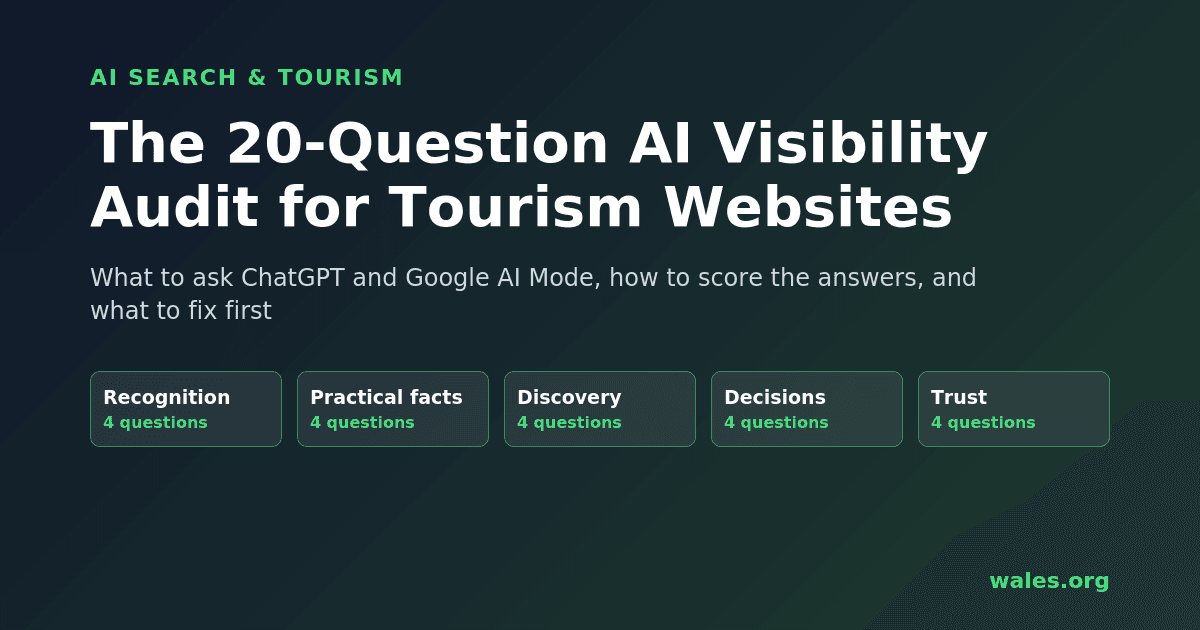
- Check your current AI visibility directly by asking ChatGPT, Google’s AI Mode and Perplexity the same 15–20 questions, and noting whether your own organisation is named, cited, or simply absent from the answer. Our 20-question AI visibility audit gives you the exact prompts and a scoring method.
- Fix the technical basics — confirm AI crawlers aren’t accidentally blocked, and that your most important factual pages carry proper schema markup.
- Talk to us about whether a licensed Interactive Map integration or a Branwen partnership could shortcut the infrastructure-building stage entirely.
Partner with Wales.org
Whether you’re a hospitality business looking to license the Interactive Map or Branwen, or a tourism board or council exploring a content partnership, we’d like to hear from you.
Get in touch via our Partner page →Frequently asked questions
What is the difference between SEO, GEO and AEO?
SEO (search engine optimisation) is the established practice of ranking pages in traditional search results. GEO (generative engine optimisation) and AEO (answer engine optimisation) describe the newer practice of structuring content so it’s more likely to be selected, summarised and cited by AI systems such as Google’s AI Overviews, ChatGPT and Perplexity. The two aren’t separate disciplines in practice: Google’s own 2026 guidance states that optimising for generative AI features is still fundamentally optimising for search, since AI systems retrieve and cite from the same ranked pages traditional search engines index.
Do AI Overviews and ChatGPT citations actually drive traffic?
Less than a traditional top-ranking click, but not nothing. Industry data shows cited domains see a smaller share of direct clicks but a measurable lift in branded search and direct traffic, since being named inside an AI answer functions as a trust signal even without an immediate click-through.
Why does travel get cited more often than other industries in ChatGPT?
Travel information changes frequently — prices, opening times and seasonal detail go stale quickly — so ChatGPT is more likely to run a live web search rather than answer from its training data alone, and more likely to cite the source it finds. This makes travel one of the categories with the clearest opportunity to be cited, since the underlying AI model trusts its own static knowledge least in this area.
Is it too late for a tourism board or council to catch up on AI search visibility?
No. Because most destination websites remain thin or infrequently updated, the bar for becoming a cited source in a given category is often lower than in more digitally mature sectors. Several documented cases show a single destination capturing a large share of informational search traffic for its region within 12 to 18 months of building a proper content strategy.
What’s the single most important technical fix for AI search visibility?
Confirming that AI crawlers can actually access your site. A misconfigured robots.txt file can silently block AI systems from reading a site’s content entirely, with no visible warning in standard analytics — effectively erasing a destination from AI-generated answers without anyone noticing until visibility has already been lost.

Pembrokeshire-born travel writer and founder of Wales.org. Born in Haverfordwest, now based in Hertfordshire — covering Welsh castles, national parks, festivals and family staycations across all 22 Welsh counties.