

How to Audit Your Tourism Site in ChatGPT and AI Mode
The 20-Question AI Visibility Audit for Tourism Websites
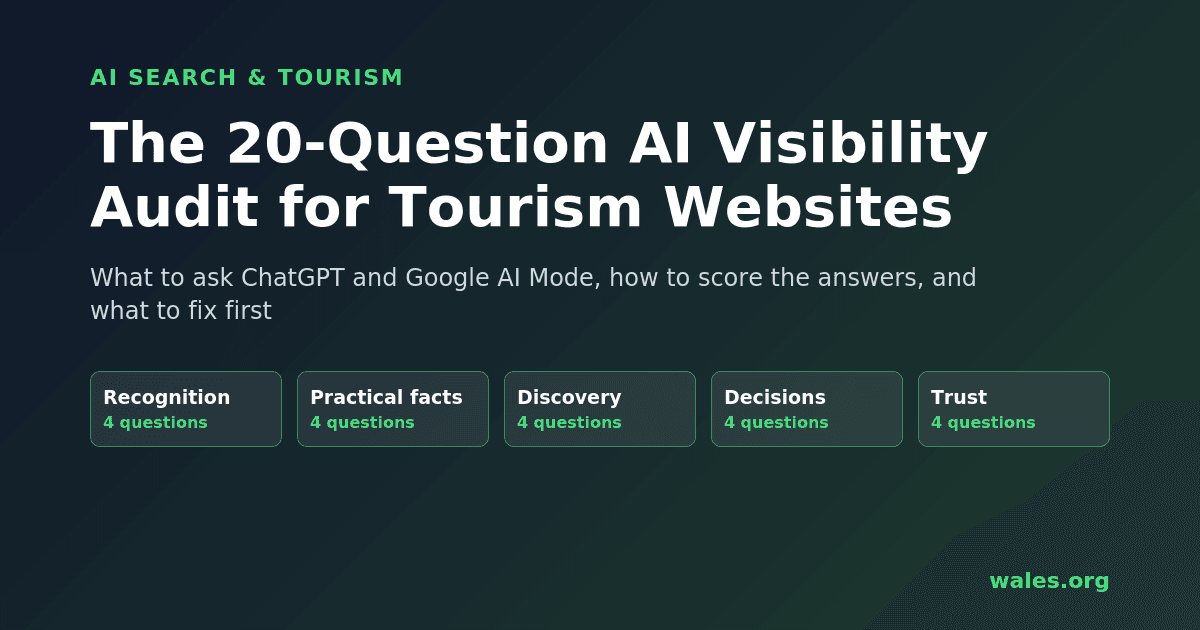
Most tourism organisations discover what ChatGPT or Google AI Mode says about them by accident. A visitor mentions it, a colleague tries it one afternoon, or someone notices that an attraction’s closing time is a season out of date. This audit replaces the accident with a method: twenty questions in five groups, each with the exact wording to paste into an AI tool, a description of a good answer, the red flags to look for, and what to change when the answer disappoints.
It works for a single attraction, a hotel group, a destination management organisation (DMO) or a council tourism team. You will need two browser windows, a spreadsheet and a few uninterrupted hours for the first pass. You do not need a paid tool, and we will say where paid tools help and where Google itself advises caution.
One warning before you start: AI answers change from one run to the next, so a single test proves very little, and the method below is built around that. If you want the wider data on how AI search is reshaping visitor behaviour first, our analysis of AI search visibility for tourism covers it, and this piece is the practical follow-up.
Planning this trip? Ask Branwen, our free AI trip planner →
Three checks to do before you ask anything
There is little point scoring AI answers if a setting nobody remembers changing has already switched your site out of the picture. These three checks take about ten minutes each and catch the failures that no amount of good content can fix.
Check 1: the Search Console setting for AI features
Open Search Console and go to Settings, then Search generative AI. In 2026 Google added a control there that decides whether your site’s links and content can appear in, and help ground the answers given by, AI Overviews, AI Mode and the AI features in Discover. Google’s help page says the default is to include your site, and that a property with a parent property inherits the parent’s setting by default. Confirm that yours has not been changed to exclude, because an excluded site receives no traffic or impressions from these features.
Then check inheritance. If your tourism pages sit inside a larger domain, such as the visit section of a council website, your property can inherit its setting from a parent property, and somebody further up may have changed it. Google says a change generally takes a few days to take effect.
While you are in Search Console, open the Generative AI performance report. Google began rolling it out to a subset of UK site owners and extended it to all websites worldwide on 31 August 2026 (Google’s announcement). It shows impressions in AI Overviews and AI Mode by page, country, device and date, and has an export button. Export the current figures now, because they become your baseline. If the report does not appear, either your site has not yet had enough impressions in these features or it has been excluded.
Check 2: whether AI crawlers can reach you
Two layers can stop a crawler: your robots.txt file and whatever sits in front of your site. Type your domain followed by /robots.txt into a browser and read it, looking for blanket disallow rules and for named AI user agents. Then ask whoever manages your hosting whether a security or bot-protection service sits in front of the site, because some of these block AI crawlers through their own settings, whatever robots.txt says.
The table lists the crawlers that matter most for visibility. Each vendor runs separate bots for separate jobs, which is why blocking the wrong one by accident is so easy. The details come from OpenAI’s crawler documentation, from Google’s guide to optimising for generative AI features and Google’s help pages, and from reporting on Anthropic’s and Perplexity’s documentation (Search Engine Journal).
| Crawler | Run by | What it does | If you block it |
|---|---|---|---|
| Googlebot | Crawls pages for Google Search, which feeds AI Overviews and AI Mode. | You disappear from Google Search and from its AI features. | |
| Google-Extended | A robots.txt token that limits use of your content to train Google’s AI models. | Does not remove you from AI Overviews or AI Mode. The Search Console control does that. | |
| OAI-SearchBot | OpenAI | Finds pages to surface in ChatGPT’s search results. | You can drop out of ChatGPT’s search answers. |
| GPTBot | OpenAI | Collects content that may be used to train OpenAI’s models. | Opts you out of training only. Search is controlled separately. |
| ChatGPT-User | OpenAI | Fetches a page when a person asks ChatGPT to open it. | OpenAI says robots.txt rules may not apply to these user-triggered visits. |
| Claude-SearchBot | Anthropic | Indexes content for Claude’s search results. | Anthropic says blocking it may reduce your visibility in Claude’s search answers. |
| ClaudeBot | Anthropic | Collects content that may be used for training. | Training only. |
| PerplexityBot | Perplexity | Indexes pages for Perplexity’s answers. | You can drop out of Perplexity’s answers. Its user-triggered fetcher is reported to ignore robots.txt. |
Whether to allow training crawlers is a separate decision from whether to allow search crawlers, and it belongs to you. Many organisations allow the search bots and block the training ones. What matters for the audit is that the choice is deliberate and not the leftover of an old plugin or a security default. Remember too that robots.txt is a request rather than a lock, so it only affects crawlers that choose to honour it.
One more technical point from Google’s guide: a page has to be indexed and eligible to appear with a snippet to be used in its AI features, so check that your SEO plugin has not applied a nosnippet setting across the site.
Check 3: the listings you control outside your website
Google’s guide names Google Business Profile as one of the ways local business details reach AI responses. Search for your own name, confirm the profile is claimed, and check the address, opening hours, phone number, website link and category. Hospitality businesses should do the same for their Tripadvisor and booking-platform listings, for reasons the next sections explain.
Also confirm that your site is verified and indexed in Bing Webmaster Tools. OpenAI says ChatGPT search draws on third-party search providers, and an OpenAI executive described Bing as an important one when the feature launched (CNBC). It costs nothing to check.
How to run the audit properly
The most useful research for anyone designing this kind of test came from SparkToro and Gumshoe.ai in January 2026. They had 600 volunteers run 12 prompts through ChatGPT, Claude and Google’s AI features, producing 2,961 responses, with each prompt repeated 60 to 100 times per platform. The chance of ChatGPT or Google’s AI returning the same list of brands twice was below one in a hundred, and the same list in the same order almost never happened (SparkToro).
That study tested recommendation-style prompts. There is less published research on plain factual questions such as opening hours, so treat every fact check in this audit the same way: run it more than once and note whether the answer changes. The practical consequence is that a single answer tells you almost nothing. Measure how often you appear across repeated runs and treat your position in any one answer as noise. SparkToro’s own conclusion was that visibility across many prompt runs is a reasonable measure, while rank position is not.
Set-up that keeps the results honest
- Use a private window and sign out where you can. Search history and personalisation change answers, and you want to see roughly what a first-time visitor sees.
- Test from a UK network. Location shapes local answers, and Search Agency found that its AI Mode tests with no location set reflected Google’s US-leaning defaults.
- Switch search on in ChatGPT. Without it, ChatGPT may answer from its training memory and cite nothing current, which defeats the purpose.
- Use the AI Mode tab in Google, and for each prompt also type it into ordinary Google and note whether an AI Overview appears. The two features may use different models and techniques and show different links, and Overviews do not appear for every query.
- Repeat each prompt three times per platform, on different days if you can, without changing the wording between runs.
- Record names, not ticks. For every run, note whether you were mentioned, which sources were cited and whether each fact was right. Paste the answer into your spreadsheet as evidence.
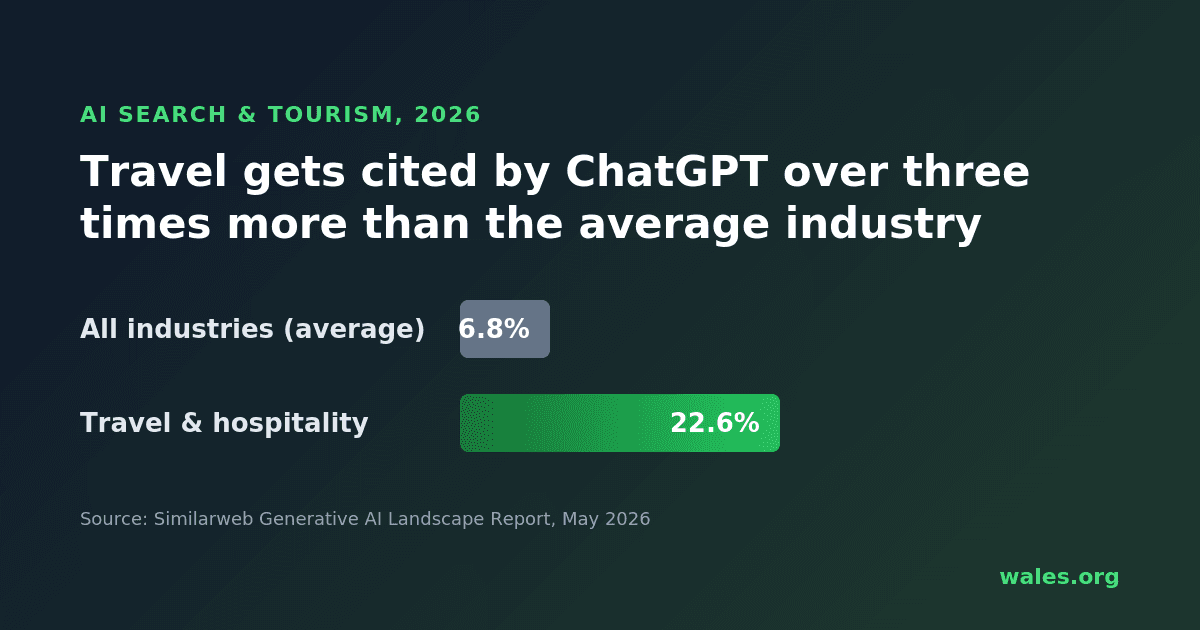
Google says AI Overviews now has more than 2.5 billion monthly users and AI Mode more than a billion, so Google’s features belong in any audit. ChatGPT is the natural second platform because it is the assistant most people have heard of, and its search feature works from a different retrieval system, which makes the comparison informative. Perplexity, Microsoft Copilot, Gemini and Claude are worth adding once the first round is done.
A quick pass and a full pass
A quick pass is one run of each prompt on each platform: 40 runs. A full audit is three runs of each: 120. Do the quick pass first. If it shows obvious failures, fix those before investing in the full version, because there is no value in measuring something you already know is broken. Record everything in a simple tracker like the one below. The three rows are illustrative, with placeholders where your own details would go.
| Prompt | Platform | Run | Mentioned | Your site cited | Facts right | Sources named | Notes |
|---|---|---|---|---|---|---|---|
| 5 | ChatGPT | 1 | Yes | No | No | Tripadvisor, a regional blog | Winter hours quoted in summer. Tripadvisor listing out of date. |
| 5 | ChatGPT | 2 | Yes | Yes | Yes | Your site | Correct this time. Note the variation. |
| 9 | AI Mode | 1 | No | No | n/a | Three travel blogs, YouTube | Competitor named instead. Content gap. |
Where AI gets its facts about your destination
Before testing, it helps to know that your own website is rarely the only source behind an answer, and often not the biggest. Two recent studies point the same way, although both come with limits.
Search Agency, a consultancy that sells AI-search services, sent 100 unbranded travel prompts to Google AI Mode on 9 July 2026. The answers cited 2,558 sources from 1,229 domains, about 26 per answer. Independent travel blogs and content sites made up 56.8% of citations, booking platforms 11.1%, video 9.7% and forums and communities 7.3%. Official tourism and government sites made up 1.2% (Search Agency). The firm points out that this is a single snapshot, that no location was set so the answers lean towards Google’s US defaults, and that source types were classified by a documented but heuristic rule set.
cloro, a company that sells AI-visibility tracking, parsed 1,548 destination and hotel prompts across six AI engines. When an answer recommended a hotel, the property’s own website made up only about 6% of citations, mostly for large chains, while booking platforms and metasearch sites supplied around 44% and travel media around 38%. Reddit was the most-cited single domain at 17% (cloro). Its shares overlap, because one answer cites many domains, and its corpus leans towards US English-language travellers.
Neither study is about Wales, and both were run by firms with something to sell, so read the exact percentages loosely. The direction is the useful part: when a visitor asks an open travel question, AI tools assemble the answer from many places, and a destination’s official site is often a small share of the mix. That has two consequences for the audit. First, when an answer is wrong, find out where the wrong fact came from before editing your own site, because it is often a Tripadvisor listing, a Business Profile, an old blog post or a booking platform. Second, group 5 asks the AI directly where it got its information, because that is the cheapest way to find the source that needs fixing.
It is also why distinctive, first-hand writing keeps earning citations. Google’s guide says that content with a unique point of view, based on real experience, is likely to influence presence in its AI features more than any other suggestion it makes.
The 20 questions
Replace anything in square brackets with your own details and keep the wording exactly as written for your first run, so the results are comparable. Once you have a baseline, change one variable at a time, such as the season or the type of visitor, to see what moves. Each group ends with a short note on what to do if it goes badly.
Group 1: Recognition
Does the AI know you exist, and does it get the basics right? Everything else depends on this.
| # | Paste this prompt | A good answer looks like | Red flags |
|---|---|---|---|
| 1 | What is [name of your attraction, hotel or destination]? | One accurate paragraph covering what it is, where it is and who it suits, describing what you offer now. | “I don’t have information”, a similarly named place mixed in, the wrong county, or an offer you stopped years ago. |
| 2 | Where is [name] and how do I get there from [nearest station or city]? | The right location, a sensible route, and the genuinely nearest station or bus stop. | A wrong postcode, a driving time that doesn’t match reality, or a station that is not the closest. |
| 3 | Is [name] worth visiting? | A balanced answer that matches how you would describe yourself, citing sources you recognise. | Sentiment drawn from one old review, praise for something you no longer have, or caveats from a single forum thread. |
| 4 | What do visitors say about [name]? | Themes that match your real reviews across several platforms, with the platforms named. | One platform only, complaints you fixed long ago, or reviews attributed to the wrong business. |
If this group goes badly: If the AI knows nothing about you, or confuses you with someone else, start with indexing and consistency. Check the site is indexed in Search Console (the URL Inspection tool) and in Bing Webmaster Tools, then make the first paragraph of each key page say plainly what the place is, where it is and who it is for. Use the same name, address and description on your site, your Google Business Profile and your Tripadvisor listing. Mix-ups with similarly named places usually come from ambiguity in public sources, so include the town or county consistently in titles and descriptions, and test both the Welsh and English forms of your name.
Group 2: Practical facts
These are the questions visitors ask most, and the ones AI tools most often get wrong. A mistake here costs real trips.
| # | Paste this prompt | A good answer looks like | Red flags |
|---|---|---|---|
| 5 | What time does [name] open and close on a Sunday in [month]? | Hours that match your own site exactly, including seasonal changes and weekly closure days, with a note to check before travelling. | Summer hours quoted in winter, weekly closures missed, “usually open daily”, or hours lifted from an old directory. |
| 6 | How much does it cost to visit [name], and are there any discounts? | Current prices, the right concession categories and any online saving, labelled with a year or an “as of” date. | Last year’s prices, figures from an aggregator, concessions you offer left out, or free entry stated for a charged site. |
| 7 | Is [name] suitable for wheelchair users, dogs and young children? | Specific detail on steps, surfaces, accessible parking and dog rules by area, matching your own access statement. | “Fully accessible” for a site with steps, dogs welcome everywhere when they are not, or a vague “check with the venue”. |
| 8 | Where can I park at [name], and is it free? | The right car parks, charges and walking distances, plus any known problem such as a postcode that misdirects satnavs. | A car park that has closed, charges that changed, or free parking claimed where fees apply. |
If this group goes badly: Wrong facts nearly always trace back to a stale source rather than your own page, so correct them at source, in this order: your own page, Google Business Profile, Tripadvisor and any booking platform, then directories and press pages you can ask to update. On your own page, put the facts in plain text near the top with a visible last-checked date, and state exceptions such as weekly closures in the same place, not in a PDF or an image. Our Harlech Castle guide is one example of the pattern: an at-a-glance box near the top with the address, ticket prices, opening pattern, dog policy and terrain rating in plain text, followed by the detail.
Group 3: Discovery without your name
Visitors who don’t know you yet never type your name. These prompts show whether you appear when they ask open questions.
| # | Paste this prompt | A good answer looks like | Red flags |
|---|---|---|---|
| 9 | What are the best things to do in [destination] in [season]? | You are named among the recommendations, described correctly, and the answer reflects the season. | Competitors named and you absent, seasonal closures ignored, or the same three headline attractions every time. |
| 10 | Plan a three-day itinerary for [destination] for [type of visitor, such as a couple without a car]. | Your venue appears on a sensible day with realistic timings and public transport options where they matter. | Impossible routes, you scheduled on a day you are closed, or a car assumed for a visitor who has none. |
| 11 | What are the best [hotels, restaurants or attractions] in or near [town] for [type of visitor]? | You appear on the shortlist for the right audience, with reasons that match your real strengths. | Missing despite strong reviews, or listed for the wrong audience, such as a family hotel recommended as a quiet adult retreat. |
| 12 | What is there to do in [destination] when it rains? | Genuine indoor options, including yours if it qualifies, with correct practical detail. | Outdoor attractions offered as wet-weather options, or no indoor choices for a destination with plenty. |
If this group goes badly: Discovery failures are content and reputation gaps, not technical faults. Google’s guide says the thing most likely to influence presence in its AI features is unique, non-commodity content: a first-hand point of view and real experience, as opposed to a restatement of what is already online. For a rainy-day question, that means a real page of real indoor options with hours, prices and who each suits. Resist writing a separate page for every prompt: the same guide says creating pages for every query variation mainly to influence AI answers breaches its scaled content abuse policy. Build one strong page per genuine visitor need, and earn a place in the “best of” guides the AI keeps citing.
Group 4: Decisions and booking
Can a visitor act on what the AI tells them? These prompts test the point where interest turns into a booking.
| # | Paste this prompt | A good answer looks like | Red flags |
|---|---|---|---|
| 13 | Compare [name] with [competitor or nearby alternative] for [type of visitor]. | A fair comparison reflecting real differences, with accurate prices and facilities for both. | Facts swapped between the two, a rival’s strengths credited to you, or a dismissal based on one old review. |
| 14 | How do I book [name], and can I book online? | Points to your official booking route, says what must be booked in advance, and describes the process correctly. | A reseller named as the only option, a booking system you dropped, or booking declared impossible when it is not. |
| 15 | What events are on at [destination] in [month]? | Real events with correct dates, including yours where relevant, and nothing cancelled. | Last year’s dates, cancelled events listed as live, or none of yours. |
| 16 | Is [name] open all year, and are there any closures or changes coming up? | Describes seasonal patterns and any current closures or works, ideally pointing visitors to your site. | Silent about a closure you announced, or reporting a closure that has ended. |
If this group goes badly: Put your booking route and current notices somewhere obvious and in text: a dated “before you visit” box at the top of key pages covering closures, works and event changes. Keep one event page that is updated promptly, and mark real, dated events up with Event structured data. If a booking partner handles your sales, check their listing too. Google began rolling out hotel booking inside AI Mode at the end of August 2026, through partner platforms, with the hotel or platform acting as merchant of record (Google’s announcement). That rollout started in the US in English, so treat it as a direction of travel rather than a UK deadline.
Group 5: Trust and source of truth
Does the AI know where its information came from, and does it treat you as the official voice? This group also tells you which source to fix.
| # | Paste this prompt | A good answer looks like | Red flags |
|---|---|---|---|
| 17 | What is [name] best known for, and what is its history? | Accurate headline facts and dates that match your own interpretation panels or guidebook. | Invented superlatives you don’t claim, wrong founding dates, another site’s history, or local legend stated as fact. |
| 18 | Which website is the official source of information for [name]? | Names your site and links to it. | A directory, booking platform or competitor named as the official source, or no answer. |
| 19 | Repeat questions 1, 5 and 9 in Welsh, or in another language your visitors use. | The answer is as accurate and complete as the English one and cites a version of your site in that language. | Thin or missing answers, facts that differ from the English version, or Welsh place names mangled. |
| 20 | Give me five facts about [name] and say where each one comes from. | Five accurate facts, each tied to a named source you can check. | Facts with no source, sources that don’t contain the claim, or confident detail you can’t match to anything. |
If this group goes badly: Open every source link in question 20: the point is to see whether the cited page actually says what the answer claims, and a wrong fact is far easier to fix once you know which document it came from. Where the AI names someone else as official, make your status explicit and consistent: say “official website” in your title or description where it is true, make sure your Google Business Profile, social profiles and tourism-body listings all link to the same page, and ask partners and local press to link to that page rather than a booking platform. We do not know how closely AI tools match their English answers when asked in Welsh, which is a good reason to test question 19 and record the result rather than assume parity.
Scoring your results
For each question, apply three tests to the answers you recorded on one platform:
- Found: the AI answered and, for discovery questions, named you.
- Right: the facts it gave about you were correct in most of your runs.
- Sourced: it linked to your own site, or to another source you control and have verified.
Award 2 points when all three tests pass in at least two of your three runs. Award 1 point when you were found and mostly right but sourced elsewhere, or found but partly wrong. Award 0 when you were absent or the answer was wrong. Twenty questions at a maximum of 2 points each gives a score out of 40 per platform. With two platforms you will have two scores, and the gap between them is often more useful than either number.
As an example, imagine question 5 on ChatGPT. In three runs the hours were correct twice and your own page was cited once. You were found, mostly right, and sourced to you only some of the time, so that question scores 1.
Read the pattern as well as the total. A weak group points you towards a type of problem: group 2 failing is usually stale sources, and group 3 failing is usually a content gap. Differences between platforms point to differences in where each one looks. Google’s AI features draw on Google’s own search index, while ChatGPT search uses OpenAI’s crawler and third-party search providers, so being strong in one and weak in the other tells you which index or source to investigate. Do not compare your total with another organisation’s, because the prompts and the competition differ. Compare yourself with your own baseline.
What to fix first
Not every fix is worth the same effort. The matrix sorts the common ones by what they cost and what they change. The “do first” items are cheap and often decisive, and the “question it” items are the ones that attract a lot of advice and very little evidence.
The table below turns the commonest symptoms into a first move.
| What you see | Likely cause | First fix |
|---|---|---|
| The AI has no information, or confuses you with another place | Site not indexed or blocked, thin or inconsistent descriptions, or an AI setting changed | Re-run the three checks, then make your name, location and one-line description identical on your site, Business Profile and listings. |
| Hours, prices or access details are wrong | A stale third-party source | Use questions 18 and 20 to find the source, correct it there, then add a visible last-checked date to your own page. |
| Facts are right but a booking site or blog is cited instead of you | Your page does not answer the question directly, or is not ranking for it | Put the answer in plain text near the top of the page and confirm the page is indexed. |
| Competitors are named for discovery questions and you are not | A content or reputation gap | Write the genuinely better page, earn a place in the guides AI keeps citing, and gather honest recent reviews. |
| A different answer every run | Normal behaviour for AI tools | Judge presence across all your runs, not any single answer. |
| Welsh or other-language answers are weaker | Thin or missing translated pages, or sources that exist only in English | Publish complete translated pages, link the language versions with hreflang, and test again. |
A sensible order of work, which is our suggestion rather than a rule, looks like this. In the first fortnight, do the three checks and correct any plainly wrong facts at source. Over the following month, add dated “before you visit” boxes to your most important pages and complete the listings you control. Over the next quarter, work on content gaps and on being mentioned in the guides AI keeps citing, then re-run the full audit and compare.
What to leave alone
Google’s guide includes a short list of things it says you can ignore for its search. Creating llms.txt files does nothing in Google Search, which ignores them, although it is harmless if you want one for other services. Breaking content into small chunks for AI is not required. You do not need to rewrite pages in a special way for AI systems or chase every long-tail variation of a query. Seeking inauthentic mentions across the web is not as helpful as it looks. And structured data is not needed for the AI features, although it remains worth using for rich results such as events and local business details. Spend the effort on accurate facts, good pages and a presence in the sources AI actually reads.
Measuring progress
In Google
The Generative AI performance report in Search Console is built around impressions: how often links to your site were shown in AI Overviews and AI Mode. You can view it by page, country, device and date, filter between text-based and image-based searches, and export the data. Google also says visits from its AI features are included in your overall Search traffic in Search Console, and Google Analytics generally records those clicks as organic search. Use Search Console annotations to mark the dates you made fixes, so you can see what changed afterwards.
In other assistants
OpenAI says links in ChatGPT search results carry a utm_source=chatgpt.com parameter, so visits usually appear in Google Analytics 4 as chatgpt.com referrals. Some visits, such as those from mobile apps or copied links, arrive without a referrer and land in the Direct channel, so the numbers will undercount. GA4 groups several assistants into an AI Assistants channel where it is available. Otherwise, filter session source for chatgpt.com, perplexity.ai, copilot.microsoft.com, gemini.google.com and claude.ai.
What to expect
Expect changes to take weeks rather than days, and expect noise. Repeat the quick pass monthly and the full audit quarterly, keep dated copies, and judge the trend over several rounds. Google’s guide also warns that no third-party tool has access to its internal ranking or AI systems, so treat any tool’s claims about “Google AI rankings” with care.
Where this is heading: AI agents and booking
The audit tests whether AI tools describe you accurately. The next step is AI tools acting on what they find. Google’s guide has a section on agentic experiences, describing AI agents that complete tasks such as making a reservation, with browser agents reading pages through screenshots, the page structure and the accessibility tree. It recommends semantic HTML and points to Google’s guidance on agent-friendly websites.
Booking is already starting to move inside the answer. As noted under group 4, Google’s hotel booking in AI Mode began rolling out in the US at the end of August 2026 through partner platforms. For a tourism business, the practical response is modest and sensible: keep your availability and prices correct on every platform that sells you, make your own booking path clear, accessible and free of unnecessary pop-ups, and re-test question 14 each time the tools change.
Where the Interactive Map and Branwen fit
An audit like this turns up two kinds of problem. Some are fixed by editing: a wrong price, a stale listing, a missing “before you visit” box. Others are infrastructure problems, such as not having reliable, structured information about your area in one place, or having no good way to answer visitors’ questions on your own site.
That second group is what we built two products to address. The Wales.org Interactive Map holds more than 1,300 hand-picked locations across Wales, and we license custom versions styled to match your own site or built around your own data. Branwen is our AI travel assistant, with live booking access, which we license to partners as a white-label tool.
We want to be precise about what they do. Neither is a route into ChatGPT’s answers, and nobody can honestly sell you one. What they do is make your own site better at answering the questions this audit tests, using information you have verified, in front of visitors who are already there. For a hotel group, a DMO or a council, that is often the most controllable part of the picture.
Found gaps you would like help closing?
If your audit points to missing structured information, or to no good way of answering visitors on your own site, talk to us about licensing the Interactive Map or Branwen, or about a content partnership for your destination.
Get in touch via our Partner page →Sources and limits
Every instruction in this audit is checked against primary documentation where it exists: Google’s Search Central guide, which was last updated on 10 July 2026, Google’s Search Console help pages, and OpenAI’s and Anthropic’s published crawler documentation. Where a statistic comes from a company that sells AI-visibility services, we have named it and repeated the study’s own caveats. All of these tools change quickly, so check the dates on anything you rely on, and treat this October 2026 snapshot as a starting point rather than a final word.
Frequently asked questions
Do I need a paid tool to run this audit?
No. Manual testing with a spreadsheet is enough to find the failures that matter. Paid trackers automate repeat runs at scale, which helps if you have many prompts or many properties. Google advises caution with third-party tools that claim to use internal Google metrics, and because AI answers vary from run to run, any tool worth using should report how often you appear across many runs rather than a rank position.
How often should I repeat it?
Run the quick pass monthly in your busy season and the full audit quarterly. Also repeat it after any significant change, such as new prices, new seasonal hours, a redesign or a site migration, and keep dated copies of each run so you can see what actually moved.
Should I block AI crawlers?
That is a policy decision for you. Search crawlers such as Googlebot, OAI-SearchBot, Claude-SearchBot and PerplexityBot are how you appear in those tools’ answers, so blocking them can remove you. Training crawlers such as GPTBot, ClaudeBot and the Google-Extended token are separate, and whether to allow them is a question about your content rights rather than your visibility. Make the choice deliberately and check it is the choice actually in force.
Do I need llms.txt or special schema markup?
For Google Search, no. Google’s guide on optimising for generative AI features says its search does not use llms.txt files and that no special markup is required for its AI features, while structured data remains worthwhile for rich results. Creating an llms.txt file is harmless, but it will not help in Google Search, and we would spend the time on the three checks and the fixes above first.
Why do I get different answers from a colleague?
AI tools generate answers rather than retrieve a fixed result, and personalisation, location and timing all play a part. SparkToro’s January 2026 research found that the same prompt almost never produced the same list of brands twice. Compare presence across repeated runs rather than comparing single answers.
What should I do if an AI tool says something wrong about us?
Find where the wrong fact came from, using questions 18 and 20, and correct it at that source: your own page, your Business Profile, a review platform or a directory. Then wait and test again, because recrawling takes time. Most AI tools offer a feedback or report option for factual errors, but there is no guaranteed route to a correction, which is why fixing the underlying source matters most.

Pembrokeshire-born travel writer and founder of Wales.org. Born in Haverfordwest, now based in Hertfordshire — covering Welsh castles, national parks, festivals and family staycations across all 22 Welsh counties.