

Hotels in AI Search: Why Guests Book Elsewhere
Why Your Hotel Is Invisible to ChatGPT (And What Actually Fixes It)
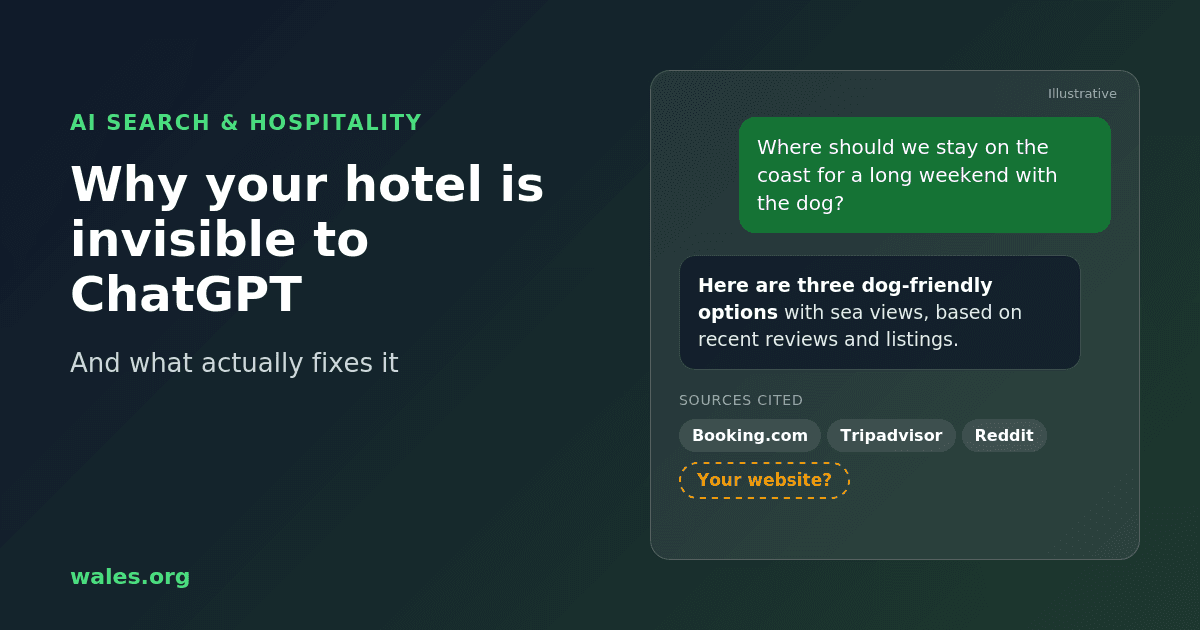
Ask ChatGPT for a hotel in Wales and you will get a confident, well-organised answer. Look at where that answer comes from and you will often find that the hotels it describes did not write any of it. The summary comes from a booking platform, a travel magazine and a Reddit thread, and the guest reading it may form an opinion of your hotel before they ever see your website.
That is what hoteliers mean when they say they are invisible to ChatGPT. It is a slightly unfair word, because most hotels are known to these tools. What they lack is control over what is said, and a reason for the guest to come to them. This guide sets out what the evidence shows, which fixes are cheap and which are not, and where our own tools, Branwen and the Interactive Map, genuinely fit and where they do not.
We built both products, so you should know the bias going in. We have tried to balance it by putting the free and low-cost fixes first, by saying plainly what our tools will not do, and by flagging where the research is mixed or comes from companies with something to sell.
Planning this trip? Ask Branwen, our free AI trip planner →
What invisible really means
ChatGPT knows most hotels exist, so invisible is not literally accurate. The problem is who gets the credit. cloro, a company that sells AI-visibility tracking, analysed 1,548 destination and hotel responses across six AI engines. Booking platforms and metasearch sites supplied about 44% of citations and travel media about 38%. Community and social sources supplied roughly a third, with Reddit the most-cited single domain at around 17%. A property’s own website made up only about 6%, and most of that went to large chains.
The caveats matter. cloro sells the service it is measuring, its corpus leans towards US English-language travellers, and because one answer cites several sources the shares overlap. Read it as a direction, not a precise measurement.
Another study points the other way at the last step. Propellic, a travel marketing agency, followed participants for a week in August 2026 as they used AI tools to choose destinations and hotels. It reported that 71% were directed to the operator’s own website when moving from an AI recommendation to booking, and that 68% said they preferred to book direct (reported by Travolution on 1 October 2026). The summary we could read does not state the sample size, and Propellic also sells AI-visibility services, so we would not lean on the exact figures.

Put the two together and you get a picture more useful than invisible. At the recommendation stage, AI tools lean heavily on other people’s pages. At the booking stage, the guest still wants a trusted place to transact, and your own site can be that place if it answers their questions when they arrive. Both halves are worth working on, and they need different fixes.
Are guests really asking AI?
Yes, in large numbers, although the surveys disagree on how far they trust what they are told. Phocuswright’s 2026 trends research found 39% of US travellers actively using AI to plan trips, up from 28% a year earlier. Phocuswright’s July 2026 summary of its US research reports that generative AI platforms such as ChatGPT reached 33% usage for trip research, roughly five times their 2024 level, and that price comparisons drive the most action on AI recommendations at 44%, ahead of summarised reviews at 33% and recognised brands at 32%. A Phocuswright figure cited by Propellic puts AI in 56% of travel purchase journeys in the first half of 2026, up from 33% a year earlier. In Europe, Phocuswright’s 2026 Europe consumer report says AI now plays a role in destination research and in hotel and flight planning across the UK, France and Germany, though we could not see UK-specific percentages.
Expedia Group’s April 2026 survey of more than 5,700 adults in the UK, US and India shows the other side. Only 8% of travellers in the US and UK said they rely on AI chatbots and agents when planning a trip, against 59% who use search engines and 49% who use online travel agencies. When it comes to booking, 68% said they turn to travel brands they trust over AI chatbots and agents, and only 8% would be comfortable booking through an AI platform. Expedia is an online travel agency with its own interests here, which is worth remembering. Phocuswright’s US research, by contrast, reports 44% willing to book directly inside an AI platform.
These findings are less contradictory than they look. Using AI to help plan is not the same as relying on it, and neither is the same as letting it take payment. The pattern in both surveys is that AI is becoming part of how guests build a shortlist, while the decision to hand over payment details still tends to go to a name they trust. For a hotel, that makes the moment a guest arrives on your own website the one you can most influence. It also explains why price visibility and reviews, the things guests act on most, sit on the fix list below.
What it costs when they book elsewhere
Every booking that goes through a booking platform instead of your own site carries commission. Booking.com does not publish one rate for every property, because the percentage is set in each property’s agreement. Commonly cited figures put the standard rate at around 15%, rising when a property joins the platform’s visibility programmes, but the number in your own extranet is the one that counts.
Direct bookings are not free either. A booking engine, payment processing and marketing all cost money, so the real saving per booking is smaller than the commission. Treat the arithmetic as an upper bound.
A useful discipline before spending on any tool, ours included, is to work out how many bookings it would need to move to pay for itself. Divide its annual cost by the commission you would save on an average booking. The table shows the answer for a £300 average booking at two commission rates and three annual costs. The costs are examples only and are not our pricing.
| Annual cost of a tool | Bookings to break even at 15% (£45 saved) | Bookings to break even at 18% (£54 saved) |
|---|---|---|
| £2,000 | 45 | 38 |
| £5,000 | 112 | 93 |
| £10,000 | 223 | 186 |
The weak point in this sum is the word move. No tool can promise to shift a given number of bookings, and we do not. What the sum does is tell you how large the on-site problem needs to be, in your own numbers, before it is worth fixing.
What actually fixes it
There are five fixes. The first three cost staff time rather than licence fees, and they should come first. The table below maps the booking journey to the fix that works at each stage, including the stages where our tools do not help.
| Stage | What goes wrong | Who controls it | What helps | Where Branwen and the Map help |
|---|---|---|---|---|
| 1. The guest asks an AI tool | The answer is built from booking platforms, media and Reddit, and your site is rarely cited | Mostly third parties | Accurate listings and reviews, pages that answer questions directly, a place in the guides AI cites | No direct effect |
| 2. The guest compares prices | Your direct rate is missing and only booking platforms are shown | You and your booking technology provider | A live price feed to Google through Hotel Center or a connectivity partner | No direct effect |
| 3. The guest reaches your site | Key facts are hard to find, and the same questions arrive every day | You | Facts in plain text near the top of the page, with last-checked dates | The map shows the area at a glance, and the assistant answers on the spot |
| 4. The guest has a question | Nobody answers at 11pm, so the guest looks elsewhere | You | A staffed chat, a clear FAQ or an assistant | Branwen answers in your brand, with scope agreed per project |
| 5. The guest books | The guest returns to the platform where they first saw the rate | You and your booking engine | A clear booking path and a visible direct offer | Branwen can connect to a live booking engine or property management system, which takes longer to set up |
1. Correct your facts at source
When an AI tool gets your hours, policies or room details wrong, the error usually sits on a page you can edit or ask someone to edit. Google’s guide to its AI features names Google Business Profile as one of the ways local business details reach AI responses, so confirm yours is claimed and complete. Then check the same details on Tripadvisor and on every booking platform that sells you, because those listings are among the pages AI tools read most. Finally, make sure your own pages state the facts guests ask about in plain text near the top, with a visible last-checked date: dog policy, parking, check-in times, distance to the beach or the nearest town. Reviews matter here too, since summarised reviews are one of the things guests act on most.
2. Get your direct rate into Google
Google’s free booking links put a hotel’s own booking page alongside the booking platforms in hotel search. Google’s help page says there is no cost for clicks and that bids do not affect how they rank. They do depend on Google receiving your live rates and availability, through a booking engine, channel manager or property management system integrated with Hotel Center, or through a Hotel Center account of your own.
There is a deadline in this. Google’s note on its help page, reported by Search Engine Roundtable, says its third-party rates feature for Hotel Ads is unavailable after 30 September 2026. Hotels that relied on rates Google sourced on their behalf need a direct price feed to stay eligible. Hospitality Today spells out the consequence: without a feed, no free official-site link takes the place of the missing ad, and a guest sees only the booking platforms under your name. If your booking engine or channel manager already sends Google a feed, nothing changes, but Hotel News Resource reports that many hotel teams do not know which arrangement they have, so ask your provider to confirm it in writing. Google has not said whether this feed affects what its AI features show (trade reporting), but it is the established route by which a hotel’s own rate reaches Google’s hotel searchers at all.
3. Be present where guests ask
The booking platforms got into AI tools first. Booking.com and Expedia launched apps inside ChatGPT in October 2025 (Skift), where guests browse live listings and click through to the platform to finish booking. Google began rolling out hotel booking inside AI Mode at the end of August 2026 through partner platforms, with the hotel or platform as merchant of record (Google’s announcement). The rollout started in the US in English. Booking-technology vendors are now offering hotels a direct route too: Lighthouse launched an app for ChatGPT in March 2026 that it says is open to independent properties and routes guests to the hotel’s own website (Lighthouse’s launch announcement, a vendor announcement we have not tested).
The practical step is a conversation, not a purchase. Ask your booking engine, channel manager and property management providers what they plan for AI channels, and keep your platform listings accurate, because those listings are what the platforms’ AI apps display.
4. Make your own site the best place to get answers
Guests reach your site from Google, social media, email, or an AI citation, and they arrive with questions. Many are about the room. Some are about the area: what is nearby, what is open, what to do if it rains. A clear FAQ, a staffed chat, an assistant and a map all help here. This is the fix our tools address, and the next section explains how, and where the limits are.
5. Measure what is happening
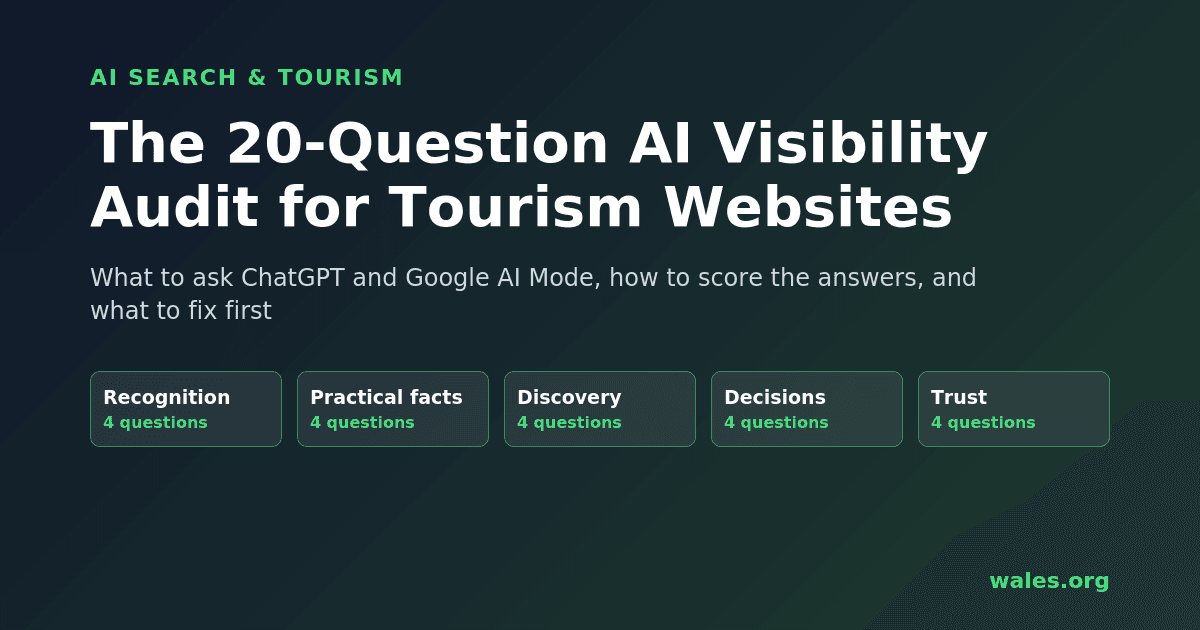
Set a baseline before you change anything. Ask ChatGPT and Google AI Mode the questions your guests would ask, several times each, and note which sources are cited and whether the facts are right. Our 20-question AI visibility audit sets out the exact prompts and a scoring method. Then watch the Generative AI performance report in Search Console and, in Google Analytics, referrals from chatgpt.com, which OpenAI tags with a utm_source parameter. Expect the numbers to move slowly and to be noisy.
Where Branwen and the Interactive Map fit
Fix 4 is the half of the problem that sits entirely on your own website, and it is the half our tools address. Neither will make ChatGPT recommend you. Nothing can promise that, and anyone who says otherwise is guessing.
Branwen, the assistant
Branwen is our AI travel assistant. On Wales.org she answers real questions about visiting Wales and points people towards live availability and bookings. A licensed version is white-labelled onto your own site and styled to match your brand. How far it connects into your systems is agreed per project: a simple embed is quicker, while connecting it to a live booking engine or property management system takes longer.
The Interactive Map
The Interactive Map holds more than 1,300 hand-picked Welsh locations across 17 categories and is built to embed cleanly into any site. The free embed carries Wales.org branding. A licence gets you a version built around your own brand, with no Wales.org logo, your own colours and categories, and data tailored to what you need. It is also partner-safe, so affiliate and booking prompts hide automatically when it runs inside another site. For a hotel, the useful version is a map of your own area that answers what is within reach without the guest leaving your page.
What it costs
Pricing depends on scope, from a simple embed through to a fully connected booking system, so we quote per project and do not publish a rate card. Use the break-even table above to judge whether the on-site problem is large enough in your own numbers before you ask.
Before and after
The diagram contrasts two setups for the same hotel. It describes a way of organising information, not a set of results.
To make that concrete, here is an illustration. It is 10.40pm. A couple with a dog are on your website, deciding between you and two other hotels. They want to know whether dogs can stay in the room, where to park, and whether there is a pub within walking distance. The dog policy is in a PDF, the parking is on a separate page, and nothing mentions pubs. Nobody is at reception. They open a booking platform tab, where all three answers sit together.
With the second setup, the same couple can ask the assistant on your site. It can answer the dog policy and parking from information you have checked, show a map of walkable pubs and dog-friendly walks, and offer the dates they asked about with a hand-off to your own booking page. Whether that wins the booking still depends on your rates, your reviews and your rooms. What changes is that the guest got their answers from you. This is an illustration of a setup, not a case study or a promise of results.
Is this right for your hotel?
It is most likely to be worth considering if you run an independent hotel or a small group with a working booking engine, enough website traffic that unanswered questions may be costing you bookings, and a clear direct-booking target. It is also a good fit where the surroundings are a selling point, such as a coast, a castle or a walking area, because that is where a map and an assistant have the most to add.
It is less suited to a very small property with few website visitors, where the first three fixes will give you more for less, to a business without a working booking path, or to anyone expecting a licence to change what ChatGPT says about them. If that last point describes what you hoped for, spend the effort on fixes 1 to 3.

How to start
- Run a quick pass of AI questions about your hotel. Ask ChatGPT and Google AI Mode five or six questions a guest would ask, two or three times each, and note which sources are cited and whether the facts are right.
- Check your Google feed and Business Profile this week. Ask your booking engine or channel manager whether they send Google a live price feed, and get the answer in writing.
- List the ten questions your front desk answers most often. Check that your website answers each one in plain text, with a last-checked date.
- If gaps remain that staff time cannot close, talk to us. Bring the list from step 3, because it tells us what an assistant or a map would need to cover.
Want to talk about your own hotel?
Tell us what your site cannot currently answer, and we will tell you honestly whether Branwen or the Interactive Map would help, and what the simpler alternatives are.
Get in touch via our Partner page →For the wider picture on how AI search is changing visitor behaviour across tourism, see our analysis of AI search visibility for tourism.
Sources and limits
The guest-behaviour figures come from Phocuswright and Expedia Group surveys, and they disagree because they ask different questions of different samples, mostly in the US. The citation shares come from cloro, and the booking-handoff figures from Propellic, both companies that sell AI-visibility services. The Google details come from Google’s own help pages and announcements as reported by trade publications, and the Lighthouse detail comes from a vendor announcement. Commission figures are commonly cited averages and not quotes. All of this is changing quickly, so check the dates on anything you rely on. This is an October 2026 snapshot.
Frequently asked questions
Will an AI assistant on my website make ChatGPT recommend my hotel?
No. They are separate things. ChatGPT’s recommendations depend on the sources it finds and relies on, such as booking platforms, travel media and reviews. An assistant on your own site improves what happens after a guest arrives there. The fixes more likely to influence what AI tools say about you are the first three in this guide: correcting your facts at source, getting your direct rate into Google, and being present on the channels guests use.
Do Google’s free booking links cost anything?
There is no cost for clicks, and Google says bids have no effect on how free booking links are ranked. You do need your rates and availability to reach Google, either through a booking engine, channel manager or property management system that is integrated with Hotel Center, or through a Hotel Center account of your own. Ask your provider to confirm in writing what they send.
How much does it cost to license Branwen or the map for a hotel?
It depends on scope, from a simple embed through to a fully connected booking system, so we quote per project. Before you ask anyone for a quote, work out your break-even using the table in this guide, so you know what size of problem you are paying to solve.
Can Branwen take bookings?
Branwen points guests towards live availability and bookings. A licensed version can be connected to a live booking engine or property management system, which takes longer to set up than a simple embed. We would scope that with you before anything is built.
How far do guests trust AI to book for them?
Surveys differ widely. Expedia Group found that only 8% of travellers are comfortable booking through an AI platform, while Phocuswright’s US research reports that 44% would book directly inside one. The questions and samples differ, so treat both as evidence that the direction is towards AI-assisted booking, not as a forecast of how fast it will happen.
Is the free map embed enough for a hotel?
The free embed is our map as it is, with Wales.org branding and our data. It is a good way to see how guests use a map on your site. A licence is for when you want your own brand, colours, categories and data, with no Wales.org logo.

Pembrokeshire-born travel writer and founder of Wales.org. Born in Haverfordwest, now based in Hertfordshire — covering Welsh castles, national parks, festivals and family staycations across all 22 Welsh counties.