

By Wales.org | Nicholas Barrett, Founder & Editor | Updated October 2026
The Llŷn Peninsula stretches 30 miles into the Irish Sea from Snowdonia — a narrow arm of ancient land pointing south-west toward Ireland, Wales’s most Welsh-speaking region, and one of the finest coastal landscapes in Britain.
It is a peninsula of extraordinary contrasts. The north coast is dramatic and exposed, with Iron Age hillforts on craggy summits and secluded coves accessible only on foot — including Porthor’s famous whistling sands. The south coast has some of the finest sandy beaches in Wales, among them Abersoch and Llanbedrog.
At the very tip sits Aberdaron — a village of whitewashed cottages at the edge of the world — with Bardsey Island two miles offshore: an island of 20,000 saints, extraordinary seabirds and a tradition of pilgrimage stretching back 1,500 years. This guide covers everything you need for Llŷn in 2027.
At a Glance: The Llŷn Peninsula
- Abersoch: North Wales’s premier resort for watersports, sailing, and sheltered family beaches.
- Porthor (Whistling Sands): a secluded, stunning beach where the sand “squeaks” underfoot.
- Porthdinllaen: a car-free fishing hamlet with a working lifeboat station and a pub rated among the world’s best beach bars.
- Aberdaron & Bardsey Island: the historic end of the Pilgrims’ Way, offering boat trips to an island steeped in Celtic history.
- Llŷn Coastal Path: 80 miles of world-class, unbroken coastal hiking with spectacular sea views.
- Welsh Culture: over 70% of the local population speaks Welsh, keeping the region’s heritage vibrantly alive.
Abersoch: North Wales’s Most Popular Beach Resort
Abersoch (LL53 7EA) on the south coast of Llŷn is the most visited destination on the peninsula — and rightly so. Its two beaches, the main village beach and the larger Warren Beach stretching north toward Llanbedrog, offer safe, sheltered swimming and watersports in Cardigan Bay with the mountains of Snowdonia as a backdrop to the north-east.
Abersoch has the highest concentration of watersports facilities in North Wales. Kitesurfing, windsurfing, sailing and kayaking are all available with hire and tuition from operators in the village. The consistent south-westerly wind that funnels down Cardigan Bay makes the main beach one of the best kitesurfing spots in Wales.
The village has an upmarket food and drink scene for its size — independent restaurants, a good Saturday market, and a range of clothing and lifestyle shops that reflect Abersoch’s reputation as the Padstow of North Wales. Accommodation is in high demand. Book cottage and hotel stays months in advance for July and August.
The Llyn Coastal Bus (TfW bus, seasonal) connects Pwllheli to Aberdaron along the south coast — useful for walkers doing linear sections of the Llŷn Coastal Path without returning to their start point.

Porthor: The Whistling Sands of Llŷn
Porthor (LL53 8LD, National Trust) on the north-west coast is known as the Whistling Sands — the beach at which the fine, dry sand grains produce an audible squeak when walked upon, a property found in only a handful of beaches in the world.
The beach itself is a sheltered cove of exceptionally fine white sand with clear water — one of the most beautiful and least accessible beaches in North Wales. It has no nearby road. A 10-minute walk from the National Trust car park is required, which keeps crowds lower than the peninsula’s more accessible beaches.
The surrounding headland is outstanding for coastal walking. The section of Llŷn Coastal Path between Porthor and Mynydd Mawr to the south-west — passing through NT-owned cliff land above dramatic quartzite headlands — is among the finest coastal walking in Wales.
Aberdaron and the Pilgrims’ Way to Bardsey Island
Aberdaron (LL53 8BE) is the last village on the Llŷn Peninsula before the tip — a cluster of whitewashed cottages around a 12th-century church on a sheltered beach. For five centuries of medieval pilgrimage, this was the departure point for Bardsey Island — the holiest site in Wales and one of the holiest in Celtic Christianity.
Y Gegin Fawr (The Great Kitchen) beside the beach in Aberdaron is a 14th-century building that fed pilgrims before they crossed to Bardsey. It now operates as a café — one of the most atmospheric places to eat in Wales, with medieval stone walls and an estuary setting.
St Hywyn’s Church on the beach at Aberdaron was built in the 12th century. The poet R.S. Thomas served as its vicar from 1967 to 1978, and one of his poems is carved on a slate displayed inside — a lasting trace of the years he spent drawing poetic inspiration from the peninsula’s landscape and people. Thomas continued to live nearby after retiring; his ashes are buried at St John’s Church in Porthmadog, rather than at St Hywyn’s itself.
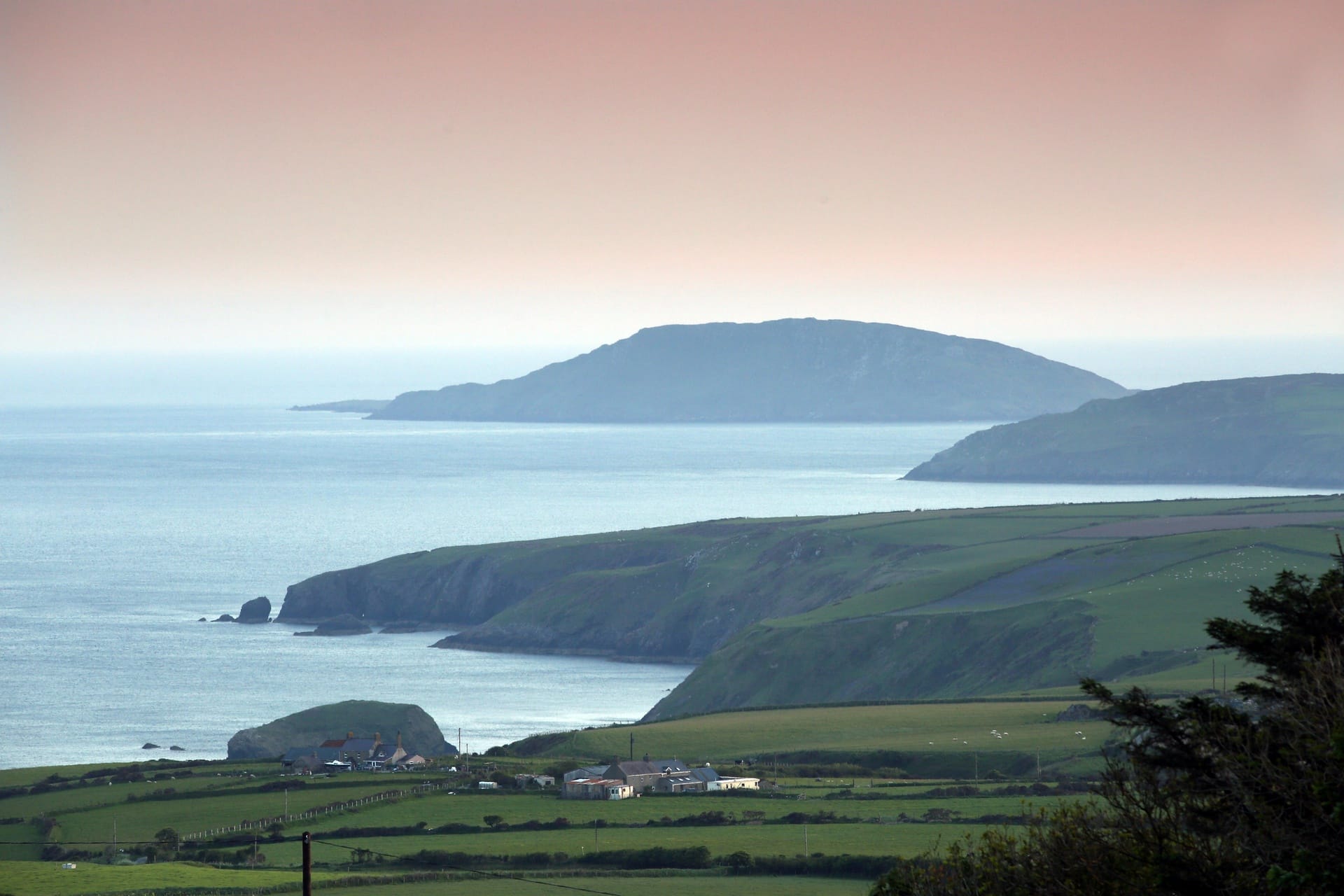
Bardsey Island (Ynys Enlli) is two miles offshore — boat trips run May to September, weather permitting, departing from Porth Meudwy, a small fishing cove just over a mile from Aberdaron village (bardseyboattrips.com). The island has been a place of Christian pilgrimage since the 6th century — legend holds that 20,000 saints are buried here. Today it is home to the Bardsey Bird and Field Observatory (one of the finest seabird and migration sites in Wales) and a small resident community. Its oldest surviving house, Carreg Bach, dates to the late 18th or early 19th century; most of the island’s farmhouses were built by Lord Newborough in the 1870s.
The Llŷn Coastal Path
The Llŷn Coastal Path forms part of the Wales Coast Path — the 870-mile national trail that was the world’s first continuous coastal walking path when it opened in 2012. The Llŷn section (approximately 80 miles) is consistently rated among the finest and most challenging sections of the entire route.
The north coast section — from Clynnog Fawr in the east around the tip to Aberdaron — is particularly remote and demanding, with significant ascents over coastal headlands and long stretches without facilities. It is best tackled over 4–5 days with pre-booked accommodation at Nefyn, Pistyll and Llŷn’s coastal villages.
The south coast section from Aberdaron to Abersoch is more accessible — shorter stages through National Trust land, past Porthor and along Llanbedrog’s fine beach, with easier access to the coastal bus and village accommodation.
Individual sections work well as day walks from Pwllheli, Abersoch or Aberdaron. The headland sections — particularly around Mynydd Mawr, Mynydd y Gwyddel and Mynydd Rhiw — give extraordinary views of Cardigan Bay, the Pembrokeshire coast on clear days, and the Wicklow Mountains in Ireland. See: walking in Wales | hiking in Wales.
Porthdinllaen: The Beach You Can Only Walk To
Porthdinllaen (LL53 6DA, National Trust) on the north coast near Morfa Nefyn is one of the most distinctive places on the peninsula — a tiny fishing hamlet on a narrow headland with no road access at all.
Visitors reach it on foot, either across the beach from Morfa Nefyn or via the Nefyn Golf Club footpath — around a 20-minute walk each way, with the beach route cut off at high tide.
The reward is the Tŷ Coch Inn, a pub standing right on the sand that has been named among the top ten beach bars in the world. Drinks on the terrace with the tide lapping a few feet away is one of Llŷn’s defining experiences.
At the far end of the headland stands the working Porthdinllaen Lifeboat Station, established by the RNLI in 1864 and one of the few lifeboat stations in Britain staffed constantly since opening. It’s open to visitors, with a small shop, and remains a genuine working station rather than a museum piece.
The National Trust has managed the headland since 1994. A circular marine trail (around 2.5 miles) loops the headland past the lifeboat station and golf course, with views across to Yr Eifl.

Llŷn’s Iron Age Hillforts and Welsh Language Heartland
Llŷn has the highest proportion of Welsh speakers of any area of Wales outside Gwynedd’s villages — over 70% of the peninsula’s population speak Welsh as a first language. It is one of the few areas of Wales where English is genuinely a second language in daily life, not a formality.
Tre’r Ceiri (LL54 — park at Llanaelhaearn) on the eastern end of the Yr Eifl mountains is one of the finest Iron Age hillforts in Wales — and one of the best preserved in Britain. Perched at 485 metres, the stone ramparts enclose the foundations of over 150 stone roundhouses, still standing to head height in places. The hillfort was built around 200 BCE, with finds showing occupation continuing into the Roman period. The 45-minute ascent from the road is on clear paths and rewards with extraordinary coastal views and an almost supernatural sense of inhabiting 2,000 years of history.
Yr Eifl (The Rivals) — the three peaks above Trefor on the north coast — give some of the finest ridge walking on Llŷn, with views on clear days to Snowdon, Anglesey, the Irish Sea and the Wicklow Hills. Tre’r Ceiri’s hillfort crowns the eastern peak; the highest of the three, Garn Ganol (564m), is a straightforward 2-hour return from Trefor. See: Anglesey guide | Snowdonia guide.
Where to Stay on the Llŷn Peninsula
Holiday cottages on the Llŷn Peninsula are the most sought-after in North Wales — stone farmhouses, cliff-edge conversions and harbourside cottages at Aberdaron, Abersoch, Llanbedrog and Nefyn. Supply is limited. Book months ahead for July and August — cottage weeks sell out well before the following summer.
Glamping on Llŷn is excellent — hill farms above the south coast offer yurts and shepherd’s huts with Cardigan Bay views and some of the darkest skies in Wales. The peninsula is within the Snowdonia Dark Sky Reserve’s influence zone.
Hotels are centred on Abersoch and Pwllheli. Porth Tocyn Hotel above Abersoch — a small hotel with Cardigan Bay views, run by the same family since it opened in 1948 — has been one of the best-regarded small hotels in Wales for nearly 80 years. The Lleyn Peninsula Hotel at Pwllheli and independent guesthouses in Nefyn and Aberdaron complete the main offer. See: holiday cottages in Wales | glamping in Wales.
Frequently Asked Questions: Llŷn Peninsula
How do you get to the Llŷn Peninsula?
By rail: the Cambrian Coast line from Birmingham and Shrewsbury via Machynlleth serves Pwllheli at the eastern end of the peninsula (approximately 4 hours from Birmingham). By car: the A487/A499 from Caernarfon is the main approach, approximately 1 hour from Caernarfon, 2 hours from Chester and 4.5 hours from Birmingham. A car is strongly recommended for exploring the western and northern parts of the peninsula, which have no regular public transport.
Can you visit Bardsey Island?
Yes — boat trips from Aberdaron run seasonally (May to September), weather permitting. The crossing takes approximately 20 minutes each way but is subject to the strong tidal currents of Bardsey Sound, which means trips are cancelled frequently. Book through Bardsey Boat Trips at bardseyboattrips.com. Week-long self-catering stays on the island can also be booked through the Bardsey Island Trust (bardseyislandtrust.org). Birdwatching, seal watching and the extraordinary sense of Celtic Christian history make the crossing memorable even on a 3-hour day visit.
What are the best beaches on the Llŷn Peninsula?
The finest beaches on Llŷn are: Porthor (Whistling Sands, National Trust, north-west coast — finest sand, less crowded, 10-min walk from car park), Abersoch main beach and Warren Beach (south coast, family-friendly, watersports), Llanbedrog (south coast, excellent sand, National Trust headland walk, good café and facilities) and Porthdinllaen (north coast, car-free, National Trust, home to the Tŷ Coch Inn). Porth Ceiriad near Abersoch is a quieter south-facing bay excellent for swimming.
All beaches are listed at beaches in Wales.