

Becoming the Source: What the Evidence Says About Destinations in AI Search
What Happens When a Destination Website Becomes the Source AI Assistants Trust
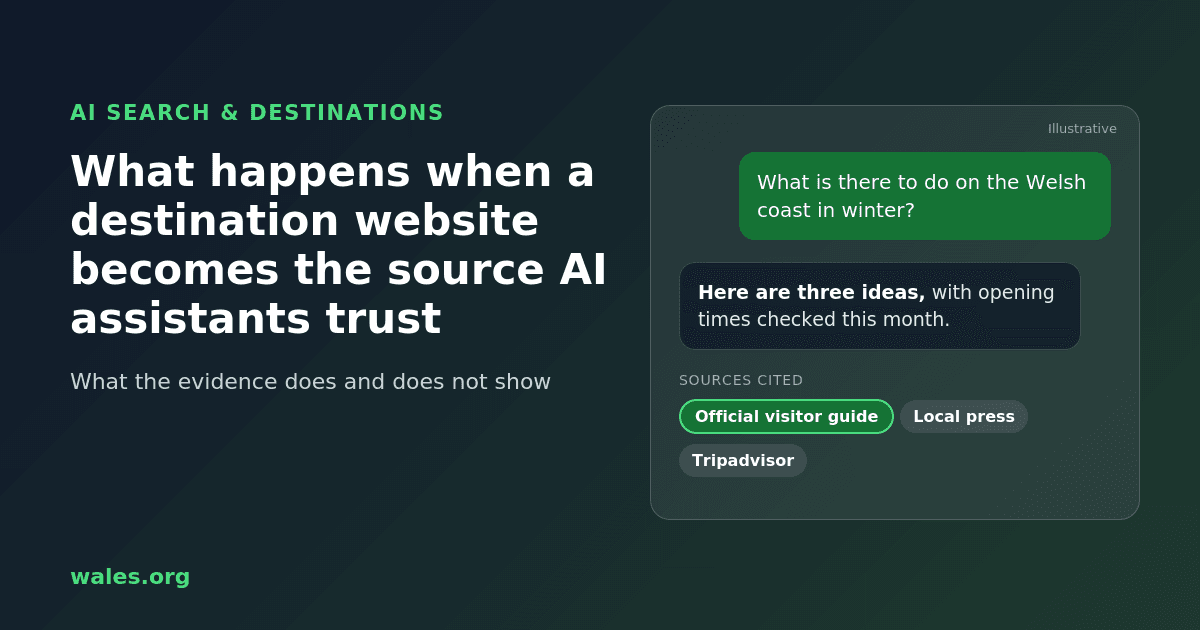
Picture a wet Tuesday in February. Someone in Leeds is planning a long weekend on the Welsh coast. They do not open a destination website. They ask an AI assistant what there is to do, what is open in winter and where to stay, and they read the answer. The assistant has assembled that answer from pages it found and judged reliable, and the destination’s own website may not be among them.
In one study of 100 travel searches in Google AI Mode, official tourism and government sites made up about 1% of the sources cited, while independent travel blogs made up more than half. This guide asks what changes for a destination when that picture shifts, and it tries to answer with evidence rather than enthusiasm. Some of the evidence is encouraging. Some of what is usually promised, such as more visitors, more press coverage and less spending on paid campaigns, has no proof behind it that we could find, and we say so.
We write this for the people who have to make the case to a committee: tourism officers, destination managers, and the elected members and finance officers who hold them to account. You will not find forecasts here. You will find what the data supports, what it does not, and how to measure the difference for yourself.
Planning this trip? Ask Branwen, our free AI trip planner →
The gap: official sites are rarely the source
Search Agency, a consultancy that sells AI-search services, sent 100 unbranded travel prompts to Google AI Mode on 9 July 2026. The answers cited 2,558 sources from 1,229 domains. Independent travel blogs and content sites supplied 56.8% of the citations, booking platforms 11.1%, video 9.7% and forums and communities 7.3%. Official tourism and government sites supplied 1.2%. The firm notes that this is a single snapshot, that no location was set so the answers lean towards Google’s US defaults, and that source types were classified by a heuristic rule set.
It is a picture of one tool on one day, not a verdict on any destination. It does help explain how a destination can rank well in ordinary search and still be absent from AI answers: these tools read many pages and weigh them differently from a results page. It also suggests where the effort has to go. Being accurate on your own site is necessary, but it is not the same as being the source an answer is built from.

What being the source means in practice
Google’s guide to its AI features says its AI features draw on pages in Google’s Search index, and that content people find unique, compelling and useful will probably influence presence in those features more than any other suggestion it makes. Read alongside the citation data, that points to three things working together.
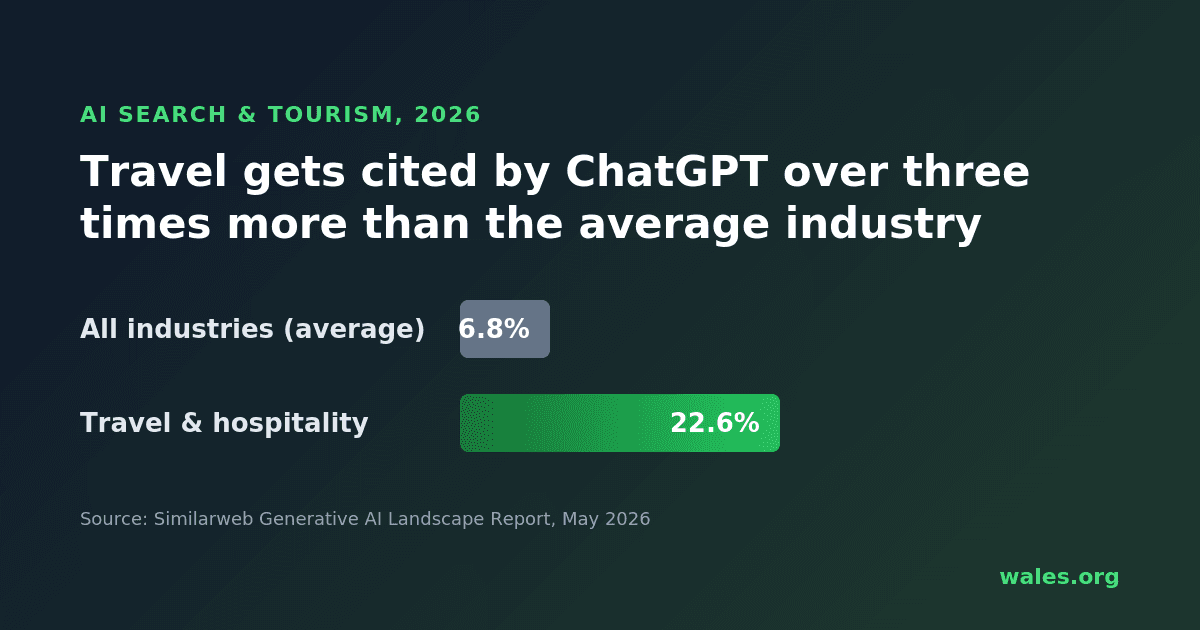
The first is your own pages: accurate, current, dated and the best answer to the question a visitor is asking. The second is the third-party pages that describe you, such as listings, reviews, guides and press coverage, which need to agree with the first. The third is repetition. Muck Rack’s May 2026 analysis of the links AI tools cite found that about 99% came from non-paid sources, with around 27% from journalism, and paid or advertorial content at only 0.3%. Muck Rack sells PR software, and earlier editions put the non-paid share at 94 to 95%, so treat the exact figures with care. The direction is consistent: AI tools lean on what others have written about you, not on what you have paid to place.
A destination becomes the source, in other words, when its facts are the ones these tools meet again and again, in places they trust, and when those facts are right.
What happens to sites that are cited
Three recent studies come closest to measuring it. None is about a Welsh destination and none proves cause, but together they show a consistent shape.
Cited sites get more clicks
Seer Interactive compared click-through for queries that showed an AI Overview. Brands cited inside the Overview earned 35% more organic clicks than brands that were not cited (0.70% against 0.52%), and 91% more paid clicks (7.89% against 4.14%), on the Q3 2025 average. Seer is careful to add that brands with stronger authority and higher baseline click rates may simply be more likely to be cited, so the figures may reflect strength that was already there.
Named brands get visited within a week
Similarweb followed opted-in US desktop users from July to December 2025 across finance, travel and beauty. Users who received a ChatGPT recommendation were 2.5 times more likely to visit the recommended brand’s site within seven days than a competitor’s, excluding anyone who had visited recently or named the brand in their prompt. The telling detail is how they arrived: 55.9% came through search, 19.9% directly and only 8.8% through an AI referral (Similarweb’s write-up). The influence is real but mostly invisible to standard analytics.
One destination portal, measured
The closest thing to destination evidence is a peer-reviewed paper in Tourism and Hospitality by Christos Ziakis and Maro Vlachopoulou, using 1.6 million sessions of Google Analytics data from HalkidikiTravel.com, a content portal for a summer destination in northern Greece, between April 2022 and January 2026. Visitors arriving from AI assistants clicked through to booking engines at a rate of 8.26%, against 3.88% for organic search, despite spending less time on the site. The authors also found that booking intent was highest in the pre-season planning months and lower in peak summer, which matters for any destination trying to spread demand through the year.
The authors are candid about the limits. AI assistants accounted for only 1,865 sessions, under 0.2% of the total. The measure was outbound booking clicks, not completed bookings. It is one portal in one region, and they call for replication before anyone leans on the numbers.
Seer reports a similar scale elsewhere. On the one site it examined in detail, AI traffic was 0.07% of organic traffic, and across the accounts it monitors the share ranged from 0.05% to nearly 4% (Seer’s own case study).
What these studies do not show: none of them measures visitor numbers, visitor spend, press coverage or paid-media effects for a destination. They show that being cited or recommended goes with more clicks, more visits and higher booking intent, at small scale, and that most of the effect is hard to see. They do not show that becoming the cited source would deliver the same for you.
The three outcomes committees ask about
Visitor numbers, press mentions and reduced reliance on paid campaigns are the outcomes most often promised for AI visibility. The evidence for each is different, and the ladder below sorts what we found.
More visitors
The evidence supports a relationship between AI recommendation and downstream visits for brands, and between AI referral and booking intent at one portal. It does not yet show a destination’s visitor numbers or spend rising because it became the cited source. The mechanism is plausible: a recommendation creates awareness that later shows up as a branded search. That makes it testable, which is why the measurement section below leans on branded search and visitor surveys, not clicks alone.
More press mentions
The evidence runs the other way. AI tools cite journalism heavily, so press coverage helps what they say about you. We found no evidence that being cited brings more press coverage in return. It is plausible that an accurate, current, quotable source is easier for a travel writer to use, but we have not seen it measured, and we would not put it in a business case.
Less reliance on paid campaigns
Paid and advertorial content is about 0.3% of what AI tools cite, so paid campaigns do not build the sources these tools read. Seer found paid click-through was higher where a brand was also cited, which suggests complement rather than replacement, though it is a correlation. We found no study showing a destination can spend less on paid campaigns as a result of being cited, and we would be wary of anyone who claims it.
A realistic 24-month path
If the evidence cannot forecast results, it can still shape a sensible order of work. The path below is a planning model, not a prediction of outcomes. It starts with the cheap, certain steps, builds the source over the following year, and ends by comparing the results with a baseline set at the start.
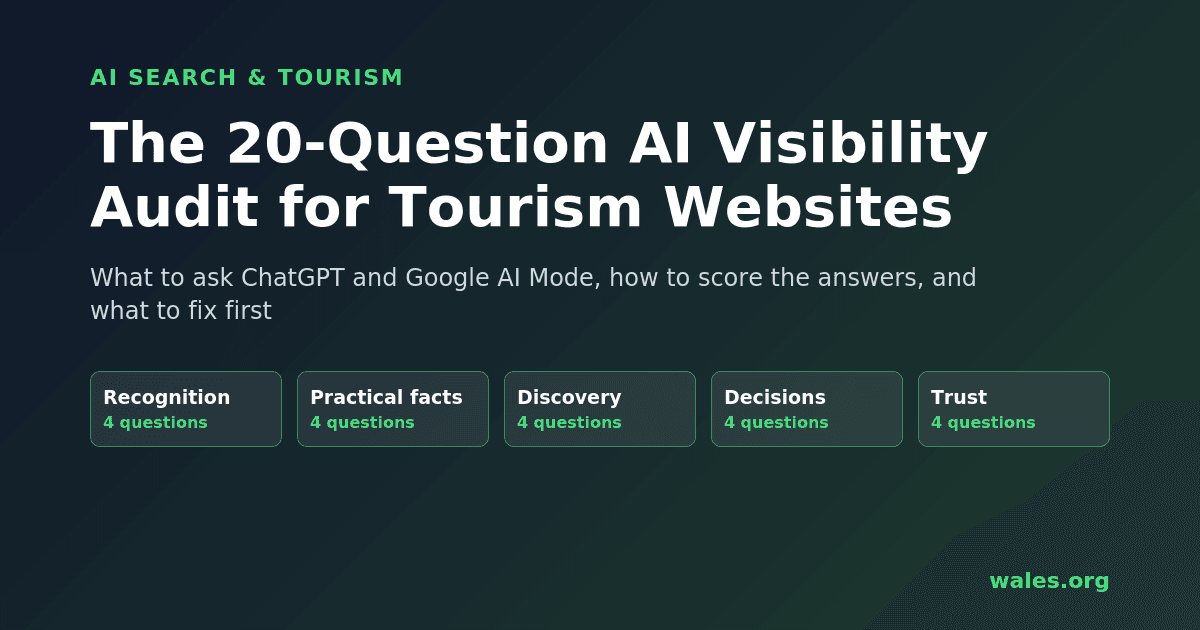
The first quarter matters most, because without a baseline nothing later can be shown to have changed. The 20-question audit gives you the prompts and a scoring method, and it is built around the fact that AI answers vary from run to run: in SparkToro‘s study of nearly 3,000 responses, the same prompt almost never produced the same list of brands twice. Plan to judge the trend over several quarters, not any single result.

What a committee will ask
In Wales this question is about to sharpen. The Visitor Accommodation (Register and Levy) Etc. (Wales) Act 2025 lets councils introduce a visitor levy from April 2027, at £1.30 per person per night for most accommodation and 75p for campsites and hostels. Councils that introduce one must spend it on destination management and local improvements and report each year on how it has been invested (the Welsh Government; House of Commons Library). In Caerdydd (Cardiff), the council has approved a levy from 1 April 2027. Wherever a levy is introduced, members will want to see what spending on visitor information has achieved.
Here are the questions we would expect, with honest answers.
| The question | An honest answer |
|---|---|
| How many extra visitors will this bring? | No study can say. What we can do is set a baseline and track branded search, direct traffic and AI impressions over several quarters, so the committee sees your own numbers. |
| Why not spend this on advertising instead? | Paid and advertorial content is a tiny share of what AI tools cite (about 0.3%), so advertising does not build the sources they read. Seer also found paid clicks performed better where a brand was cited too, which points to the two working together, though that is a correlation. |
| How do we know the information is right? | Ask for facts that are sourced, dated and checked on a schedule, with a named person responsible. A wrong opening time repeated by an AI tool is a cost to visitors and to the council. |
| What happens when the contract ends? | Ask who owns the content, whether it stays online and how it will be kept accurate. Content that goes stale undoes its own value. |
| Will it work in Welsh? | Ask for it, and test it. We do not know how closely AI tools match their English answers in Welsh, which is why the audit includes a Welsh-language question. |
Two routes to becoming the source
There are two ways to put your facts where AI tools find them, and they are not alternatives.
The first is to build the authority of your own site. It is the foundation, and it is fully yours, but it takes sustained effort: first-hand content, facts that are dated and checked, and the discipline to keep them current. For any small team, keeping a large site accurate is a real resource question.
The second is to place accurate, useful content in independent publications whose pages already appear in AI answers. The Google AI Mode data suggests that is where much of the citation weight sits. A content partnership with an independent publisher is one way to do this, and it brings reach that your own site would take years to build.
We should be plain about a limit here. A paid partnership is not a way to buy AI citations, since paid and advertorial content is about 0.3% of what these tools cite. Its value rests on whether the content is accurate, current and genuinely useful to a visitor. Whoever you commission, ask them:
- Is the content factual, with sources and dates for each claim?
- Is it disclosed as a partnership, and who keeps editorial control?
- Who checks it, and how often is it refreshed?
- What will be measured, and when will you see it?
- What happens to the content when the contract ends?
- Will it be available in Welsh?
How to measure it
Because so much AI influence shows up later as branded search, clicks alone will understate it. These six measures together give a committee a fairer picture. Google’s Generative AI performance report in Search Console, rolled out to all sites on 31 August 2026, is the first official measure of how often your pages appear in its AI answers.
| What to track | Where to find it | What it tells you |
|---|---|---|
| AI Overview and AI Mode impressions | Search Console, Generative AI performance report | How often your pages appear in Google’s AI answers, by page and country |
| Branded search | Search Console, queries containing your destination or brand name | Where much AI-influenced demand shows up: Similarweb found 55.9% of AI-influenced visits arrived via search |
| AI referrals | Google Analytics 4, referrals from chatgpt.com and similar | The small, visible part of AI influence. Most of it will not appear here |
| Audit scores | A quarterly run of the 20-question audit | Whether AI tools find you, state your facts correctly and cite you |
| How visitors planned | A question in visitor surveys about using an AI assistant | Whether the effect reaches real visitors, which clicks cannot show |
| Press mentions | Media monitoring, or a simple log | Whether the third-party sources describing you are growing |
Set the baseline before anything changes, record it with a date, and repeat it on a schedule. The numbers will be small at first, and that is not a sign that nothing is happening. It is the scale the studies above found.
Where Wales.org fits
We are an independent Welsh travel platform, and we work with local authorities, tourism bodies and organisations on paid content partnerships, from seasonal guides to themed series. We also license the Interactive Map and Branwen, our AI travel assistant, to organisations that want them on their own sites. For a destination, those two address the on-site half of the problem: giving visitors who arrive a useful map and a good way to ask questions. Neither is a route into AI answers, and nobody can honestly sell you one.
We can show you where our own guides rank against official bodies in search. When we checked in October 2026, our castles hub appeared alongside VisitWales for the query “best castles to visit in Wales”. We have not measured an AI citation rate for Wales.org and we do not claim one. Nothing in this guide is a case study of our work, and we would rather say so than imply it.
What we can offer is a way to find out. The 20-question audit measures how AI tools describe a destination today, and a partnership can be set up with a baseline, agreed measures and a review date, so that a committee sees evidence rather than promises. For wider context on how AI search is changing visitor behaviour, see our analysis of AI search visibility for tourism.
Making the case to a committee?
Tell us what you are trying to achieve and what your members will need to see. We will tell you honestly what we can measure, what we cannot, and whether a content partnership, a licence or neither is the right next step.
Get in touch via our Partner page →Sources and limits
The citation shares come from Search Agency and Muck Rack, and the click and visit figures from Seer Interactive and Similarweb, all companies that sell search, AI-visibility or PR services. The destination figures come from a peer-reviewed paper on a single Greek portal. The Welsh levy details come from the Welsh Government and the House of Commons Library. Seer and the paper’s authors both caution against reading the results as proof of cause, and we have repeated those cautions. Most of the data is from the US or Greece, not the UK. These tools change quickly, so check dates before relying on any figure. This is an October 2026 snapshot.
Frequently asked questions
Can a destination website really become the source AI assistants trust?
It can become a source, but no site controls what an AI assistant cites, because these tools assemble answers from many pages. Google’s own guidance says content that people find unique, compelling and useful is the most likely influence on presence in its AI features, and those features draw on the same pages that perform in ordinary search. That is a direction to work in, not a guarantee.
Will being cited increase visitor numbers?
The evidence so far is encouraging but incomplete. Cited sites get more clicks than uncited ones, brands named by ChatGPT get more visits within a week, and AI referrals showed higher booking intent at one destination portal. None of these studies measured visitor numbers or spend for a destination, and Seer notes that cited sites may simply be the stronger ones. The responsible position is to measure it against your own baseline.
Is paying for content a way to get cited by AI?
No. Muck Rack’s May 2026 analysis found that paid and advertorial content makes up only about 0.3% of the links AI tools cite. What earns citations is accurate, useful, well-sourced content, so a content partnership should be judged on those qualities and should be disclosed as a partnership.
How long before a council would see a difference?
There is no reliable benchmark, and we would not trust anyone who offered one. AI answers vary from run to run, and much AI-influenced demand arrives later as branded search, so effects are slow to see. Set a baseline in the first quarter and judge the trend over several quarters.
Do we need both our own website and a content partner?
Your own website is where your facts should be held and checked, so it comes first. A content partner can extend those facts into sources AI tools already read, which matters because independent sites made up most of the citations in the Google AI Mode study. The two work together, and neither replaces the other.
What would you ask a committee to approve as a first step?
A baseline audit, a short list of agreed measures, a disclosure statement for any partnership content, and a date to review the results. That is a small, reversible decision, and it gives the committee evidence instead of forecasts.

Pembrokeshire-born travel writer and founder of Wales.org. Born in Haverfordwest, now based in Hertfordshire — covering Welsh castles, national parks, festivals and family staycations across all 22 Welsh counties.