

Walking the Wales Coast Path: The Complete 2026 Guide
By the Wales.org Outdoor Team | Updated for July 2026 | Trail & Hiking Experts
If you are looking for the ultimate outdoor adventure, lace up your boots and prepare to hike the Wales Coast Path. As the only country in the world to offer a single, unbroken walking trail around its entire national border, exploring the Welsh coastline delivers an unforgettable experience for hikers of all levels.
Spanning a massive 870 miles, this trail presents a unique opportunity to navigate unspoiled cliff tops, vast beaches, and historic port towns without missing a landmark or losing your way.
At a Glance: Wales Coast Path Fast Facts
- Total Distance: 870 miles (1,400 kilometres).
- World First: The first path in the world to follow an entire country’s coastline. Opened 5 May 2012.
- Official Start & End Points: Chester in the North to Chepstow in the South. Official halfway point: New Quay, Ceredigion.
- Official Sections: 8, ranging from 68 miles (Carmarthenshire) to 182 miles (Pembrokeshire).
- Total Ascent (Pembrokeshire section alone): Approximately 35,000 feet — equivalent to climbing Mount Everest from sea level.
- Average Completion Time: 6 to 8 weeks for continuous through-hikers. Section walkers usually take about a week per section.
- Fastest Known Time: 14 days, set by ultra-marathon runner Rhys Jenkins.
- The Trail Marker: Look for the official blue and yellow “Dragon Shell” logo painted on gates and signposts.
The epic adventure winds through the serene Isle of Anglesey, the vibrant capital city of Cardiff, and Britain’s only fully coastal National Park. Along the way, you will navigate the fringes of Snowdonia and pass numerous ancient fortresses.
Planning this trip? Ask Branwen, our free AI trip planner →
Please note that the entire trek cannot be completed in a single weekend. Most visitors choose to research specific sections to explore, devising targeted itineraries that suit their fitness levels and timeframes. To help you plan, we have broken down the journey into its core geographical stages.
The 8 Official Sections at a Glance
The Wales Coast Path is officially divided into eight geographic sections. Here is how they compare on distance, difficulty, best base town, and when to walk. Use this to choose which section suits your fitness, timeframe and interests.
Logistics & Trail Navigation
Planning a coastal hike requires careful logistical preparation. The official route is exceptionally well maintained, but understanding how to access and navigate it is crucial for a smooth journey.
The path is heavily integrated with the national public transport network. The TrawsCymru bus service and the coastal railway lines (such as the Cambrian Coast Line) make it incredibly easy to hike linearly. You can walk a 10-mile section and simply catch a bus or train back to your starting point, eliminating the need to retrace your steps or bring two cars.
The 2026 Trail Logistics Power-Up
🧳 Luggage Transfers
You do not need to carry a heavy 15kg rucksack for 870 miles. Dedicated services like Wales Coast Path Holidays and Luggage Transfers Ltd will collect your heavy bags from your accommodation in the morning and deliver them to your next overnight stop. You simply hike with a lightweight daypack.
🆘 Emergency Protocols (Dial 999)
If you get into trouble on the cliffs or get cut off by the tide, dial 999 and explicitly ask for the Coastguard (not the police). Before setting off, we highly recommend downloading the what3words app. It allows rescue teams to pinpoint your exact location on remote, featureless coastal paths.
🛂 The Official Trail Passport
Gamify your hike by downloading the official Wales Coast Path Passports. The trail is divided into manageable regional sections, and you can record your progress by ticking off specific checkpoints as you walk. Upon finishing, you can even claim an official completion certificate and badge to commemorate your epic 870-mile achievement.
Interactive Wales Coast Path Map: Route & Waypoints
Plan your epic 870-mile adventure with our exclusive, interactive Wales Coast Path map. We have traced the complete official route from Chester to Chepstow and overlaid it with hand-picked recommendations to help you build the perfect hiking itinerary. Whether you are searching for historic Welsh castles, secluded Blue Flag beaches, top-rated coastal pubs, or the best places to pitch your tent, you can explore them all below.
🗺️ How to Use This Map
- Filter Your View: Use the checklist menu in the top-right corner to toggle specific categories on and off (e.g., uncheck “Beaches” to focus strictly on “Places to Stay”).
- Expand the Clusters: The solid blue numbered circles indicate how many locations are in a specific region. Click on a circle to instantly zoom in and reveal the individual map pins.
- Get Local Details: Click on any individual pin (🏰, 🏖️, ⛺, or 🍺) to view its current Google rating. Click the button inside the popup to read our dedicated guide or open the exact location on Google Maps.
1. The North Wales Coast
The North Wales section of the path winds through deeply historic sites and expansive seaside promenades lined with golden sands. A defining landmark on this route is the formidable Conwy Castle. Managed by Cadw and designated as a UNESCO World Heritage Site, it stands as an exceptional example of medieval military architecture, offering sweeping vantage points of the trail ahead.

Hiking further west takes you around the spectacular Great Orme. This prominent limestone headland rises 679 feet above the resort town of Llandudno and the Irish Sea. The ascent rewards walkers with diverse local flora and frequent sightings of the resident feral Kashmiri goats grazing freely on the steep slopes.
2. The Isle of Anglesey
As you approach the university city of Bangor, you can safely traverse the Menai Suspension Bridge to reach the Isle of Anglesey. Almost the entire coastline here is a designated Area of Outstanding Natural Beauty (AONB), showcasing some of the country’s most distinctive and memorable seaside scenery.
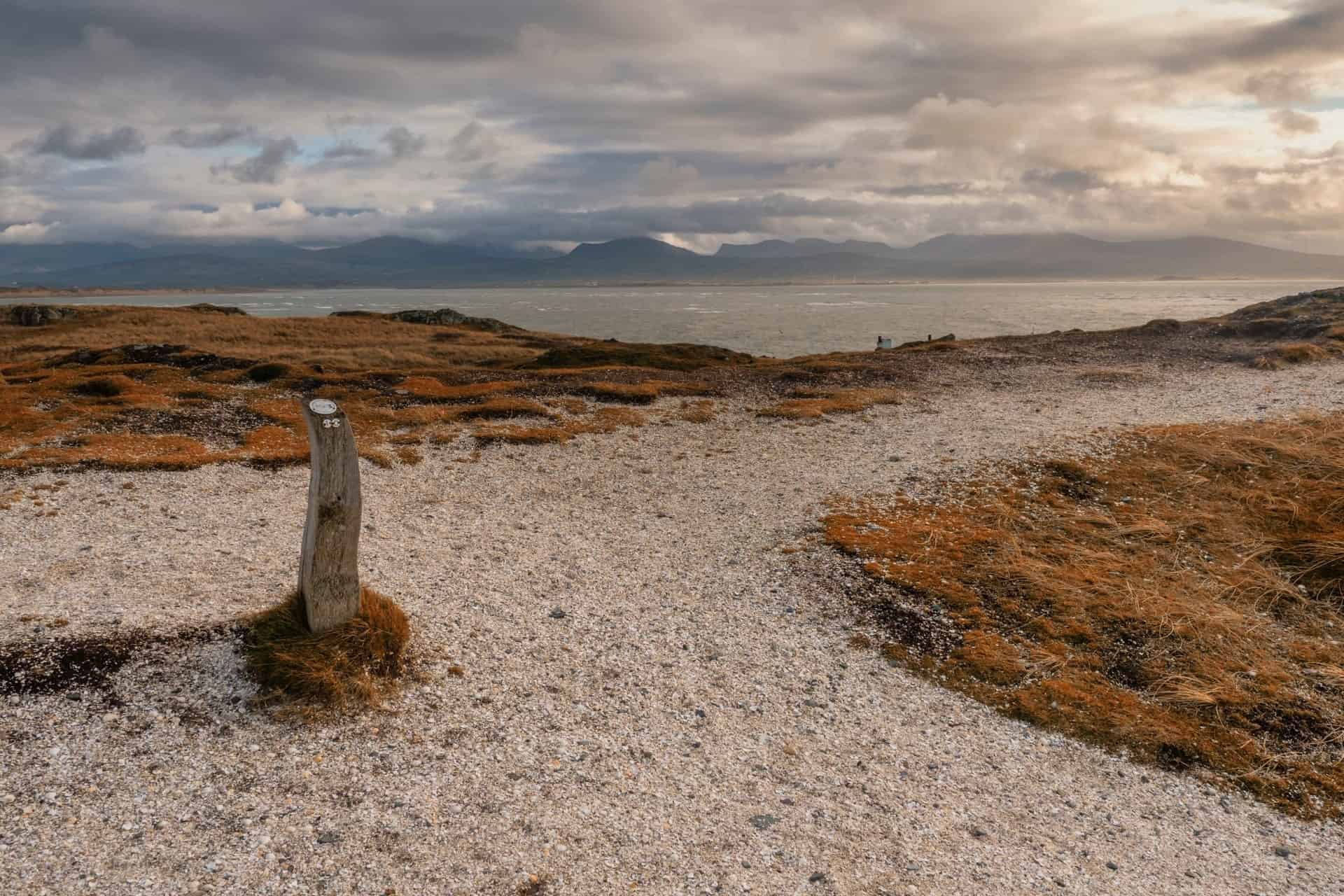
This continuous coastal circuit is set against the dramatic, looming backdrop of the Snowdonia mountain range. The terrain encompasses hidden coves, expansive dunes, and pristine beaches, providing plenty of tranquil spaces to rest. Furthermore, Anglesey remains a proud cultural heartland of the Welsh language, so expect to hear the native tongue spoken widely as you explore.
3. The Llŷn Peninsula & Snowdonia Coast
At 167 miles, this is the longest single section of the whole path. From Bangor it crosses the Menai Strait, sweeps west around the wild Llŷn Peninsula — a designated Area of Outstanding Natural Beauty — and then south down the Meirionnydd coast past Porthmadog, Harlech and Barmouth to end at Machynlleth. This is where the Wales Coast Path meets the mountains of Eryri (Snowdonia National Park), giving walkers permanent glimpses of Yr Wyddfa (Snowdon) and Cadair Idris rising inland.
The Llŷn is a stronghold of the Welsh language, with over 70% of residents speaking Welsh as a first language in some villages. Aberdaron, at the very tip, was for centuries the last stop for medieval pilgrims heading to Bardsey Island (Ynys Enlli), Europe’s first International Dark Sky Sanctuary. Wildlife highlights include wild goats grazing above the sea cliffs at Yr Eifl and the resident grey seal colony at Porth Neigwl.
4. The Ceredigion Coast
Hikers with a passion for marine biology and untouched nature will rejoice as the trail sweeps down into Ceredigion. This stretch of the coastline is officially designated as a Special Area of Conservation, renowned globally for its thriving native wildlife populations.
Cardigan Bay is famously home to the UK’s largest resident pod of bottlenose dolphins, alongside grey seals and harbour porpoises. Because this section of the route is more remote, it tends to be incredibly quiet, allowing walkers to experience the untarnished beaches and tranquil coves almost entirely to themselves.
If you crave cultural Welsh attractions after a long day on the cliffs, the region offers superb stopping points. You can catch an independent film at the intimate Theatr Mwldan in Cardigan, or head north to the vibrant university town of Aberystwyth to explore its varied selection of coastal pubs and exceptional seafood restaurants.
4. The Pembrokeshire Coast
The path now enters what many consider its crown jewel: the Pembrokeshire coastline. Stretching for 186 miles, this stage lies almost entirely within the boundaries of the Pembrokeshire Coast National Park—the only park in the United Kingdom designated solely for its spectacular coastal landscapes.

Here, the terrain becomes highly dramatic, featuring towering limestone cliffs, hidden smuggler’s coves, and world-renowned beaches. Midway through this section, hikers will discover St Davids. With a population of roughly 1,600 residents, it is the UK’s smallest city, built around a magnificent 12th-century cathedral hidden within a natural hollow to protect it from historical sea raids.
5. Carmarthenshire
The shortest of the eight sections at 68 miles, the Carmarthenshire coast is the Wales Coast Path’s most underrated stretch. It runs from Amroth in the west to Loughor Bridge in the east, weaving through tidal estuaries, ancient oak woodland, and the Dylan Thomas literary country at Laugharne. This is not a dramatic cliff section like Pembrokeshire — it is a section of estuaries, low headlands, saltmarsh, and long beach walking.
Highlights include Laugharne, where Dylan Thomas wrote “Under Milk Wood” in the boathouse overlooking the Taf estuary, the medieval castle at Kidwelly (managed by Cadw), and the Millennium Coastal Park at Llanelli — a 14-mile stretch of car-free path perfect for gentler walking or family-friendly cycling.
7. The Gower Peninsula & Swansea Bay
The penultimate chapter of the extensive coastal hike covers the Gower Peninsula. In 1956, Gower was designated as the UK’s very first Area of Outstanding Natural Beauty (AONB), and it is easy to see why. The landscape is a striking mix of unspoilt, golden surfing beaches and rugged limestone cliffs just waiting to be explored.

No hike across Gower is complete without pausing at Three Cliffs Bay, where three towering limestone crags provide a dramatic backdrop to the shifting tidal sands. As you walk eastwards toward Swansea, the terrain features fewer steep ascents than Pembrokeshire, but expect long stretches of uneven, sandy paths. Be aware that during the peak summer season, these internationally renowned beaches become highly popular with families and surfers.
8. The South Wales Coast & Severn Estuary
The final section of the path shifts from remote, wild landscapes into a fascinating mix of industrial heritage and urban regeneration. The trail sweeps through Cardiff, the vibrant Welsh capital, but that does not mean you are confined to city streets. The route incorporates expansive wetlands, peaceful nature reserves, and the rejuvenated Cardiff Bay.

As you hike towards the English border, you will pass through iconic Victorian seaside resorts like Barry, Porthcawl, and Penarth. You will also encounter remarkable feats of engineering, such as the towering Newport Transporter Bridge. Because this section runs through active port towns and coastal defense zones, we highly recommend checking the official Wales Coast Path diversion notices before setting off to avoid any temporary closures.
The epic 870-mile journey officially concludes (or begins) at Chepstow Castle, the oldest surviving post-Roman stone fortress in Britain, resting proudly on the banks of the River Wye.
⛰️ The Ultimate Challenge: The Full Wales Loop
True hiking enthusiasts looking for the ultimate expedition will want to know about the complete circuit. The Wales Coast Path (870 miles) links directly with the historic Offa’s Dyke Path National Trail (177 miles). Connecting seamlessly at both Chepstow in the south and Prestatyn in the north, these two monumental routes combine to form a continuous 1,047-mile loop that completely circumvents the entire country of Wales!
Which Direction Should You Walk?
The Wales Coast Path has no strict start or end — you can walk it in either direction. For serious through-hikers, the choice matters. Both directions have distinct advantages:
South to North (Chepstow → Chester)
- Ease-in gradient: Start with the flat, paved South Wales section to build fitness before hitting Pembrokeshire’s cliffs.
- Prevailing wind: Often at your back once you turn north up the west coast — the dominant wind in Wales is from the southwest.
- Sun behind you: Walking north means the sun is behind you for most of the day, reducing eye strain on clifftop paths.
- Best for through-hikers aiming for a 6-8 week continuous walk.
North to South (Chester → Chepstow)
- Anglesey first: Get the flatter, easier northern sections done before hitting the tougher Pembrokeshire cliffs.
- Sunny views: Coast on your right the whole way — best for photographers wanting sea views in the mid-morning light.
- Better for section walkers who plan to complete the path over several holidays, since the North Wales public transport network makes short-return day walks easier.
💡 Our Recommendation
For a first-time through-hike, walk south to north. The gradual difficulty ramp, prevailing tailwind, and the emotional payoff of ending at the wide sands of the North Wales coast (rather than in the Chepstow industrial estate) makes for a stronger overall experience. If walking in sections over several years, direction doesn’t matter — but always check tide times for the Pembrokeshire section regardless.
Tidal Crossings You Must Plan Around
Two tidal crossings on the Pembrokeshire section require careful timing — both between Dale and Milford Haven. Getting them wrong means a 4-mile road detour with no pavement, or worse, being cut off by the incoming tide.
🌊 The Two Critical Crossings
- Sandy Haven: Passable 2½ hours each side of low tide. Miss it and the detour is 4 miles on road with no pavement.
- The Gann (Pickleridge): Passable 3½ hours each side of low tide. Miss it and the detour is 2 miles.
Best strategy: Time your walk to reach the first crossing about 3 hours before low tide. You’ll then have roughly 5-6 hours to walk the ~6 miles between them and cross the second before it’s underwater. Check the Met Office tide times before setting off.
Several smaller tidal points elsewhere on the path (Newport Sands, Quoits Mill near Pembroke, Point House Lane at Angle) are only affected by the highest spring tides. For these, the standard advice is simply to wait an hour for the water to drop.
The 2026 Hiker’s Reality Check & Preparation
Standard outdoor advice tells you to bring sturdy boots and a waterproof jacket. However, tackling the Wales Coast Path requires highly specific preparation. The environment is rugged, the weather patterns shift rapidly off the Atlantic, and the landscape presents unique logistical challenges.
🌊 Check Live Coastal Tides
Tidal conditions change rapidly along the Wales Coast Path, especially around the Gower Peninsula and Carmarthenshire estuaries. Always check the official live data before your daily trek.
View Official Met Office Tides →Developer Note: Hiking further north? You can generate a free, custom tide widget for any specific Welsh beach using the WillyWeather Widget Builder. Alternatively, always consult the Official Met Office before your trek.
The Coastal Wind Factor
When checking the weather forecast, you must factor in the wind chill. A mild 12°C day in Pembrokeshire can quickly feel like freezing when exposed to a 30mph headwind coming straight off the Irish Sea. Layering is not just about staying dry; it is fundamentally about blocking the wind.
🎒 The Expert Coastal Packing List
Move beyond the generic camping checklist. To successfully navigate the Welsh coastline, ensure these specific items are in your rucksack:
- Tick Removal Tool: Walking through the dense bracken and long coastal grasses (especially in Ceredigion and Pembrokeshire) carries a high risk of picking up ticks. A proper removal tool is essential during the spring and summer months.
- Dedicated Windproof Layer: A heavy waterproof jacket will cause you to overheat on steep climbs. Pack a lightweight, highly breathable windproof shell to wear over your t-shirt on dry but blustery days.
- Low-Profile Gaiters: While usually reserved for muddy mountains, lightweight ankle gaiters are phenomenal on the coast path. They stop fine beach sand from entering your boots, which is the primary cause of severe friction blisters.
- Digital Offline Maps: Mobile signal is notoriously patchy along the remote western cliffs. Download the OS Maps app and save the specific route sectors directly to your phone for offline GPS tracking.
- The ‘Refill’ App: Carrying enough water for a 15-mile hike is heavy. Download the Refill app to locate participating Welsh cafes, pubs, and public fountains that will fill your reusable bottle with tap water for free.
8. Resting Your Legs: Accommodation Along the Route
Navigating 870 miles is as much a logistical puzzle as it is a physical challenge. Because the trail weaves through remote headlands and highly popular tourist hotspots, planning where you will sleep requires strategy. In 2026, the surging popularity of the Wales Coast Path means booking your accommodation well in advance is absolutely essential, particularly during the peak summer months.
⛺ The Reality of Wild Camping in Wales
Unlike Scotland, which operates under the Land Reform Act, wild camping is generally illegal in Wales without explicit permission from the landowner. Pitching a tent directly on the beach, in the dunes, or on the clifftops is strictly prohibited across the coastal National Parks.
However, do not despair. The route is densely packed with “wild-style” budget options. Hundreds of coastal farmers operate low-cost, pop-up campsites during the summer, allowing you to pitch your tent in a safe, legal field right on the trail for as little as £10 a night.
Choosing Your Comfort Level
Whether you are carrying a 65-litre rucksack with a lightweight tent or prefer luggage transfer services and a hot bath every evening, the Welsh coast caters to every budget. Here is how to structure your stays:
🏡 The Wales.org Coastal Base Camp Directories
Use our expertly curated regional directories to secure the best accommodation directly on the path:
- For Premium Comfort: Explore our main Glamping Hub page to find luxury yurts, heated geodomes, and safari tents featuring private hot tubs—the ultimate way to soothe aching muscles.
- For Group Treks & Families: Browse our extensive directory of Holiday Cottages in Wales. Renting a stone cottage for a week allows you to hike sections of the path linearly using local buses, returning to a solid roof each night.
- For Budget Hikers: Find the most picturesque fields and dedicated campervan pitches by checking out our Welsh Camping guides.
Top Coastal Waypoints & Stays
To give you an idea of the logistics, pricing, and exact locations, we have highlighted a cross-section of highly rated, path-adjacent accommodations covering every region and budget for the 2026 season.
Frequently Asked Questions: Walking the Wales Coast Path
How long does it take to walk the entire Wales Coast Path?
For a continuous, unbroken through-hike, it typically takes an experienced walker between 6 to 8 weeks to complete the full 870 miles. However, the vast majority of visitors choose to walk the path in smaller, manageable sections over several holidays or weekends.
Where does the Wales Coast Path start and finish?
The trail does not have a strict “start” or “finish,” as you can walk it in either direction. The official northern terminus is located at Chester (right on the English/Welsh border), and the southern terminus is at Chepstow in Monmouthshire.
Is the Wales Coast Path dog-friendly?
Yes, dogs are welcome on the vast majority of the path. However, you must keep them on a short lead when crossing farmland with livestock and when walking near steep cliff edges. Also, be aware that many popular tourist beaches enforce seasonal dog bans between May and September.
Can you cycle the Wales Coast Path?
You cannot cycle the entire route. Much of the trail is designated strictly as a public footpath, traversing narrow, uneven clifftops and kissing gates that are impassable on a bike. However, certain sections (like the North Wales coastal promenade and the Millennium Coastal Park in Llanelli) are fully paved and share routes with the National Cycle Network.
What is the hardest part of the Wales Coast Path?
The Pembrokeshire and Ceredigion sections are generally considered the most physically demanding. While the path rarely goes higher than a few hundred feet, the constant, steep ascents and descents into coastal ravines mean you will accumulate massive elevation gains very quickly.
Is the path well signposted?
Yes, the path is exceptionally well marked. You simply need to follow the distinctive blue and yellow “Dragon Shell” logo, which is painted or engraved onto wooden fingerposts, kissing gates, and stone markers along the entire 870-mile route.
Can you wild camp on the Wales Coast Path?
Wild camping is generally illegal in Wales without the explicit prior permission of the landowner. Pitching tents on beaches or clifftops within the National Parks is strictly prohibited. Fortunately, there is a dense network of affordable farm campsites located directly adjacent to the trail.
Which direction should you walk the Wales Coast Path?
For a first through-hike, most experienced walkers recommend south to north (Chepstow to Chester). Starting on the flat South Wales section lets you build fitness before tackling the tougher Pembrokeshire and Ceredigion cliff sections. The prevailing southwest wind is more often at your back once you turn north up the west coast. If you are walking in sections over several years rather than a continuous through-hike, direction does not matter — pick whichever section suits your fitness and season best.
When is the best time of year to walk the Wales Coast Path?
May, June and September are the optimum months. Weather is generally driest and mildest, daylight hours are longest, and the visitor crowds of high summer are avoided. April and October are excellent shoulder-season options with fewer walkers but more changeable weather. The path is walkable year-round, but winter walking on remote Pembrokeshire or Llŷn clifftop sections is only recommended for experienced hikers prepared for rapid Atlantic weather changes and shorter daylight (dark by 4pm in December).

Pembrokeshire-born travel writer and founder of Wales.org. Born in Haverfordwest, now based in Hertfordshire — covering Welsh castles, national parks, festivals and family staycations across all 22 Welsh counties.