

Quirky Stays in Wales: Treehouses, Chapels & Cabins
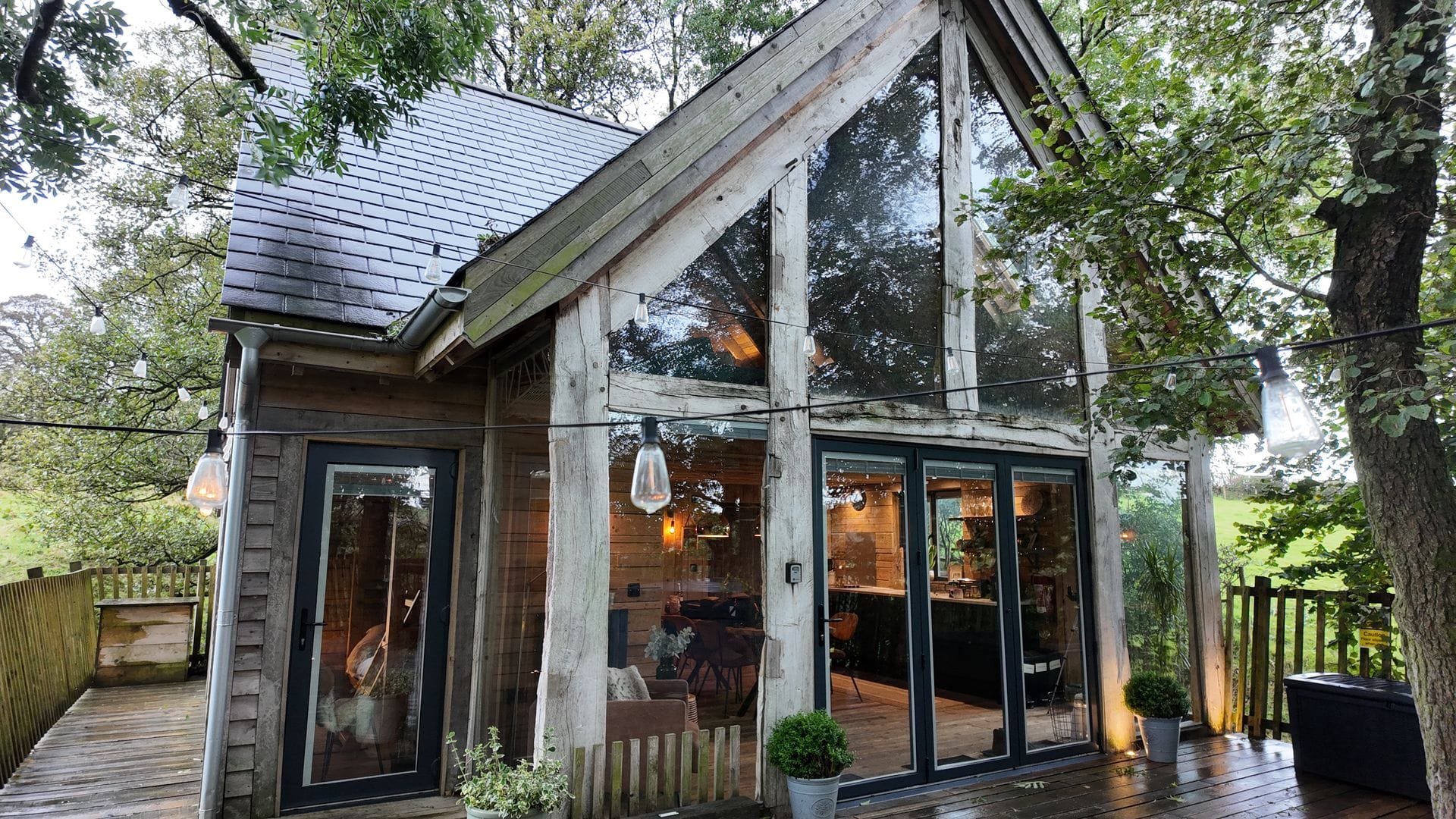
The striking exterior of Squirrel’s Nest Treehouse Retreat, offering an elevated woodland stay. © Crown copyright Cymru Wales 2026
Wales has quietly become one of the strongest destinations in Britain for standout unusual accommodation. Converted 19th-century chapels, high-canopy treehouses, lighthouse lodges, restored railway carriages, wood-fired hot tub cabins, hobbit-style earth shelters and a growing collection of one-off design-led builds have all appeared across the countryside over the last decade. Most are family-run, most sit in landscapes that would already justify the trip, and most cost less per night than a chain hotel in Cardiff. This guide is a curated look at the property categories that make Welsh accommodation different — the stays a visitor books because the property itself is the reason for the trip, not just a place to sleep between activities.
This is the curated commercial roundup. For the full glamping category — pods, yurts, safari tents, geodesic domes — see our comprehensive Welsh glamping guide. For adult-only options that overlap with several of these categories, see our adult-only hotels and cottages in Wales guide. For hot-tub-focused stays, see our guide to hot tub cottages in Wales.
Planning this trip? Ask Branwen, our free AI trip planner →
At a Glance: Quirky Stays in Wales
- Strongest categories: converted chapels, treehouses, lighthouse lodges, railway carriages, hobbit and earth-shelter houses
- Best regions: Mid Wales (chapels, treehouses), South East Wales (lighthouse), Ceredigion (chapels, hobbit dwellings)
- Typical prices: £120–£320 per night for two adults
- Minimum stays: two or three nights standard; one-night bookings usually only midweek in shoulder season
- Best-value months: May, June, September, October, and mid-January to mid-February
- Book ahead: at least three months for July/August weekends and school holidays
- Watch for: minimum-age policies, off-grid access limits, minimum-night rules, no-vehicle access
- Key tip: most quirky stays are one-off properties booked directly through the owner or a small letting agency — Airbnb and Booking.com listings are limited
Treehouses in the Welsh Canopy
A genuine treehouse — one built up in the tree canopy on branches rather than on stilts pretending to be aloft — is one of the rarest accommodation categories in Britain. Wales has a small cluster of them, with the best-known operation in Mid Wales near Machynlleth.
Living Room Treehouses, near Machynlleth
Living Room Treehouses sits on a 250-acre working sheep farm in a hidden woodland valley on the edge of Eryri (Snowdonia) National Park, 8 miles from the market town of Machynlleth. Six individually-named treehouses (Hengoed, Gwdy Hw, Lofty, Ty Mawr, Bryn Meurig Bach, Pen y Bryn) are built up to 30 feet high in the tree canopy among sustainably-harvested oak, larch and Scots pine — genuine tree-borne structures rather than stilted cabins. Each is open-plan with a double bed and a bunk arrangement suitable for a family of four, plus a day-bed for a third child. Log burners, gas hobs, cool-box style fridges on the balcony, and off-grid systems throughout. Machynlleth station is a 15-minute drive; owners can sometimes offer station pickup subject to availability. Bookings taken through the property’s own website or specialist agents including Canopy & Stars and Kip Hideaways.
Learn more: living-room.co
What to look for in a genuine treehouse booking: the words “built into the trees” or “canopy level” rather than “raised” or “elevated” — the latter usually indicates stilt-built cabins marketed as treehouses. A genuine treehouse will be at least 15 feet off the ground with visible tree support and a rope-bridge or elevated walkway approach.
Converted Chapels: Wales’s Nonconformist Heritage as Holiday Cottage
Wales has a distinctive stock of former Nonconformist chapels — Methodist, Baptist, Presbyterian and Congregational — that have been converted into holiday cottages over the last thirty years. Nonconformist Christianity was central to Welsh cultural identity through the 19th and early 20th centuries, and the country was left with more chapels per head of population than almost anywhere in Europe. Congregational decline through the late 20th century emptied hundreds of these buildings; conversion into holiday accommodation has saved some of the best of them.
A converted chapel typically retains:
- Original arched Gothic-Revival or Round-Head windows — often the single most striking design feature
- Pitched slate roof with exposed roof timbers as interior beams
- Original stone walls, often two feet thick, giving excellent thermal mass
- Occasional original features — pews used as bench seating, pulpit as breakfast bar, brass wall plaques from the congregation
- Mezzanine floor where the original balcony seating for the congregation has been floored over to create a bedroom level
Converted chapels are concentrated in Mid Wales, Ceredigion, Carmarthenshire, Powys and the South Wales Valleys. The best cottage-letting search terms are:
- “Capel” — Welsh for chapel; appears in the property name of many chapel conversions
- “Chapel Cottage”, “The Old Chapel”, “Chapel House”
- “Bethel”, “Ebenezer”, “Salem”, “Bethesda” — traditional Welsh chapel names retained as property names
Sleeping capacity ranges from a small conversion of the original vestry (couples-only) to full 6-8 person cottages using both the main sanctuary and the mezzanine. Expect £120-£240 per night for two adults in a small chapel, £600-£1,200 per week for a full family-sized chapel cottage.
Cross-reference: Capel: The Chapels Heritage Society (Cymdeithas Treftadaeth y Capeli), founded in 1986, records that Welsh chapels are currently closing at a rate of approximately one per week — driving conversion to residential and holiday-cottage use. A separate charity, Addoldai Cymru (the Welsh Religious Buildings Trust), takes ownership of some of the most significant redundant chapels for preservation rather than conversion. See our holiday cottages in Wales guide for the wider cottage category.
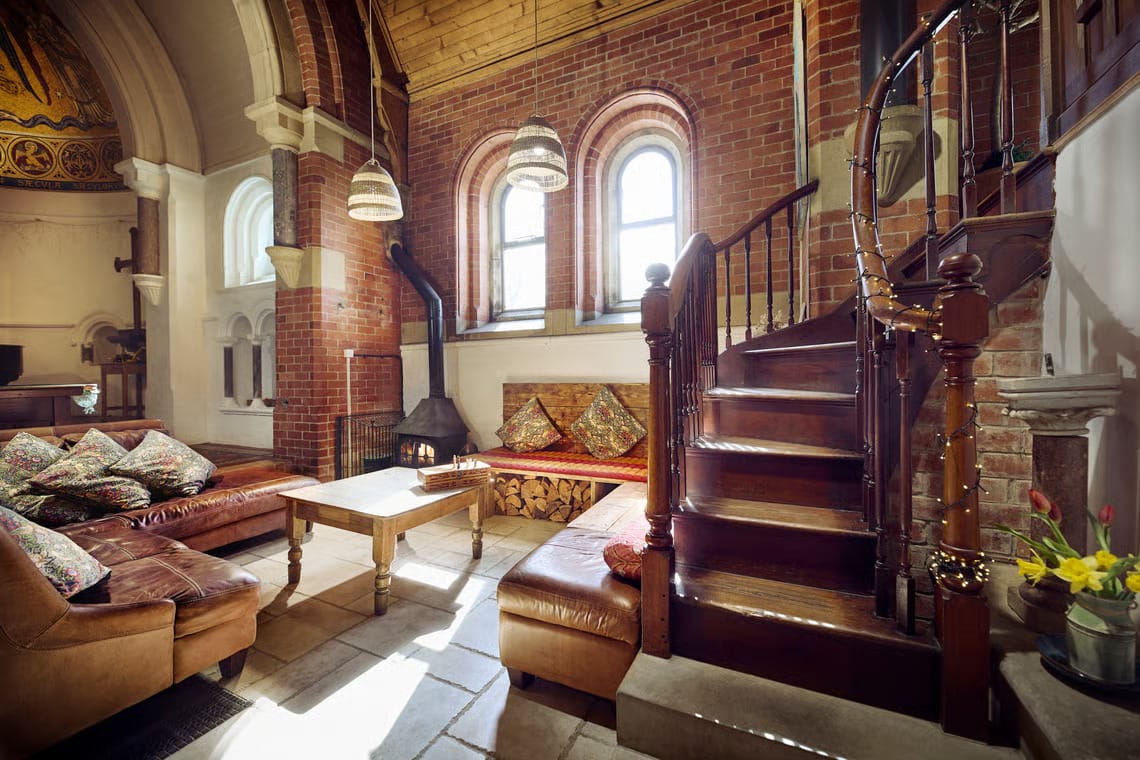
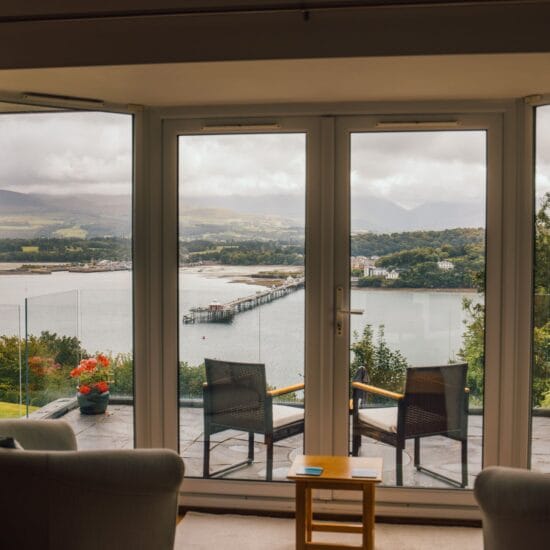
A beautifully restored Welsh chapel interior, blending original architectural features like arched windows and exposed brick with comfortable living spaces.
Lighthouse Stays on the Welsh Coast
Wales has 20-plus historic lighthouses on its 870-mile coastline but only a small number of them offer accommodation to visitors, and the picture has shifted since the pandemic. Some former lighthouse B&Bs have converted to owner-occupied residences or self-catering-only formats.
The Light-keeper’s Lodge, West Usk Lighthouse, Newport
The West Usk Lighthouse was built in 1821 by James Walker on the mudflats where the River Usk meets the Bristol Channel — a squat, unusually wide lighthouse with a large circumference rather than the tall thin profile of most Trinity House lights. The lighthouse itself is now the owners’ private residence and is no longer available as a B&B (having operated in that format for many years before the pandemic). The self-catering Light-keeper’s Lodge sits at the rear of the lighthouse and provides a single-room stay with a super-king four-poster bed, kitchenette, en-suite shower room, private terrace, hot tub and fire pit, all with sea views across the Severn Estuary. The Wales Coast Path runs along the sea wall directly outside. Cardiff is a 30-minute drive; Tredegar House (National Trust) is 5 minutes away. Featured on BBC’s My Unique B&B.
Learn more: westusklighthouse.co.uk
Other Welsh lighthouse-related accommodation exists but is limited. The best-known active option is Ariel and Stella at Nash Point Lighthouse on the Vale of Glamorgan Heritage Coast — two former keeper’s cottages at a Trinity House-operated Grade II listed lighthouse (built 1832 by James Walker, automated 1998). Both cottages sleep up to five guests and are booked through Rural Retreats, the specialist agency Trinity House partners with for all UK lighthouse holiday cottages. Point Lynas Lighthouse on Anglesey also has former keeper’s cottages let as holiday accommodation, though these are managed privately rather than through the Trinity House scheme.
Railway Carriages and Converted Vehicles
The Welsh countryside is scattered with restored railway carriages, converted horseboxes, and one-off vehicle conversions repurposed as holiday accommodation. These are the strongest single category for visitors travelling with children — the novelty factor is universal, and the physical space is usually generous compared to a shepherd’s hut or pod.
Common vehicle-based accommodation you’ll find in Welsh listings:
- Restored Victorian and Edwardian railway carriages — often clustered on former station sites and heritage-railway-adjacent land, particularly in Powys, Ceredigion and along the Cambrian Coast. Expect original hardwood panelling, brass fittings and etched glass, with modern beds, showers and kitchenettes discreetly integrated.
- Converted horseboxes — surprisingly spacious once converted, with a double bed at the front (over the cab), a small kitchen area, and a shower room at the rear. Typically £100-£160 per night. Concentrated in Mid Wales farm-based glamping sites.
- Vintage buses and coaches — full double-decker conversions offer sleeping upstairs and living downstairs; single-decker conversions typically sleep 4-6. Occasional in Wales but genuine ones exist particularly in Pembrokeshire and Carmarthenshire.
- Converted fire engines and specialist vehicles — rare, but a handful of one-off conversions exist. These are marketed as much for the photography as for the practicality.
Booking these directly is often the only option: most vehicle-based stays are single-property operations rather than parts of larger sites, so they rarely appear on Booking.com or Expedia. Search Canopy & Stars, Kip Hideaways, Sawday’s Special Places to Stay, and the Cool Places directory. Airbnb also lists some of the smaller conversions.
Cabins, Hot Tub Retreats and Off-Grid Cottages
The most rapidly-growing quirky accommodation category in Wales is one-off design-led cabin builds — architect-designed cabins, off-grid retreats, dark sky cabins with rooflight bedrooms, and secluded hot tub cabins that operate as micro-hotels of one or two units. These blur the line between glamping and cottage without fitting neatly into either category.
Common feature sets to search for:
- Rooflight or skylight bedrooms designed for stargazing from bed. Strongest in the Bannau Brycheiniog International Dark Sky Reserve and the Elan Valley Dark Sky Park.
- Wood-fired hot tubs heated by a wood-burning stove rather than electric heater. Slower to heat but strong sensory experience and off-grid compatibility.
- Freestanding stone or copper bath, often positioned to look through a window at the landscape
- Sauna cabins — private wood-fired saunas as a separate structure, growing in popularity following the Nordic cabin trend
- No-Wi-Fi digital-detox positioning — a small but growing category of properties that explicitly do not offer internet or mobile signal
- Sole-occupancy off-grid where you have the whole site to yourself, with a shared property host reachable by phone but no other guests on site
Typical prices: £180-£280 per night for a well-equipped 2-person design cabin; £280-£420 per night for a premium off-grid property with hot tub and hot food delivery.
Hobbit Houses and Earth-Shelter Dwellings
A small but distinctive Welsh accommodation category is the earth-shelter or “hobbit house” — a low, curved structure with grass-covered roof and organic curved walls, typically part-buried into a hillside so the front elevation looks conventional and the rear disappears into the earth. Wales has more of these than any other UK country, largely thanks to the Low Impact Development planning permissions available in Pembrokeshire and Ceredigion, which have supported experimental earth-shelter construction since the early 2000s.
Expect:
- Curved timber-framed structure with straw-bale, cordwood or earth-bag walls
- Turf or wildflower-planted roof
- Small round windows and organic-shape doors
- Solar-powered off-grid electricity, composting toilets, rainwater harvesting for washing
- Interior warmth from a small wood-burning stove — earth-shelters are unusually well-insulated by design
- Typically £120-£200 per night for two
These are one-off owner-run properties. Search Canopy & Stars, Sawday’s, and the Cool Places directory. Best concentrations in Pembrokeshire (Newport area), Ceredigion and Carmarthenshire.
Find Quirky Accommodation in Wales
Browse the interactive map below to see real-time prices for cottages, cabins and unique stays across every Welsh region. Filter for cottages, glamping and unique stays to surface treehouses, shepherd’s huts and cabin-style properties. For chapel conversions and one-off design cabins, the specialist directories mentioned above (Canopy & Stars, Kip Hideaways, Sawday’s, Cool Places) return the most complete inventory.
What Quirky Stays Cost in Wales
| Property type | Typical rate (2 adults) | Peak (Aug/Christmas) |
|---|---|---|
| Converted horsebox / small vehicle | £100–£160 | £160–£220 |
| Small converted chapel | £120–£220 | £220–£320 |
| Hobbit / earth-shelter house | £120–£200 | £200–£280 |
| Design cabin with hot tub | £180–£280 | £280–£420 |
| Lighthouse lodge | £180–£280 | £280–£380 |
| Restored railway carriage | £140–£220 | £220–£320 |
| High-canopy treehouse | £180–£320 | £320–£450 |
| Off-grid premium cabin | £280–£420 | £420–£620 |
| Full-family chapel cottage (per week) | £600–£1,200 | £1,200–£2,400 |
Practical Things to Check Before Booking
Because quirky stays are usually one-off properties owned by individuals rather than corporate operators, they come with practical caveats that mainstream hotels and cottages don’t have. Five things to check every time:
- Vehicle access. Many treehouses and off-grid cabins are reached by a track that is not driveable — you’ll park at a designated area and carry luggage in. This is fine if you know about it in advance; a shock if you don’t. Ask specifically about the last stretch of the approach.
- Minimum age policy. Some properties operate strict adult-only, some 12+ or 16+, some family-friendly. Some off-grid cabins are unsuitable for young children on safety grounds (exposed decking, unfenced hot tubs, no stairgates). Confirm with the property.
- Utilities and off-grid systems. “Off-grid” can mean many things — solar-only power, composting toilet, no fridge, no Wi-Fi, no mobile signal, or all of the above. Check what’s included and whether it will affect a stay with children, medication needs or work requirements.
- Minimum-night rules. Two-night minimums are standard; three-night minimums for weekend Friday check-ins are common; some properties require full weeks in peak season.
- Cancellation terms. Small operators typically operate stricter cancellation windows than hotel chains — often 30% deposit at booking with the balance due 8-12 weeks before arrival, and no refunds within 12 weeks of stay. Check for optional travel insurance.
Safety note for off-grid and elevated properties: treehouses and elevated cabins have accessible-but-narrow stairs, edges and drops. Wood-fired hot tubs run hot and take hours to cool. Wood-burning stoves need proper handling. These properties are not designed to be child-safe by default — always check with the owner if travelling with young children or anyone with mobility issues.
Where to Find Genuine Quirky Welsh Stays
Most quirky Welsh accommodation is booked through one of a small number of specialist directories rather than the mainstream OTAs. The best sources by category:
- Canopy & Stars — the strongest curated directory for treehouses, shepherd’s huts, cabins, off-grid and design-led glamping across Wales. Living Room Treehouses lists through them.
- Kip Hideaways — small, hand-picked selection of some of the most photographed quirky properties in Britain, with strong Welsh coverage.
- Sawday’s Special Places to Stay — traditional-guide-style directory with strong coverage of chapel conversions, historic cottages and B&Bs with character.
- Cool Places — mixed directory including quirky B&Bs, lighthouse lodges and one-off properties.
- Under the Thatch — Wales-specific cottage agency with distinctive properties including watermills, converted schools and traditional cottages.
- Best of Wales — regional letting agency with a growing quirky section.
For chapel conversions specifically, the best keyword searches to try are “capel”, “chapel cottage”, “old chapel” and traditional Welsh chapel names (Bethel, Ebenezer, Salem, Bethesda) across the standard cottage-letting sites including Sykes, HolidayCottages.co.uk, Vrbo and Airbnb.
Frequently Asked Questions: Quirky Stays in Wales
What is the most unusual place to stay in Wales?
Wales has one of the strongest ranges of unusual accommodation in the UK. The most distinctive property types are converted chapels (former Nonconformist chapels renovated into holiday cottages, most common in Mid Wales and Ceredigion), lighthouse lodges (West Usk Lighthouse near Newport being the best-known), high-canopy treehouses (Living Room Treehouses near Machynlleth), Victorian railway carriages, converted horseboxes and shepherd’s huts, and small hobbit-style earth-shelter dwellings in Mid Wales. Prices for these unusual stays typically range from £120 to £320 per night for two.
Can you stay in a treehouse in Wales?
Yes — Wales has some of the best treehouse accommodation in Britain. Living Room Treehouses near Machynlleth is the most established and highest-profile operation, offering six off-grid, high-canopy treehouses in a private valley on Bryn Meurig farm. Other treehouse options exist across Powys, Ceredigion and North Wales, though most are one-off properties rather than clustered sites. Prices typically range from £180 to £320 per night for two adults, with most treehouses accepting up to two children as well.
Are there any converted chapels to stay in Wales?
Yes. Wales has a distinctive stock of former Nonconformist chapels — Methodist, Baptist and Congregational — that have been renovated into holiday cottages, particularly across Mid Wales, Ceredigion, Carmarthenshire and Powys. Converted chapels typically retain original arched windows, pitched slate roofs, stone walls and sometimes the original pulpit or pews as design features. Sleeping capacity varies from cosy couples’ retreats (converted vestry rooms) to full 6-8 person cottages. Search cottage-letting agencies for “chapel” or “capel” in the property name to find them.
Can you stay in a Welsh lighthouse?
Yes, though the options are limited. The West Usk Lighthouse near Newport offers the Light-keeper’s Lodge, a self-catering cabin at the rear of the historic Grade II listed lighthouse with sea views, a private hot tub and firepit. The lighthouse itself is now the owners’ private residence and no longer operates as a B&B. Other options include Ariel and Stella at Nash Point Lighthouse on the Vale of Glamorgan Heritage Coast, two Trinity House keeper’s cottages booked through Rural Retreats. Availability is limited and prices are typically £180 to £280 per night.
How much do quirky stays cost in Wales?
Unusual accommodation in Wales typically costs £120 to £320 per night for two adults in shoulder season, rising to £180 to £450 in July and August. The specific price bands: converted chapels £120-£240 per night; treehouses £180-£320; lighthouse lodges £180-£280; converted horseboxes and railway carriages £100-£180; hobbit and earth-shelter houses £120-£200. Minimum stays of two or three nights are standard, and one-night bookings are usually only available midweek in shoulder season.
When is the best time to book a quirky stay in Wales?
Book at least three months ahead for July and August weekends and for Christmas, New Year and Easter breaks. May, June and September deliver the best price-to-weather ratio with cottages typically 30 to 40% cheaper than peak summer. Mid-January to mid-February (outside Valentine’s Day) is the cheapest window of the year and works well for weatherproof properties like converted chapels, insulated pods and cabins with hot tubs and wood burners. Avoid Six Nations rugby weekends across South Wales unless attending, as accommodation rates rise sharply.
Are quirky Welsh stays suitable for families?
Many are, but check individual property details. Larger converted chapels, safari tents and family treehouses typically accept children. Some quirky properties designed for couples (small shepherd’s huts, single-room lighthouse lodges, romantic escape pods) do not accept children under a stated minimum age, and other properties simply do not have the space or safety features (no stairgates, exposed decking, unfenced hot tubs) for younger guests. Living Room Treehouses in Machynlleth explicitly welcomes families of up to two adults plus three children per treehouse.
Related Welsh Accommodation Guides

Pembrokeshire-born travel writer and founder of Wales.org. Born in Haverfordwest, now based in Hertfordshire — covering Welsh castles, national parks, festivals and family staycations across all 22 Welsh counties.