


WALES.ORG RESEARCH · Part of the Wales.org Research Series
Second Homes in Wales: The 2026 Local Authority Breakdown
Wales’s councils have had the power to charge up to a 300% council tax premium on second homes since April 2023, and 20 of the 22 local authorities now charge some level of premium. Three years on, we analysed the full StatsWales record to see whether the geography of second-home ownership has actually shifted. Largely, it hasn’t. The same seven rural and coastal counties held two-thirds of Wales’s second homes in 2019, and hold two-thirds today.
Underneath that stability, though, two genuinely new patterns stand out. Powys has added more second homes than any other county since 2019, more than the traditional stronghold counties. And Cardiff, not a place usually associated with holiday cottages, has quietly become the third-largest concentration of second homes in Wales.
Key findings
- Gwynedd remains the largest concentration of second homes in Wales, with 5,004 in 2026/27, 19% of the national total.
- Powys has grown the most of any county since 2019, up 451 second homes (+36%), more than any of the traditional stronghold counties added.
- Cardiff has risen to third place nationally by raw count, 3,332 second homes, up 359 since 2019, ahead of Anglesey, Powys and Ceredigion.
- Swansea and Ceredigion saw the largest declines, down 302 and 200 respectively.
- The traditional seven rural and coastal counties (Gwynedd, Pembrokeshire, Anglesey, Ceredigion, Conwy, Powys, Carmarthenshire) held 67.8% of Wales’s second homes in 2019/20 and 66.7% in 2026/27, essentially unchanged.
- Blaenau Gwent recorded zero chargeable second homes in every year from 2019/20 to 2026/27, the only local authority in Wales to do so.
Where Second Homes Are Concentrated
Gwynedd and Pembrokeshire remain, by a wide margin, the two counties with the most second homes in Wales, together accounting for more than a third of the national total. The Isle of Anglesey, Swansea, Powys, Ceredigion and Conwy round out the next tier. At the other end, four local authorities, Blaenau Gwent, Torfaen, Wrexham and Bridgend, each individually have fewer than 100 chargeable second homes.

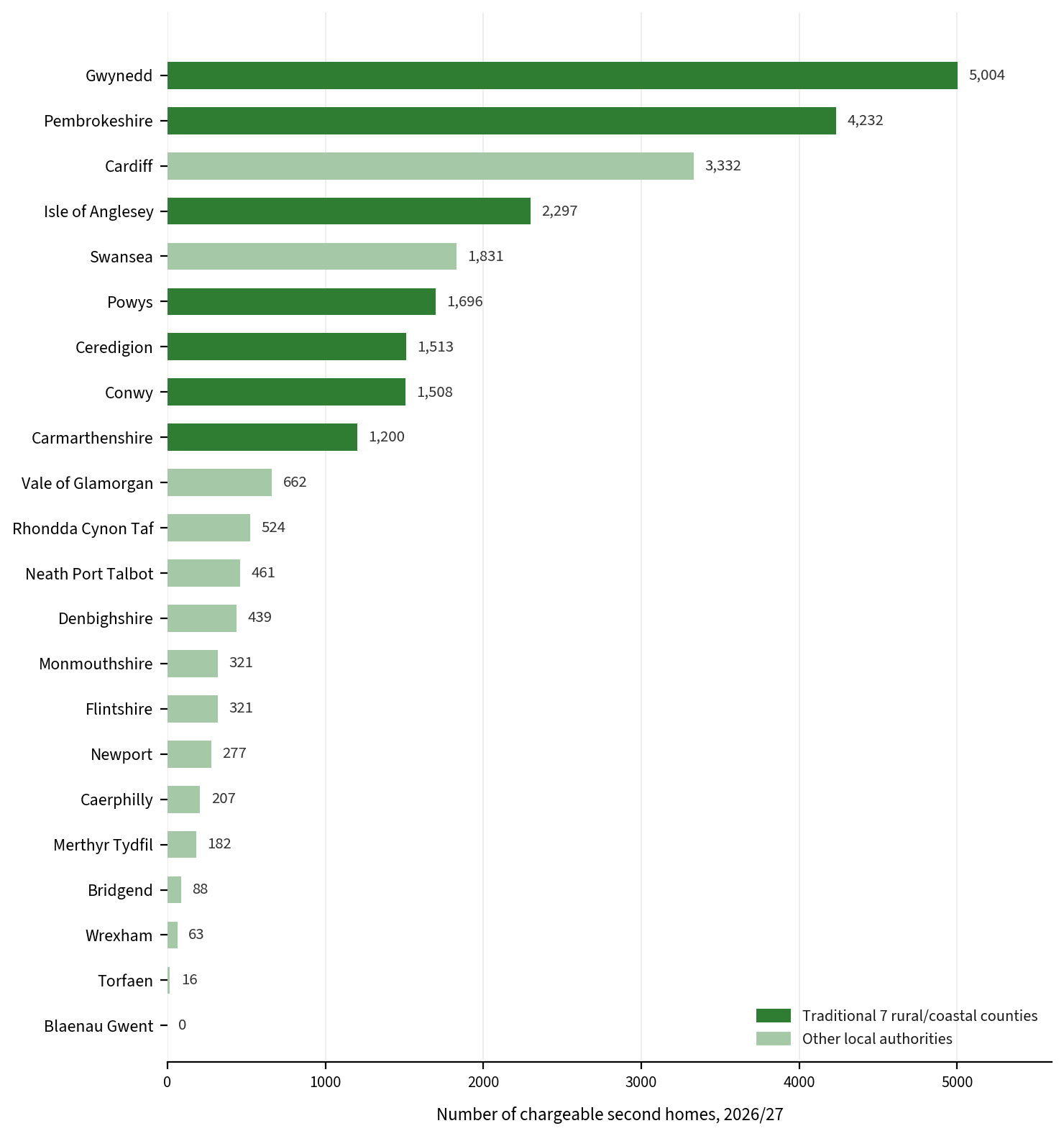
Figure 1. Number of chargeable second homes by local authority, 2026/27. Dark green marks the seven traditional rural and coastal counties with the highest historical concentration.
The Traditional Seven, Largely Unmoved
Gwynedd, Pembrokeshire, the Isle of Anglesey, Ceredigion, Conwy, Powys and Carmarthenshire, the seven counties most associated with second-home ownership in Wales, held 67.8% of the national total in 2019/20. In 2026/27, after several years of an escalating council tax premium specifically designed to influence this market, that figure stands at 66.7%. The overall geography of second-home ownership in Wales has been remarkably stable, even as the total number of second homes nationally has grown from 24,197 to 26,174 over the same period.
This report doesn’t attempt to explain why concentration has held steady, that would need data this dataset doesn’t contain, such as how many properties have moved to business-rates self-catering registration instead of council tax. It simply reports what the geography looks like now compared with 2019.
The Fastest Movers
Powys added 451 second homes since 2019/20, a 36% rise, the largest increase of any county in Wales in absolute terms. The Isle of Anglesey (+341) and Rhondda Cynon Taf (+304, more than doubling from a much smaller base) follow. Several counties with historically negligible second-home numbers, Newport, Wrexham and Bridgend among them, have also moved from close to zero to a small but real presence, though the small starting base makes percentage changes for these areas unreliable as a headline figure.
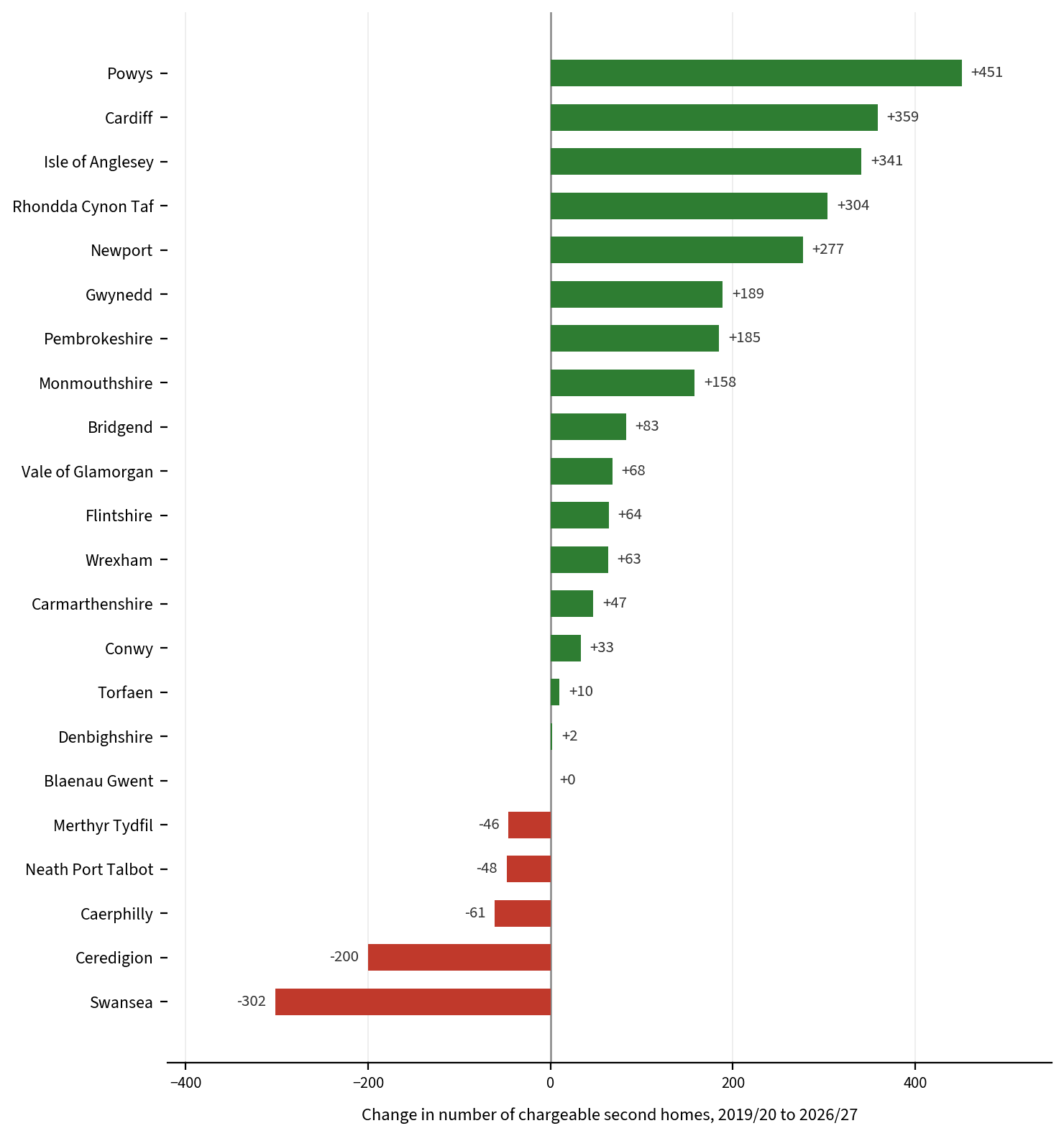
Figure 2. Change in the number of chargeable second homes by local authority, 2019/20 to 2026/27.
The Cardiff Story
Cardiff’s rise is the least expected finding in this data. With 3,332 chargeable second homes in 2026/27, up 359 since 2019, Cardiff now sits ahead of long-established second-home counties like Anglesey, Powys and Ceredigion, a city, not a coastal or rural holiday destination.
It’s worth being precise about what this figure does and doesn’t represent. The Welsh Government’s own guidance on this data notes that “second home” is a council tax classification, a furnished property that isn’t anyone’s main residence, not a measure of holiday lettings specifically. A city-centre second home in Cardiff is more likely to be a professional’s weekday flat, a family’s investment property, or student-adjacent accommodation than a holiday cottage in the way a second home in Gwynedd or Pembrokeshire typically is. The data can’t distinguish between these different uses, which is a limitation worth keeping in mind rather than assuming Cardiff has quietly become a tourist hotspot to rival the coast.
Where It’s Falling
Swansea (-302) and Ceredigion (-200) recorded the largest declines of any county since 2019/20. Both remain among the counties with a substantial number of second homes overall, this is a reduction in an already large base, not a disappearance of the phenomenon locally.

Regional Breakdown
Grouping the 22 local authorities into the same four regions used across Wales.org, North Wales has held a stable 37% share of the national total throughout the period. West Wales’s share has slipped from 32.4% to 29.5%, driven mainly by Swansea’s decline, since Pembrokeshire and Carmarthenshire both grew modestly over the same period. South Wales has grown from 18.4% to 21.4% of the national total, largely on the strength of Cardiff and Rhondda Cynon Taf. Mid Wales has stayed essentially flat.
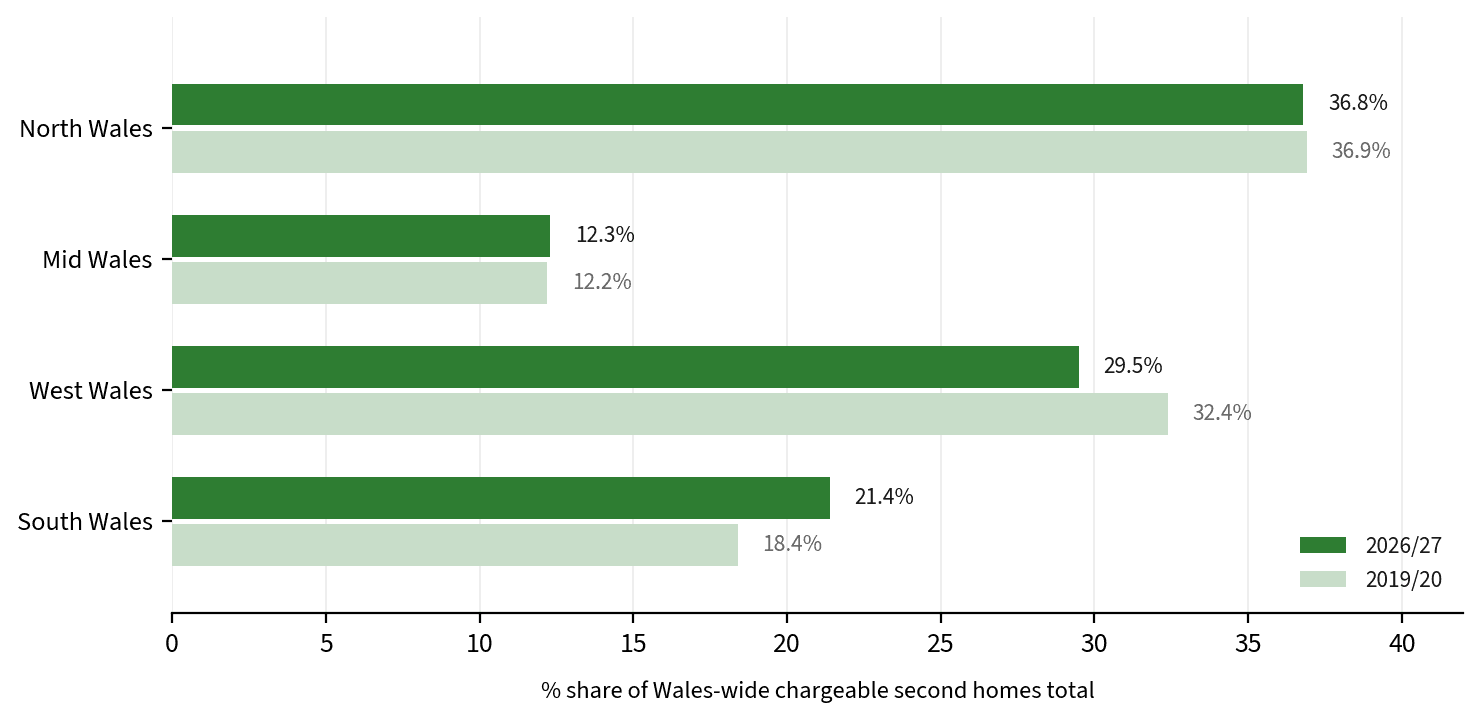
Figure 3. Regional share of Wales-wide chargeable second homes, 2019/20 vs 2026/27. Regional groupings match Wales.org’s own North / Mid / West / South Wales destination categories.
Full Data by Local Authority
| Local authority | 2019/20 | 2026/27 | Change |
|---|---|---|---|
| Blaenau Gwent | 0 | 0 | 0 |
| Bridgend | 5 | 88 | +83 |
| Caerphilly | 268 | 207 | −61 |
| Cardiff | 2,973 | 3,332 | +359 |
| Carmarthenshire | 1,153 | 1,200 | +47 |
| Ceredigion | 1,713 | 1,513 | −200 |
| Conwy | 1,475 | 1,508 | +33 |
| Denbighshire | 437 | 439 | +2 |
| Flintshire | 257 | 321 | +64 |
| Gwynedd | 4,815 | 5,004 | +189 |
| Isle of Anglesey | 1,956 | 2,297 | +341 |
| Merthyr Tydfil | 228 | 182 | −46 |
| Monmouthshire | 163 | 321 | +158 |
| Neath Port Talbot | 509 | 461 | −48 |
| Newport | 0 | 277 | +277 |
| Pembrokeshire | 4,047 | 4,232 | +185 |
| Powys | 1,245 | 1,696 | +451 |
| Rhondda Cynon Taf | 220 | 524 | +304 |
| Swansea | 2,133 | 1,831 | −302 |
| Torfaen | 6 | 16 | +10 |
| Vale of Glamorgan | 594 | 662 | +68 |
| Wrexham | 0 | 63 | +63 |
| Wales | 24,197 | 26,174 | +1,977 |
Methodology
Data sourced directly from the Welsh Government via StatsWales: “Council tax dwellings by authority and band” (Dataset ID: 062488e2-3fd6-4755-9b0b-a64547fc570f), collected through the annual Council Tax Dwellings (CT1) return. Analysis uses Row H8 (“Total chargeable second homes”), Band “Total” (all council tax bands combined), for the 2019/20 to 2026/27 financial years.
A “second home” in this dataset is a council tax classification: a furnished dwelling that is nobody’s sole or main residence, and which has not been registered instead as a self-catering business subject to non-domestic rates. It does not distinguish between holiday cottages, investment properties, or homes kept for other personal reasons, and it will not capture properties that have moved to business-rates registration, which the Welsh Government’s own research notes some owners do in response to the council tax premium.
Three local authorities, Cardiff, Carmarthenshire and Monmouthshire, show values for 2024/25 that sit noticeably outside the surrounding trend for that year only (including a non-whole-number figure for Carmarthenshire), most likely reflecting a data collection or reporting issue in that year’s return rather than a genuine one-year shift. Where this report discusses change over time, it compares 2019/20 directly with 2026/27 rather than relying on the 2024/25 figure. Newport and Wrexham show a rise from zero in earlier years to a small non-zero figure in the most recent two years; this may reflect genuinely new second-home registrations or a change in local recording practice, and this analysis cannot distinguish between the two.
Since April 2023, Welsh local authorities have had discretionary power to charge a council tax premium of up to 300% on second homes, and the Welsh Government’s own December 2026 release states that 20 of the 22 local authorities currently charge some level of premium on second homes. This report does not assess the premium’s effectiveness or intent; it reports the underlying second-homes data only.
Data reused under the Open Government Licence v3.0. Raw data available via StatsWales.
Part of the Wales.org Research Series. See all our data reports on the Wales Research Hub.

Pembrokeshire-born travel writer and founder of Wales.org. Born in Haverfordwest, now based in Hertfordshire — covering Welsh castles, national parks, festivals and family staycations across all 22 Welsh counties.