


WALES.ORG RESEARCH · Part of the Wales.org Research Series
Wales Has Lost 3,500 Holiday Lets From the Business Rates List. Here’s Where.
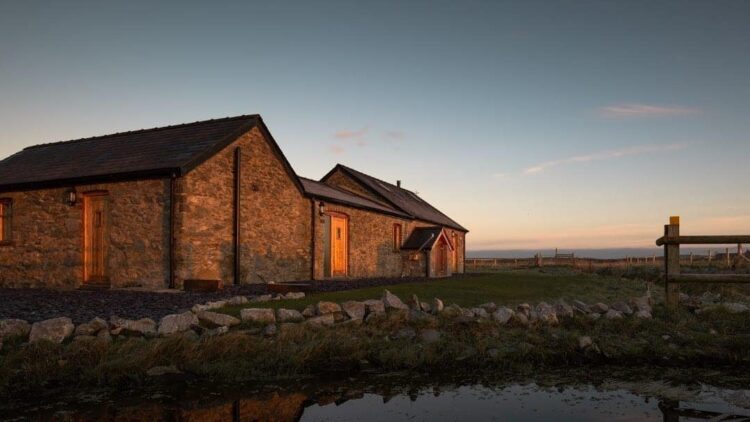
Since 1 April 2023, a self-catering property in Wales has paid business rates, rather than council tax, only if it is available to let for at least 252 days a year and actually let for at least 182 of them. The rule was brought in because of concerns about growing numbers of self-catering properties and the ease with which owners of second homes could escape council tax.
According to Valuation Office figures, the number of self-catering holiday lets on the business rates list in Wales has fallen from 11,310 at 31 March 2023 to 7,810 at 31 March 2026. That is 3,500 fewer, a fall of 31%. This report breaks the fall down by council, and sets it beside the second homes charged council tax, to see whether the missing holiday lets show up there.
The timing matters. The Welsh Government’s consultation on the rule closes on 23 October 2026. It asks about a possible reduction in the 182-day threshold and proposes five new exemptions, with any change intended to take effect from 1 April 2027. This report takes no position on the rule. It sets out what the official figures show, and where they are limited.
Key findings
- Business-rated holiday lets are down by almost a third. The count fell from 11,310 to 7,810 in three years (−31%), so today’s figure is 69% of the 2023 level. The Welsh Government describes the current number as around 8,000, about 70% of the 2023 peak.
- Two councils account for more than half of the fall. Gwynedd (2,860 to 1,860) and Pembrokeshire (2,640 to 1,640) each lost 1,000, together 57% of the Wales total. Adding Ceredigion and Powys (290 each), the four account for 74%.
- Carmarthenshire lost the largest share. Its count fell by 48% (580 to 300), ahead of Pembrokeshire (−38%), Gwynedd and Ceredigion (−35% each) and Powys (−32%).
- Cardiff went the other way. Its count rose from 110 to 180 (+70), the largest rise of any council.
- Second homes rose while holiday lets fell. Chargeable second homes on council tax rose by 2,004, from 24,170 in 2023–24 to 26,174 in 2026–27. Together, second homes and business-rated holiday lets fell by about 1,500 (4%): the drop in holiday lets was bigger than the rise in second homes. The data cannot say where individual properties went.
- The map of holiday lets has barely changed. Gwynedd, Conwy and Anglesey, the three councils that have paused or rejected the visitor levy, hold 3,430 of Wales’s 7,810 business-rated holiday lets (44%), against 4,870 of 11,310 (43%) in 2023.
The 182-day rule and the consultation
For local tax purposes, a property is either domestic (council tax) or non-domestic (business rates). Self-catering accommodation can be either, so a specific definition applies. Since 1 April 2023 a self-catering property is classed as non-domestic only if it will be available to let for at least 252 days in the coming 12 months, was available for at least 252 days in the previous 12, and was actually let for at least 182 days. The 182-day test can now use an average over two or three years.
| Date | What happens |
|---|---|
| 1 April 2023 | The 252-day availability and 182-day letting criteria begin. |
| 1 April 2026 | Refinements take effect: operators can rely on an average of days let over the previous two or three years, and count up to 14 days a year of short breaks donated to charity. |
| 31 July to 23 October 2026 | Welsh Government consultation on a possible reduction in the 182-day threshold and five proposed exemptions. |
| By the end of 2026 | The Welsh Government intends to complete its review of the threshold. |
| 1 April 2027 | Intended start date for legislation implementing any resulting changes. |
The five proposed exemptions are for properties that are part of a wider business, large multi-unit properties (five or more units), properties subject to a relevant planning restriction, properties within the grounds of the owner’s home, and properties on the owner’s farm. On the threshold, the consultation sets out competing considerations. Some established self-catering properties let for almost half the year, it says, make a significant contribution to local economies. Some of those that fell short were let for little more than 10 weeks a year and may be better used as permanent homes. It suggests that a cut of more than four weeks could risk substantially undermining the aim of the rule.
Separately, the Welsh Government has said it will encourage councils to give operators who move from business rates to council tax a stepped transition, charging the standard rate for the first year before any premium applies. It intends this to begin from 1 April 2027.
How many holiday lets are left
The Valuation Office, which is part of HMRC, publishes a count of the properties on the business rates list at 31 March each year, including a category for “Holiday Homes Self Catering”. For Wales it shows 11,310 at 31 March 2023, the last count before the new criteria applied, then 10,680 in 2024, 9,360 in 2025 and 7,810 in 2026. The fall has accelerated: 630 fewer in the first year, 1,320 in the second and 1,550 in the third.
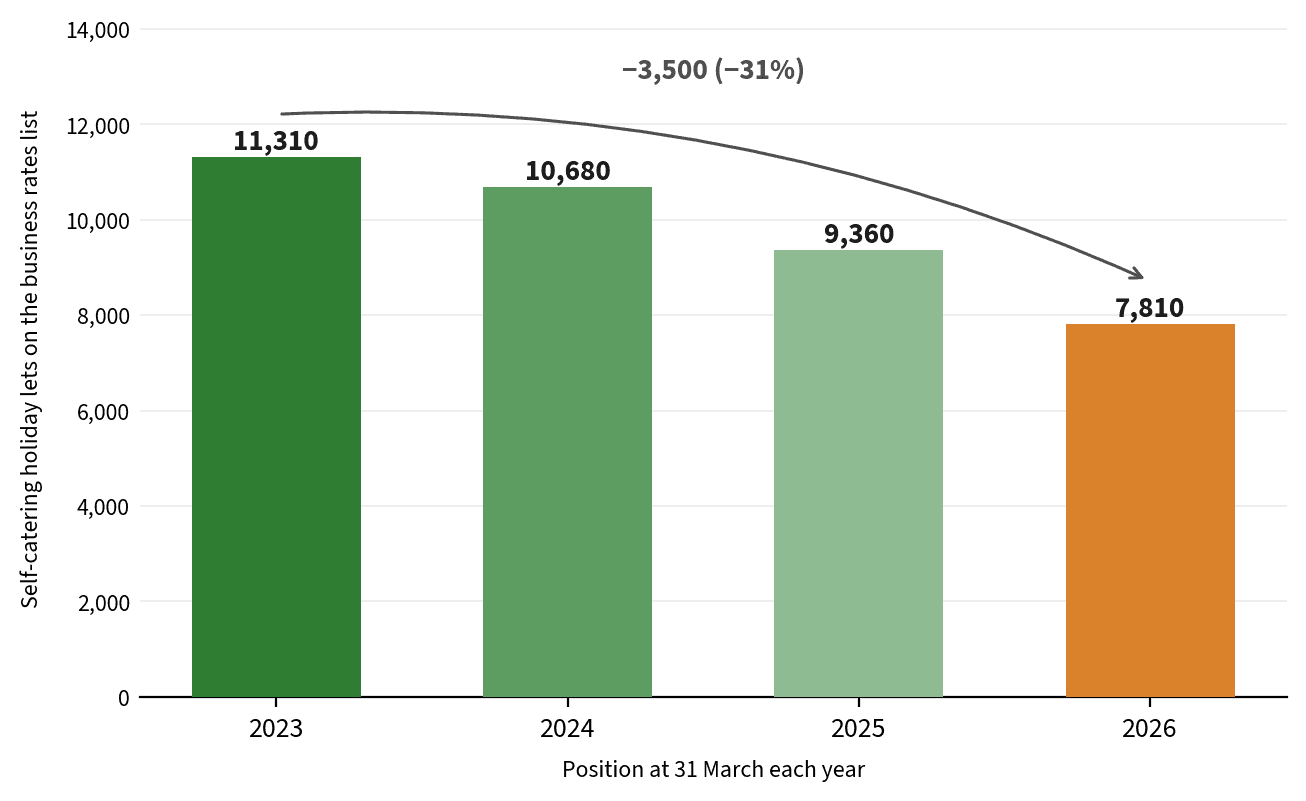
Figure 1. Self-catering holiday lets on the business rates list in Wales at 31 March each year. Counts are rounded to the nearest 10. Source: HMRC Valuation Office, non-domestic rating stock of properties, 2023 to 2026.
The Welsh Government notes that the position at March 2026 does not reflect any additional benefit to operators from the refinements that took effect on 1 April 2026, so later counts could differ.
Which councils lost them
The fall is heavily concentrated. Gwynedd and Pembrokeshire lost 1,000 holiday lets each. Ceredigion and Powys lost 290 each, Carmarthenshire 280 and Anglesey 250. Carmarthenshire’s fall was the steepest in proportion (−48%), though from a smaller base. Across most of South and East Wales there were few holiday lets on the list to begin with, so changes there are small and, because counts are rounded to the nearest 10, close to the margin of error.
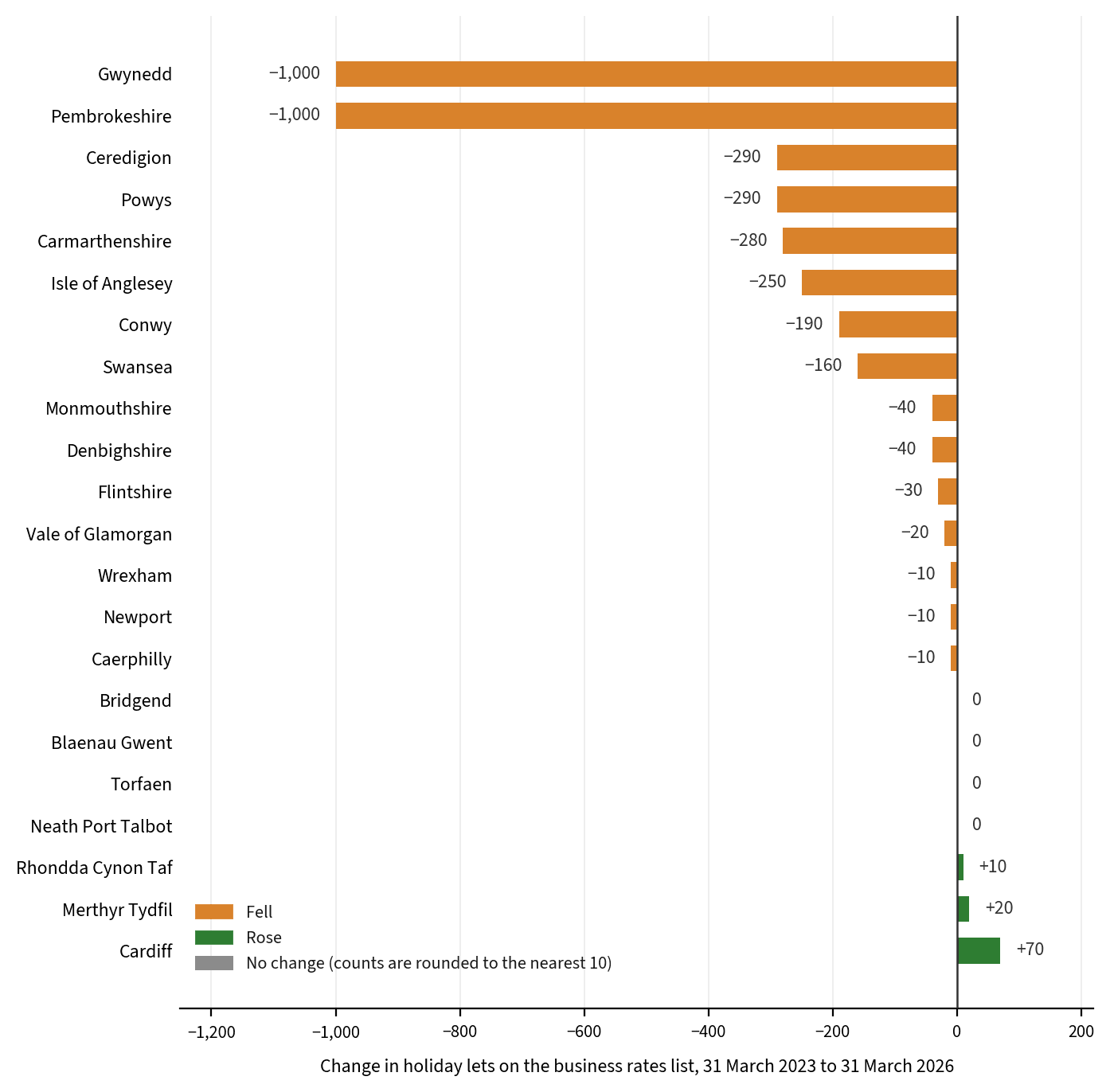
Figure 2. Change in the number of holiday lets on the business rates list, 31 March 2023 to 31 March 2026, by council. Counts are rounded to the nearest 10. Source: HMRC Valuation Office.
Even after the falls, the places where holiday lets are concentrated have hardly changed. Gwynedd (1,860), Pembrokeshire (1,640), Anglesey (900), Conwy (670) and Powys (610) still hold 5,680 of Wales’s 7,810 (73%), against 74% in 2023. Gwynedd, Conwy and Anglesey, the three councils that have paused or rejected the visitor levy, hold 44% on their own. Self-catering lets fall within the levy at £1.30 per person per night wherever a council introduces it, so the two policies overlap in the same places. Our visitor levy report sets out where each council stands.
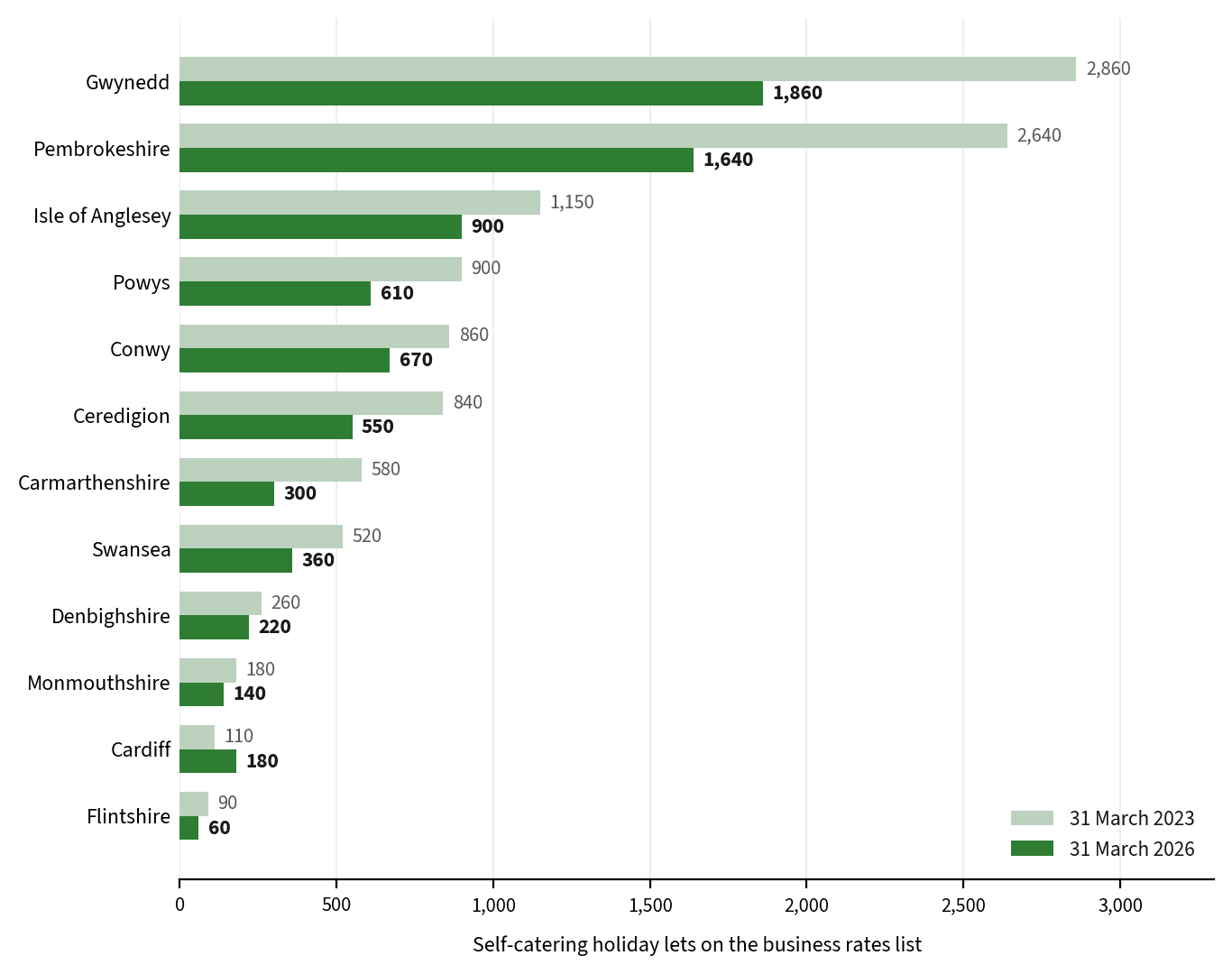
Figure 3. Holiday lets on the business rates list in 2023 and 2026, for the 12 councils with the most in 2023. Source: HMRC Valuation Office.
Holiday lets and second homes together
A property is on one list or the other: business rates if it meets the letting criteria, council tax if it does not. Where a second home is charged council tax, councils can add a premium of up to 300%, which is why the two counts are worth reading together. They are also the subject of our second homes report.
Added together, Gwynedd has 6,864 properties of these two kinds (5,004 second homes and 1,860 business-rated holiday lets) and Pembrokeshire 5,872 (4,232 and 1,640). Cardiff is third on this measure with 3,512, but almost all of those (3,332) are second homes: it has only 180 business-rated holiday lets. Anglesey (3,197) and Powys (2,306) follow.
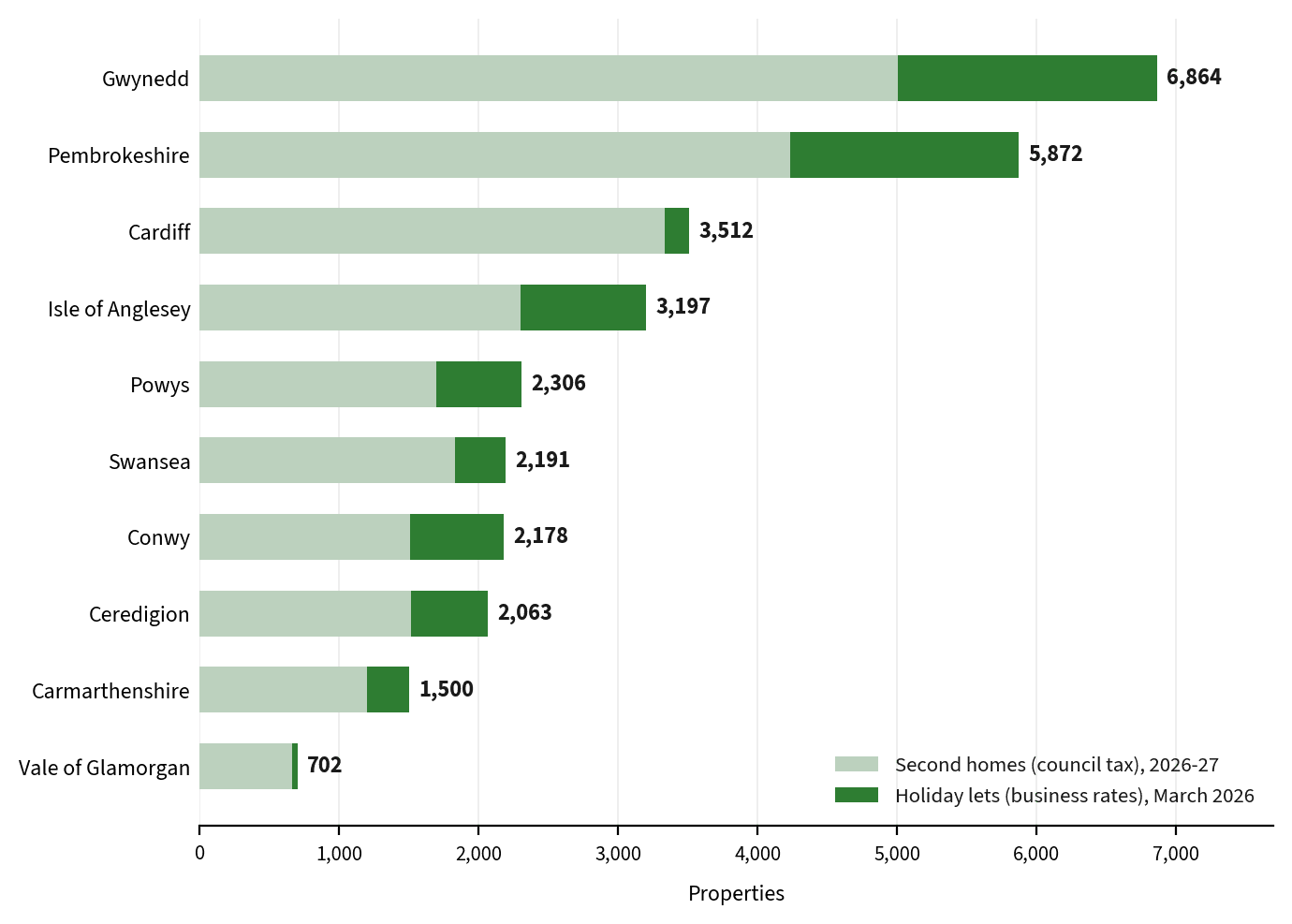
Figure 4. Second homes (council tax, 2026–27) and holiday lets (business rates, 31 March 2026) for the 10 councils with the most of the two combined. Sources: StatsWales; HMRC Valuation Office.
Did the missing holiday lets become second homes?

In part, perhaps. Between 2023–24 and 2026–27, chargeable second homes rose by 2,004 across Wales while business-rated holiday lets fell by 3,500, so the two combined fell by 1,496 (4%). Some councils look like a straight swap. Powys lost 290 business-rated holiday lets and gained 320 second homes; Carmarthenshire lost 280 and gained 200. In Gwynedd and Pembrokeshire, second homes rose by 246 and 292 against falls of 1,000 each, so the combined total fell by 754 and 708. In Ceredigion both fell, by 290 and 275.
The timing is worth noting. Second homes were broadly flat for the first three years of the rule, at 24,170 in 2023–24 and 23,967 in 2025–26, then rose by 2,207 (9.2%) in 2026–27, a rise the Welsh Government’s own release describes as expected. Business-rated holiday lets also fell fastest in the latest year, by 1,550 in the twelve months to 31 March 2026. That is consistent with properties moving from one list to the other, but it is not proof: the data does not follow individual properties.
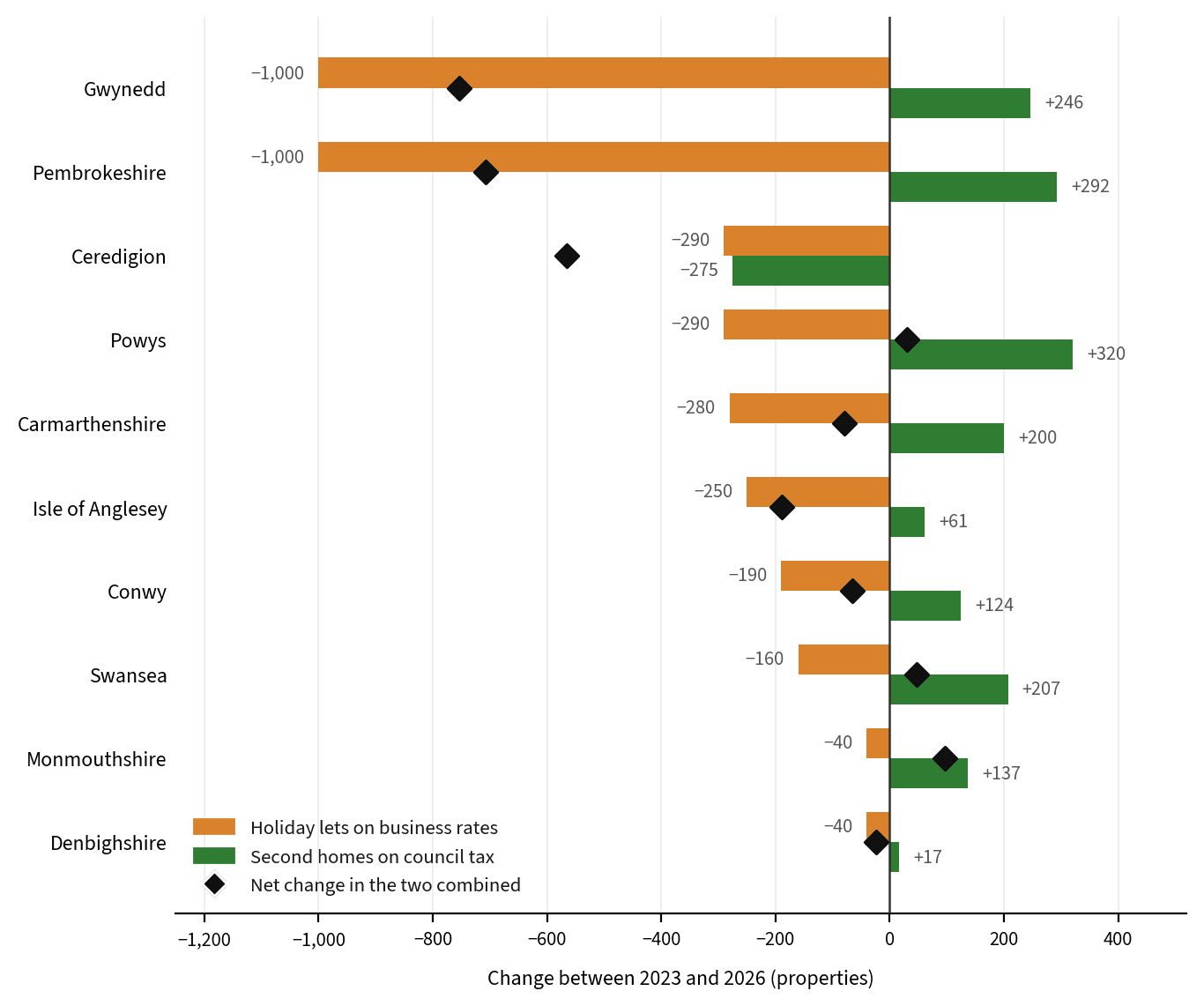
Figure 5. Change in holiday lets on business rates (31 March 2023 to 2026) and in second homes on council tax (2023–24 to 2026–27), for the 10 councils with the largest falls in holiday lets. Diamonds show the net change in the two combined. Sources: HMRC Valuation Office; StatsWales.
The pattern is not simple, and some rises in second homes have no obvious link to business rates at all. Newport (+265) and the Vale of Glamorgan (+213) are examples, and may reflect councils changing how they record or charge second homes (see our second homes report for the caveats). Nor do the files follow individual properties. A holiday let that left the business rates list may now be a second home, a main residence that was sold or let long term, or a property that is no longer let at all. The data cannot separate these.
What the data can and cannot tell us
- Counts are rounded. The Valuation Office rounds council-level counts to the nearest 10, so changes of 10 or 20 are close to the margin of error. The 22 council counts do not add exactly to the Wales figure for the same reason (in 2023 they sum to 11,340 against 11,310).
- The business rates list is not a count of all holiday lets. Owners are not required to register as non-domestic, and lets that do not meet the letting criteria sit on council tax instead. All visitor accommodation providers in Wales must register with the Welsh Revenue Authority by 31 March 2027, which should give a fuller picture.
- Properties are not followed. We cannot say how many holiday lets moved to council tax, how many were sold, or how many stopped letting.
- The March 2026 count predates the April 2026 refinements. Later counts may differ.
- The two datasets are measured at different points. Business rates counts are at 31 March; council tax figures are the councils’ own returns of the dwellings they expect to be liable in each council tax year, collected the November and December before, so each is a few months earlier than the matching 31 March count. We pair 31 March 2023 with 2023–24 and 31 March 2026 with 2026–27.
- Official totals vary by date. Welsh Government statements have cited around 6,500 properties in January 2026 and around 8,000 in July 2026. We use the Valuation Office’s dated counts at 31 March throughout.
- No measure of use or income. The figures do not show how many nights holiday lets are actually let, what they earn, or how many jobs they support.
- No forecasts. We have not estimated the effect of any change to the rule.
Full data by council
| Council | Holiday lets 2023 | 2024 | 2025 | 2026 | Change 2023–26 | Change % | Second homes 2026–27 | Both combined |
|---|---|---|---|---|---|---|---|---|
| Gwynedd | 2,860 | 2,630 | 2,180 | 1,860 | −1,000 | −35% | 5,004 | 6,864 |
| Pembrokeshire | 2,640 | 2,470 | 2,170 | 1,640 | −1,000 | −38% | 4,232 | 5,872 |
| Isle of Anglesey | 1,150 | 1,100 | 970 | 900 | −250 | −22% | 2,297 | 3,197 |
| Conwy | 860 | 830 | 770 | 670 | −190 | −22% | 1,508 | 2,178 |
| Powys | 900 | 860 | 760 | 610 | −290 | −32% | 1,696 | 2,306 |
| Ceredigion | 840 | 770 | 630 | 550 | −290 | −35% | 1,513 | 2,063 |
| Swansea | 520 | 520 | 460 | 360 | −160 | −31% | 1,831 | 2,191 |
| Carmarthenshire | 580 | 520 | 420 | 300 | −280 | −48% | 1,200 | 1,500 |
| Denbighshire | 260 | 260 | 240 | 220 | −40 | −15% | 439 | 659 |
| Cardiff | 110 | 110 | 160 | 180 | +70 | +64% | 3,332 | 3,512 |
| Monmouthshire | 180 | 180 | 170 | 140 | −40 | −22% | 321 | 461 |
| Flintshire | 90 | 90 | 70 | 60 | −30 | n/a | 321 | 381 |
| Merthyr Tydfil | 40 | 50 | 50 | 60 | +20 | n/a | 182 | 242 |
| Wrexham | 60 | 50 | 50 | 50 | −10 | n/a | 63 | 113 |
| Neath Port Talbot | 50 | 60 | 50 | 50 | 0 | n/a | 461 | 511 |
| Bridgend | 40 | 40 | 40 | 40 | 0 | n/a | 88 | 128 |
| Vale of Glamorgan | 60 | 60 | 60 | 40 | −20 | n/a | 662 | 702 |
| Rhondda Cynon Taf | 30 | 30 | 40 | 40 | +10 | n/a | 524 | 564 |
| Newport | 30 | 20 | 20 | 20 | −10 | n/a | 277 | 297 |
| Torfaen | 10 | 10 | 10 | 10 | 0 | n/a | 16 | 26 |
| Caerphilly | 20 | 20 | 20 | 10 | −10 | n/a | 207 | 217 |
| Blaenau Gwent | 10 | 10 | 10 | 10 | 0 | n/a | 0 | 10 |
| Wales | 11,310 | 10,680 | 9,360 | 7,810 | −3,500 | −31% | 26,174 | 33,984 |
Sources and methodology
Sources and periods
- Holiday lets on the business rates list, 2023 to 2026: HMRC (Valuation Office), Non-domestic rating: stock of properties, the 2023 (published 25 May 2023), 2024, 2025 (published 19 June 2025) and March 2026 (published 14 May 2026) releases. We use the “Stock SCat Tables by region, county, local authority district and rateable value band” (all rateable value bands, counts), special category code 131, “Holiday Homes Self Catering”, for the 22 Welsh local authority districts and for Wales. Counts are at 31 March each year and are rounded to the nearest 10.
- Second homes: StatsWales, Council tax dwellings by authority and band (dataset 062488e2-3fd6-4755-9b0b-a64547fc570f), row H8, “Total chargeable second homes”, band “Total”, for 2023–24 and 2026–27.
- Rules and consultation: Welsh Government, Classification of self-catering properties for local tax purposes (consultation, 31 July 2026), the accompanying written statement (31 July 2026), and the summary of responses to the earlier consultation on refinements (21 January 2026).
- Visitor levy: GOV.WALES, Step-by-step guide to Visitor Levy for accommodation providers, and our visitor levy report for council positions.
Definitions and calculations
- “Holiday lets on the business rates list” means properties in the Valuation Office’s “Holiday Homes Self Catering” special category. “Second homes” means chargeable second homes on the council tax list. A property is on one list or the other, so the two can be added.
- Changes are 2026 minus 2023. Percentage changes are calculated from the rounded counts. Wales totals use the Valuation Office’s figure for Wales, so they can differ slightly from the sum of the 22 councils. The 2023 count is on the 2017 rating list; later counts are on the 2023 rating list.
- The combined figures add second homes and business-rated holiday lets for the same council. For Wales we add the Wales second homes total to the Wales holiday lets figure.
- Second homes figures for Cardiff, Carmarthenshire and Monmouthshire show anomalies in 2024–25, a year we do not use. Newport and Wrexham rise from low or zero levels in recent years. See our second homes report for details.
- The consultation, rules and dates are as published by the Welsh Government at 15 October 2026.
Contains public sector information licensed under the Open Government Licence v3.0. Analysis and charts by Wales.org.
Part of the Wales.org Research Series. See all our data reports on the Wales Research Hub.
How to cite: Barrett, N. (2026). Wales Has Lost 3,500 Holiday Lets From the Business Rates List. Here’s Where. Wales.org Research Hub, 15 October 2026. https://wales.org/research/holiday-lets-wales/

Pembrokeshire-born travel writer and founder of Wales.org. Born in Haverfordwest, now based in Hertfordshire — covering Welsh castles, national parks, festivals and family staycations across all 22 Welsh counties.