


WALES.ORG RESEARCH · Part of the Wales.org Research Series
Where the Visitor Levy Matters Most: Tourism by County in Wales
Wales’s visitor levy is moving from legislation to reality, but not evenly. Cardiff will start charging for stays from 1 April 2027. In the past few weeks, Anglesey has voted against introducing the levy for now, Conwy has voted to defer its decision, and Gwynedd has postponed its own so that it can analyse almost 7,000 consultation responses.
Behind those decisions sits a simple question: how much does the levy matter in each place? We brought together the Welsh Government’s own county-level tourism data to compare visitors, spending, length of stay, accommodation and jobs in the four councils that have made a move. All four rank among the seven busiest councils for overnight visitors in both of the Welsh Government’s county-level data sets, but they attract different kinds of visitor and offer very different kinds of accommodation.
This report takes no position on whether a levy should be introduced. It does not estimate how much the levy might raise or how it might affect visitor numbers, because the data cannot support either. It sets out what the official figures show, and where they are weak.
Key findings
- The same four councils lead on visitor nights in both surveys. Gwynedd, Cardiff, Pembrokeshire and Conwy are the busiest for overnight visitors in both the 2017–19 and the provisional 2022–24 data, although their order changes.
- Cardiff and Gwynedd now record almost identical visitor nights, about 3.14 million a year each in 2022–24 (a gap of 750 nights), but Cardiff recorded 1.68 times as many trips: 1.36 million against 0.81 million.
- The four councils account for 40.7% of visitor nights in the 2022–24 data: 13.3% in Cardiff, which is going ahead, and 27.4% across Gwynedd, Conwy and Anglesey, which have paused or rejected the levy for now. In 2017–19 the figures were about 9% and 35%.
- Stays are shorter in Cardiff. The average trip lasts 2.3 nights in Cardiff, against 4.0 in Anglesey, 3.9 in Gwynedd and 3.2 in Conwy. At the standard £1.30 rate, that is roughly £3.00 per person for the average Cardiff stay and £4.22 to £5.24 in the other three (illustrative arithmetic, not a forecast).
- The accommodation is different. Caravan and camping makes up 79% of bedspaces in Gwynedd, 81% in Conwy and 87% in Anglesey. In Cardiff, 62% of bedspaces are serviced and 34% are in hostels.
- The three councils that paused or rejected the levy are among the most tourism-dependent for jobs. Tourism industries provided 20.8% of jobs in Anglesey, 20.0% in Conwy and 18.3% in Gwynedd in 2022, first, third and fourth of the 22 councils, against 11.6% in Cardiff and 11.8% for Wales. Cardiff has the most tourism jobs in absolute terms, about 26,000, roughly as many as the three combined.
What the levy is, and where councils stand
The Visitor Accommodation (Register and Levy) Etc. (Wales) Act 2025 gives councils the power to charge a levy on overnight stays in visitor accommodation. Each council decides for itself, but only after consulting residents and businesses, and a council can start the levy on 1 April or 1 October each year. The rates are set nationally: 75p per adult per night for a tent on a camping pitch or a shared room in a hostel, bunkhouse, bothy or dormitory (under-18s in those are not charged), and £1.30 per person per night, for guests of all ages, in everything else, including hotels, self-catering lets, caravan parks, and caravans, motorhomes and campervans on camping pitches. Accommodation providers pay the levy to the Welsh Revenue Authority and can choose whether to absorb it or pass it on to guests. Councils can spend the proceeds on improving local tourism, protecting nature and landmarks, and promoting the Welsh language. Separately, every visitor accommodation provider in Wales must register with the Welsh Revenue Authority by 31 March 2027, even where the local council does not charge the levy.
| Council | Position |
|---|---|
| Cardiff | Confirmed. The levy applies to stays from 1 April 2027. |
| Isle of Anglesey | Voted against introducing the levy for now (24 September 2026). |
| Conwy | Voted 29 to 9 to defer a decision until further evidence is available. |
| Gwynedd | Postponed its decision to analyse 6,856 consultation responses. |
| All other councils | No levy confirmed. The Welsh Government’s list shows no other council has confirmed the levy or is currently consulting. |
ITV Wales reported that some other councils have opted out of the levy without a council vote, so “no levy confirmed” does not necessarily mean “undecided”.
Wales’s visitor economy at a glance
The national figures set the scale. In 2024, Great Britain residents took 7.61 million overnight trips in Wales, spending 22.30 million nights and £2.24 billion, an average of 2.9 nights and £295 per trip. These are domestic trips, so international visitors are not included. Tourism industries accounted for 11.8% of employment in Wales in 2022 (159,000 jobs). On a slightly different definition used for output, tourism-related industries generated 5.1% of Welsh gross value added (£3.8 billion). Pay in the sector is lower than average: the median hourly wage in accommodation and food service was £10.99 in the year to April 2023 (provisional), compared with £14.85 across all industries in Wales.
Where overnight visitors go
The Welsh Government releases county-level visitor figures from the Great Britain Tourism Survey only as three-year averages, because the samples for individual councils are too small to rely on in any single year. The latest set, a provisional average for 2022 to 2024, was released in response to a Freedom of Information request in June 2025. The previous set, covering 2017 to 2019, comes from the compendium of visitor data the Welsh Government published alongside the levy legislation.
In the newer data, Cardiff and Gwynedd each record about 3.14 million visitor nights a year, followed by Pembrokeshire (2.48 million) and Conwy (2.19 million). In the 2017–19 data Gwynedd was well ahead on 5.6 million, followed by Pembrokeshire (3.97 million), Conwy (3.25 million) and Cardiff (3.04 million). The same four councils lead both lists, in a different order. Cardiff is a bigger draw by trips than by nights: it recorded 1.36 million trips a year in 2022–24, the most of any council and 1.68 times Gwynedd’s 0.81 million.
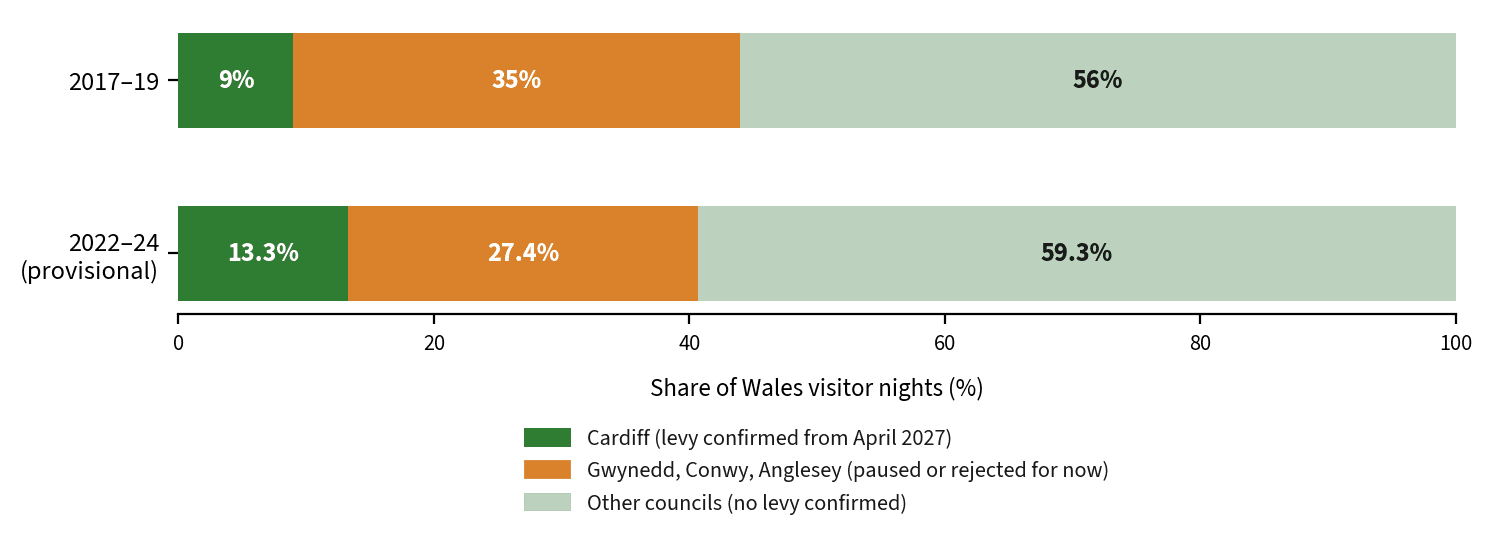
Figure 1. Share of Wales’s visitor nights in the four councils at the centre of the levy decisions. 2017–19 shares are the rounded whole-number shares published by the Welsh Government; 2022–24 shares are calculated from the provisional council figures. The two periods use different versions of the survey and are not directly comparable.
Taken together, Cardiff and the three councils that paused or rejected the levy account for 40.7% of visitor nights in the 2022–24 data (13.3% in Cardiff and 27.4% across Gwynedd, Conwy and Anglesey) and about 44% in 2017–19 (9% and 35%). The survey was redesigned after 2019, and VisitBritain advises that the newer data is not comparable with the earlier series, so the difference between the two periods should not be read as a trend.
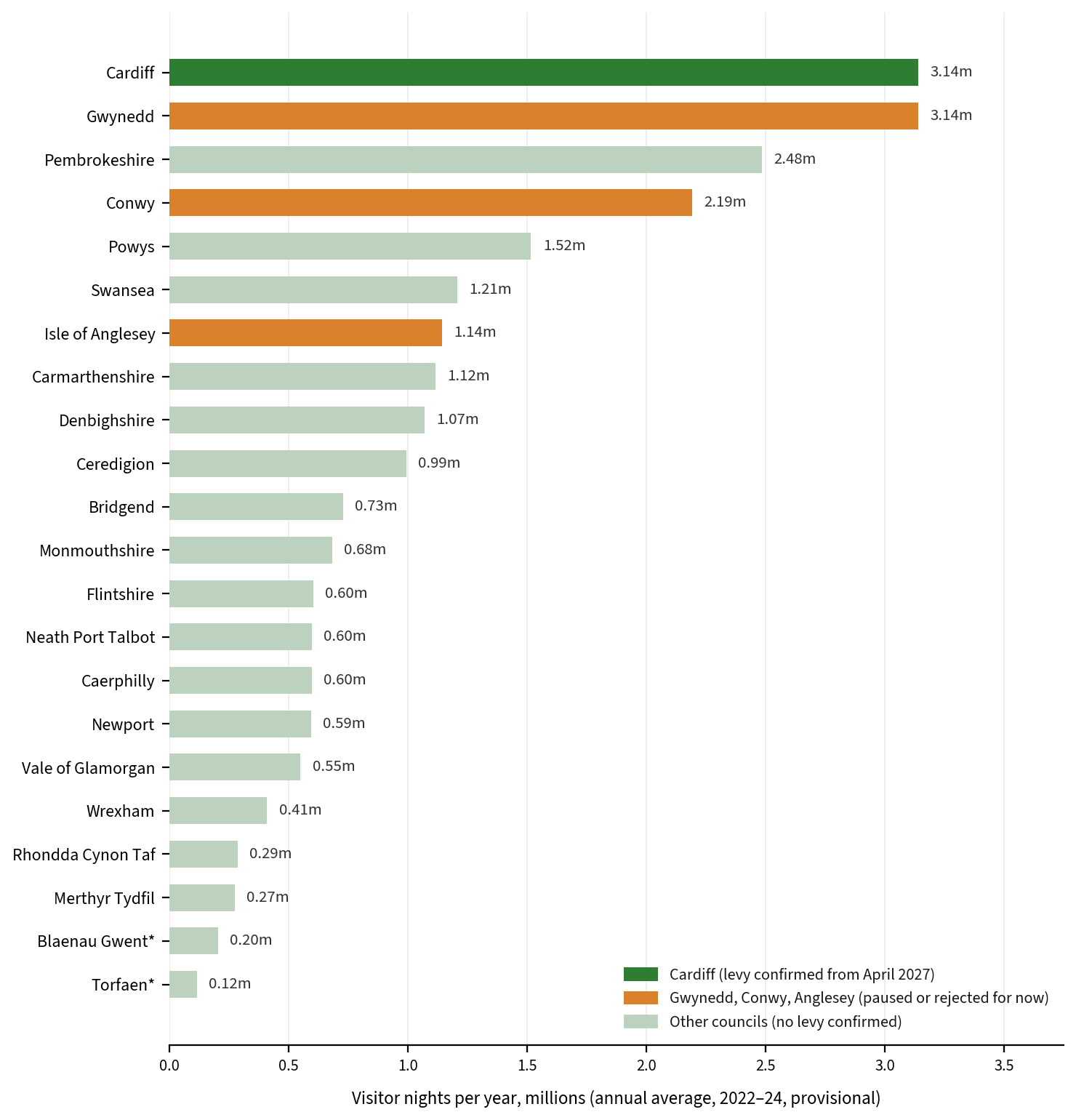
Figure 2. Visitor nights per year by council, annual average 2022–24 (provisional). An asterisk marks councils with a survey sample of fewer than 30 over the three years. Source: Welsh Government, response to FOI request ATISN 24725, June 2025.
What visitors spend
County-level spend is only available for the older 2017–19 period. Gwynedd led with £288 million a year, followed by Cardiff (£230 million), Conwy (£222 million) and Pembrokeshire (£220 million). Across the 21 councils the compendium itemises (it does not list Newport), spend totals £1.73 billion a year. Gwynedd, Conwy and Anglesey account for £602 million of that (34.7%) and Cardiff for £230 million (13.3%).
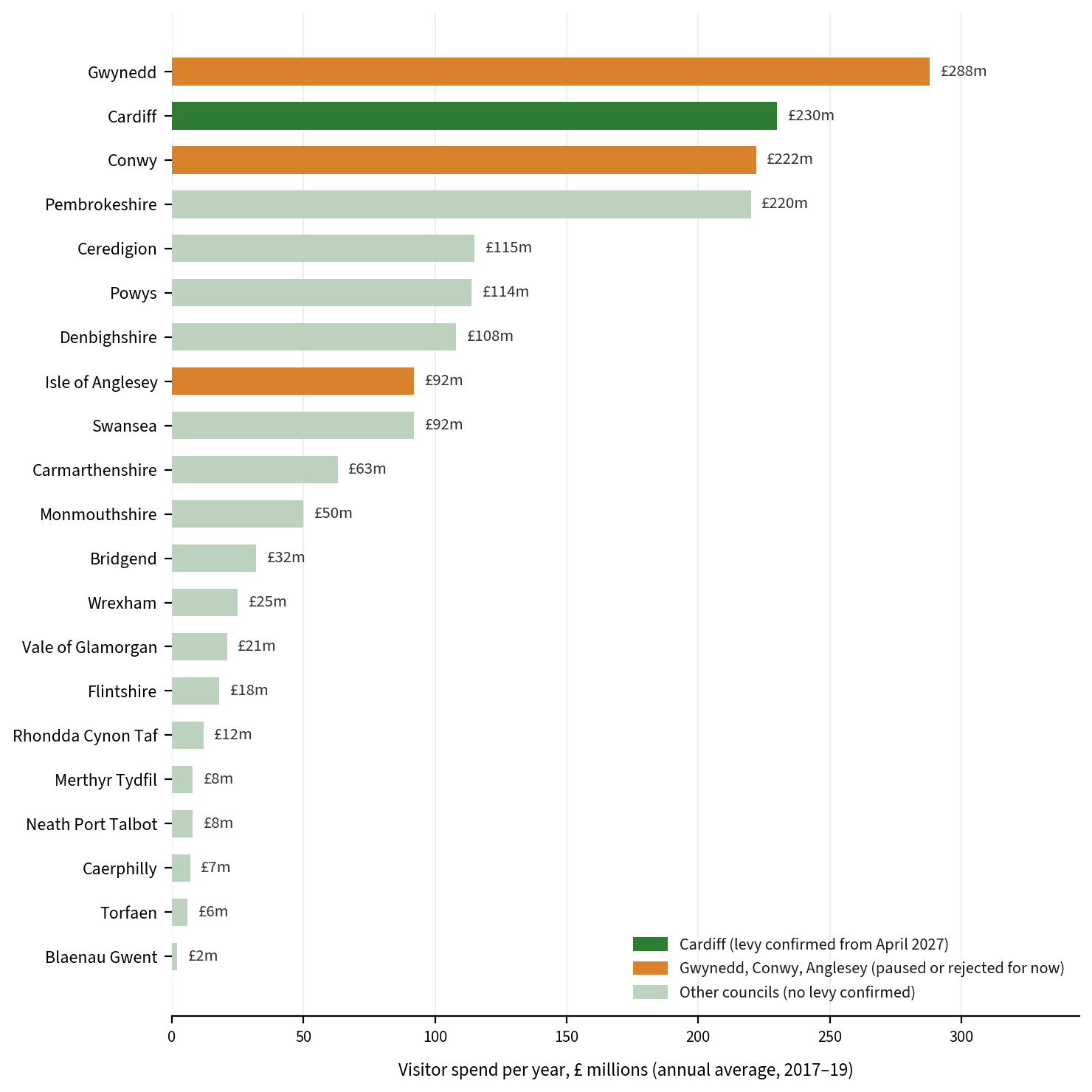
Figure 3. Visitor spend per year by council, annual average 2017–19. Newport is not itemised in the source. Source: Welsh Government, compendium of visitor data sources (November 2024).
Dividing spend by nights from the same data gives a rough measure of spend per night. It was highest in Cardiff, at about £76, followed by Conwy (£68), against about £51 in Gwynedd and £38 in Anglesey. These are 2017–19 prices calculated from rounded published figures, so they are indicative rather than precise, but they point the same way as the length-of-stay data below: Cardiff visitors spend more per night and stay fewer nights than visitors to the three councils that paused.
How long visitors stay
A levy charged per person per night makes length of stay central. Average stay, calculated as visitor nights divided by trips, is 4.0 nights in Anglesey, 3.9 in Gwynedd and 3.2 in Conwy, against 2.3 in Cardiff and an average of 2.8 across the 22 councils in 2022–24. The pattern is the same in the older data: about 2.4 nights per trip in Cardiff, against 3.3 in Gwynedd, 3.2 in Conwy and 4.5 in Anglesey (calculated from rounded published figures). Bangor University’s Dr Linda Osti made a similar observation in BBC Wales coverage on 27 September, describing Cardiff as a typical city destination where people tend to stay a few nights.
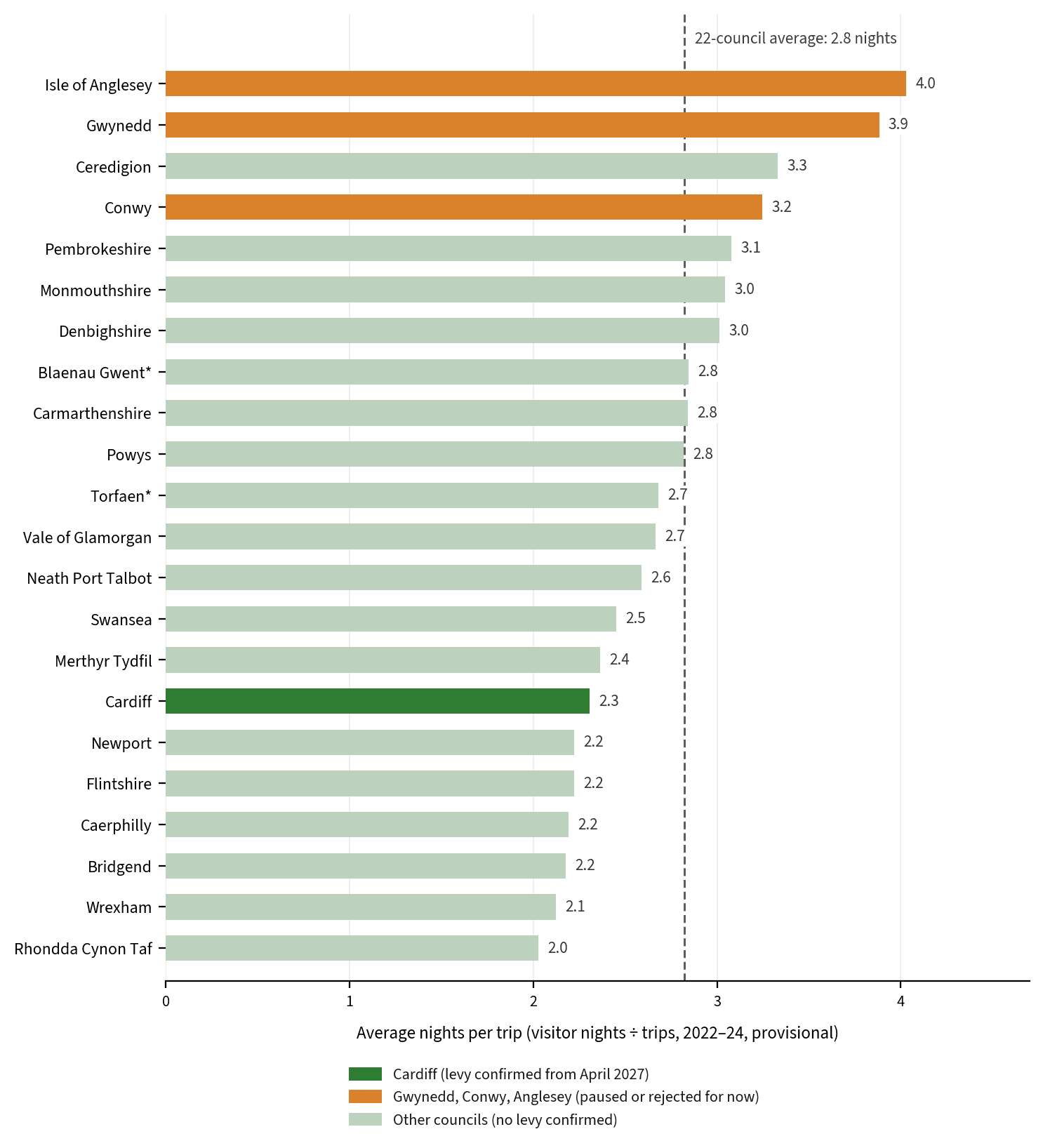
Figure 4. Average nights per trip by council, 2022–24 (provisional), calculated as visitor nights divided by trips. The dashed line is the average across the 22 councils. An asterisk marks councils with a survey sample of fewer than 30.
To show what that difference means in practice, Table 2 multiplies each council’s average stay by the standard £1.30 rate. This is simple arithmetic, not a forecast. The actual charge depends on the type of accommodation (tents and shared hostel-type rooms pay 75p per adult), the size of the party, and exemptions and refunds, such as for stays of 32 nights or more on a single booking.
| Council | Average stay (nights, 2022–24) | Illustrative levy per person |
|---|---|---|
| Isle of Anglesey | 4.0 | £5.24 |
| Gwynedd | 3.9 | £5.05 |
| Conwy | 3.2 | £4.22 |
| Pembrokeshire | 3.1 | £4.00 |
| Cardiff | 2.3 | £3.00 |
| Average of all 22 councils | 2.8 | £3.67 |
What visitors stay in
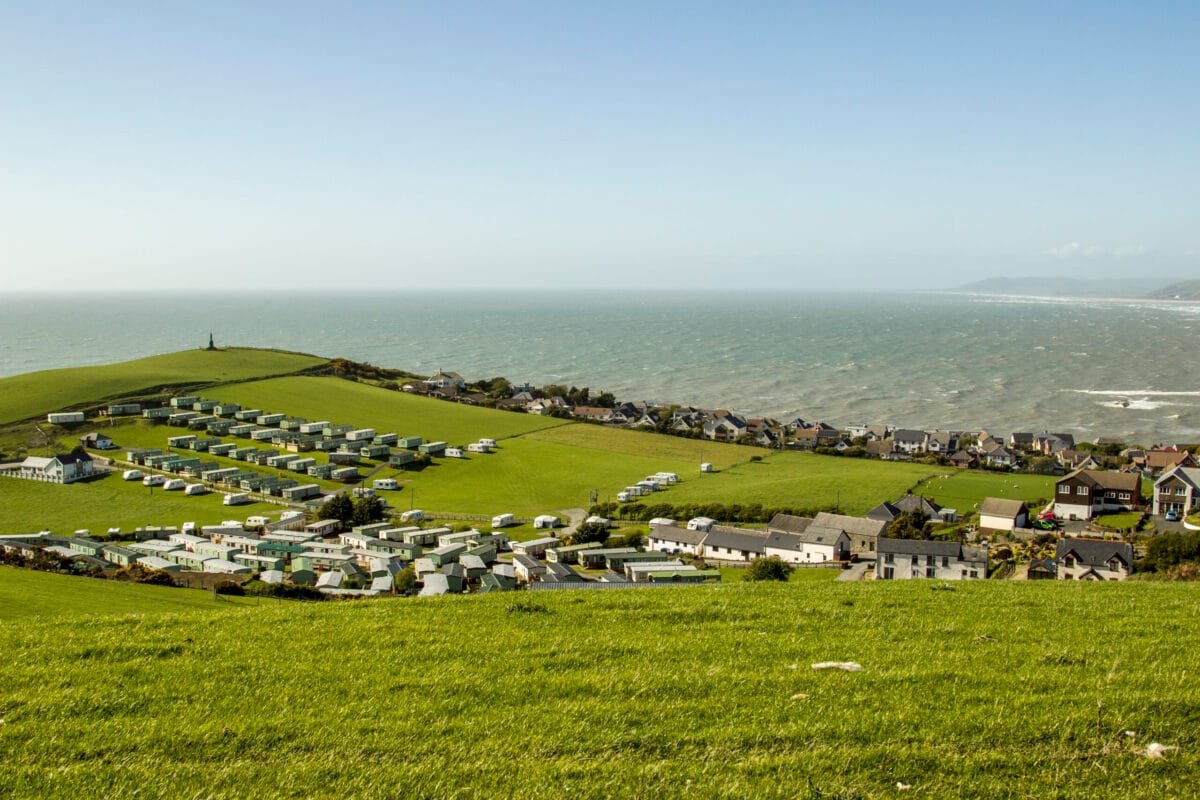
The Welsh Government’s bedstock data, collected by councils and summarised as at June 2022, counts how many places to stay each council has and how many people they can sleep. Gwynedd has the most bedspaces of any council, 136,556, followed by Pembrokeshire (100,929) and Conwy (76,359). Those three alone hold 51.8% of the 605,728 bedspaces itemised across 21 councils, and the three councils that paused hold 40.3%.
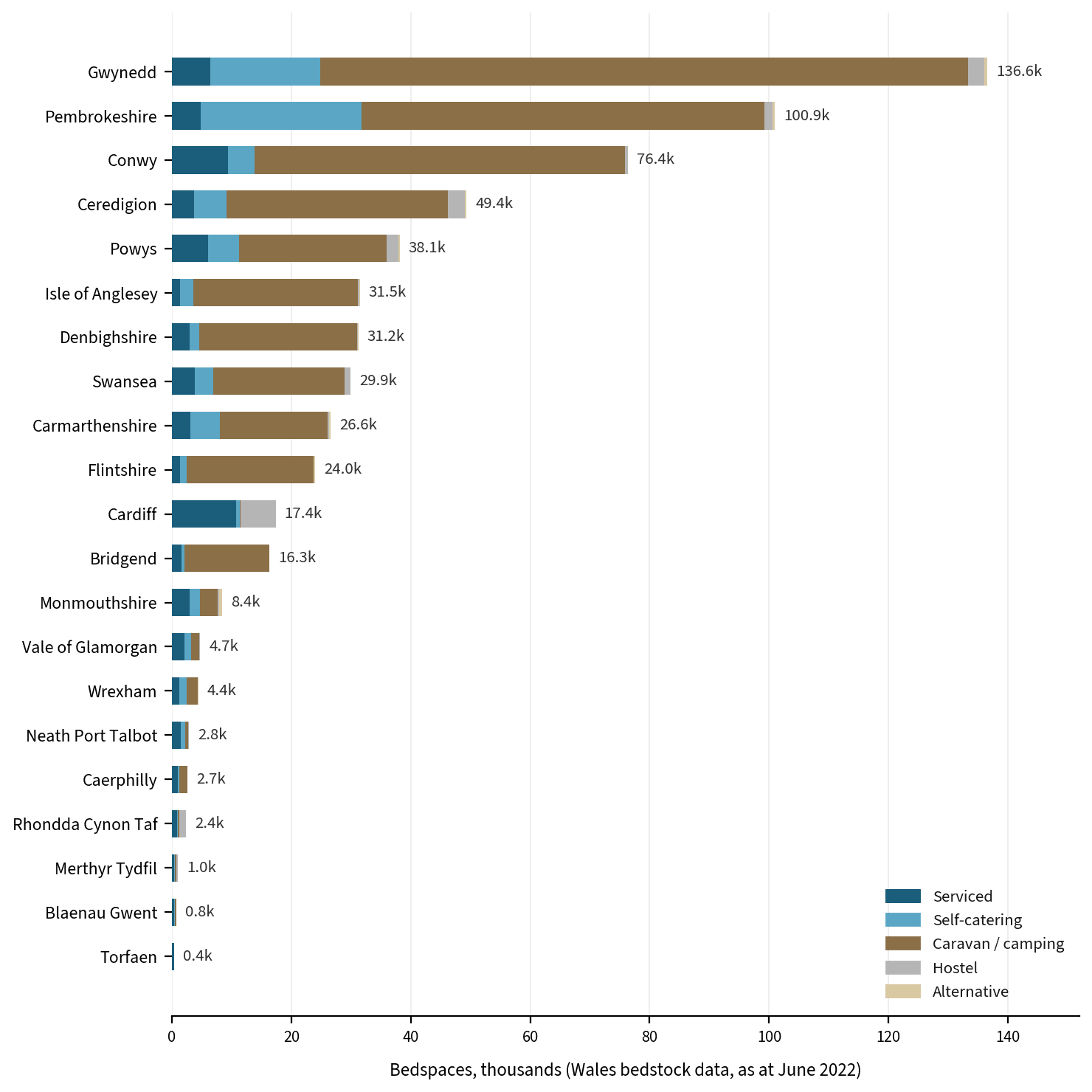
Figure 5. Bedspaces by accommodation type and council, as at June 2022. Newport is not itemised in the source. Source: Welsh Government, compendium of visitor data sources (November 2024), drawing on the Wales bedstock report.
What stands out is the mix. Caravan and camping accommodation makes up 79% of bedspaces in Gwynedd, 81% in Conwy and 87% in Anglesey, and 72% across the 21 councils combined. In Cardiff, 62% of bedspaces are in serviced accommodation such as hotels and 34% are in hostels. By count of establishments, self-catering dominates the big coastal counties: 3,165 of Gwynedd’s 3,952 establishments (80%) and 4,618 of Pembrokeshire’s 5,113 (90%). Our guides to caravan holidays and camping in Wales cover this side of the market for visitors.
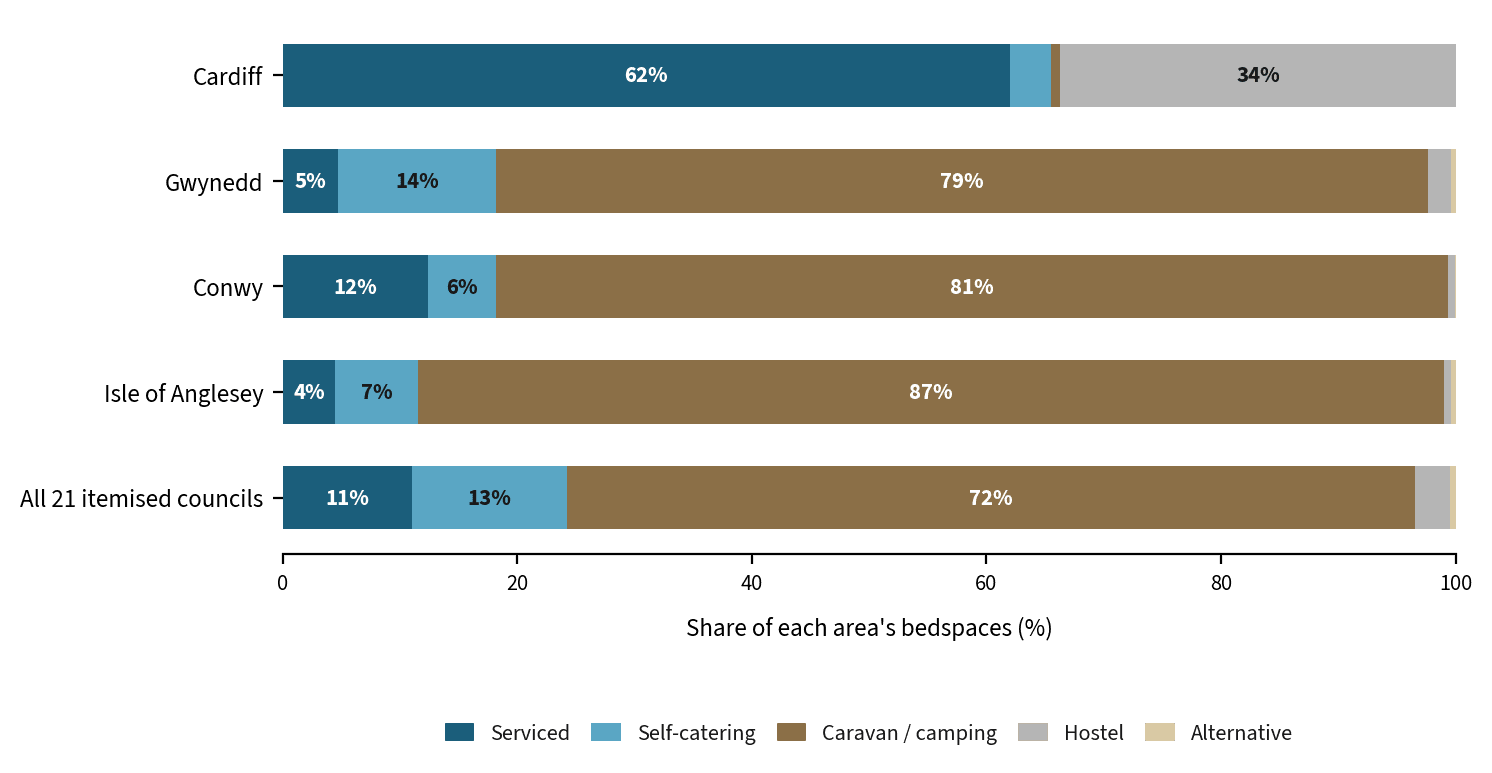
Figure 6. Accommodation mix by share of bedspaces, as at June 2022. Segments under 4% are not labelled.
This matters because the levy’s two rates depend on the type of accommodation. Caravan parks, and caravans, motorhomes and campervans on camping pitches, pay the higher £1.30 rate, while tents pay 75p per adult. The bedstock’s “caravan and camping” category combines static caravans, touring pitches and tent pitches, so it cannot be divided between the two rates, and this report does not try to. The Welsh Government also notes that data scraped from booking platforms points to a self-catering sector that may be larger than the bedstock records capture, although it cautions that the platform data should not be used as an official count.
Jobs and businesses
The data annex to the Welsh Government’s visitor economy profile breaks tourism employment down by council. Measured as a share of all jobs in 2022, tourism industries mattered most in Anglesey (20.8%), Pembrokeshire (20.4%) and Conwy (20.0%), followed by Gwynedd (18.3%) and Ceredigion (16.1%), and least in Wrexham (7.5%). The figure for Wales as a whole is 11.8%. That puts Anglesey, Conwy and Gwynedd, the three councils that paused or rejected the levy, first, third and fourth of the 22 councils. Cardiff, at 11.6%, sits close to the Wales average. Pembrokeshire, second on the list, has not confirmed a levy.
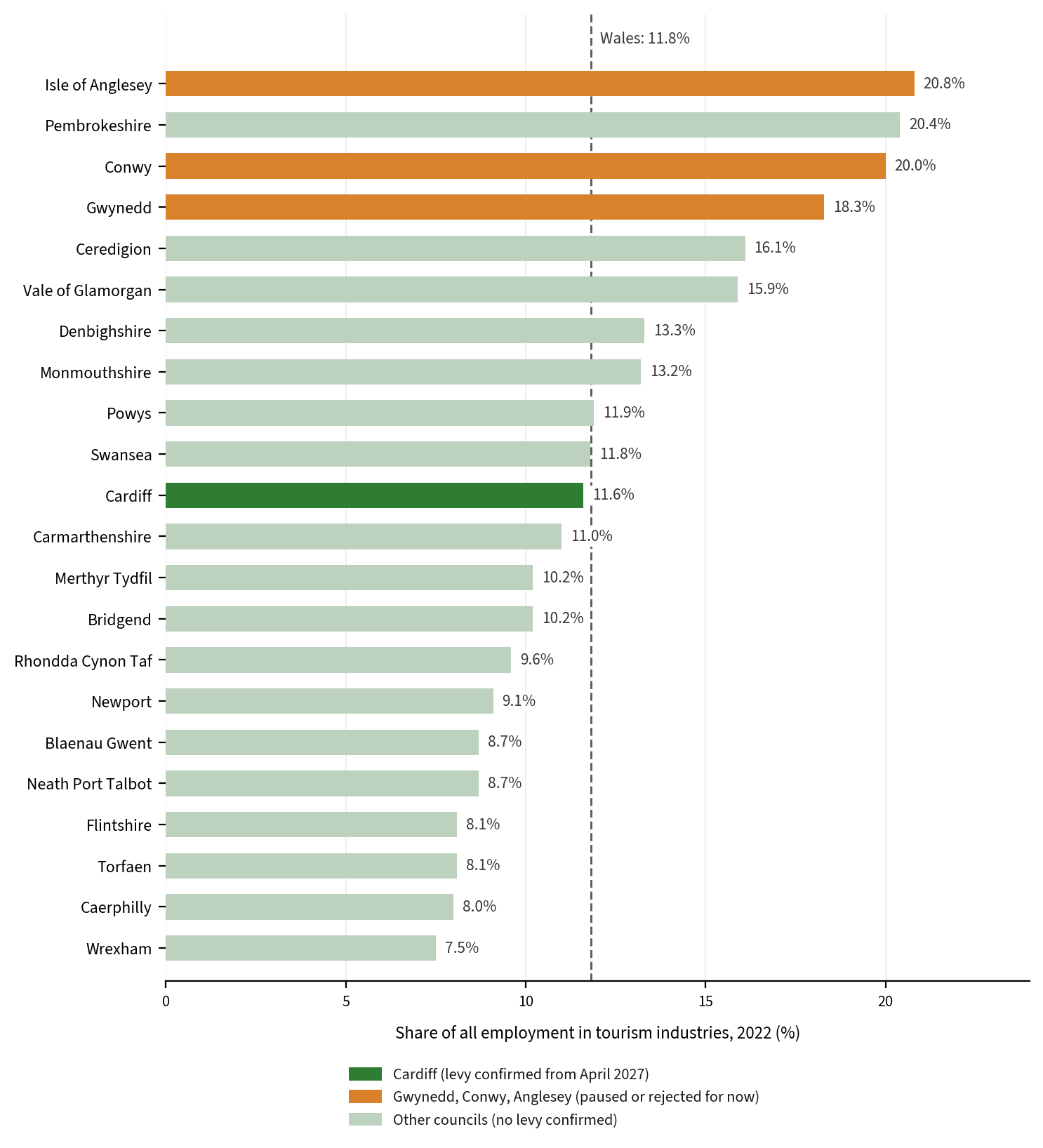
Figure 7. Tourism industries’ share of all employment by council, 2022. The dashed line is the Wales figure (11.8%). Source: Welsh Government, Wales visitor economy profile 2024, data annex, Table 5.8, based on the ONS Business Register and Employment Survey.
Share and scale tell different stories. Cardiff has about 26,000 tourism jobs, the most of any council and more than twice Gwynedd’s 11,000, simply because its economy is so much larger. The three councils that paused (Gwynedd about 11,000, Conwy about 9,000 and Anglesey about 5,000) have roughly 25,000 between them, about the same as Cardiff alone. Tourism is a bigger share of the local economy in the three northern councils, but Cardiff has about as many tourism jobs as all three combined.
The pattern on enterprises is similar but narrower. In 2021, the latest year in the annex’s council table, tourism industries made up 16.1% of registered enterprises in Gwynedd (the highest), 14.9% in Conwy, 14.3% in Pembrokeshire and 14.1% in Anglesey, against 11.1% in Cardiff, 11.3% for Wales and 8.1% in Flintshire (the lowest).
| Council | Share of jobs in tourism, 2022 | Rank of 22 | Tourism jobs, 2022 (rounded) | Share of enterprises in tourism, 2021 |
|---|---|---|---|---|
| Isle of Anglesey | 20.8% | 1st | 5,000 | 14.1% |
| Pembrokeshire | 20.4% | 2nd | 10,000 | 14.3% |
| Conwy | 20.0% | 3rd | 9,000 | 14.9% |
| Gwynedd | 18.3% | 4th | 11,000 | 16.1% |
| Cardiff | 11.6% | 11th | 26,000 | 11.1% |
| Wales | 11.8% | n/a | 159,000 | 11.3% |
The councils still to decide
Among councils with no levy confirmed, the six busiest for overnight visitors in 2022–24 are Pembrokeshire (2.48 million nights), Powys (1.52 million), Swansea (1.21 million), Carmarthenshire (1.12 million), Denbighshire (1.07 million) and Ceredigion (0.99 million). Between them they account for 35.5% of visitor nights, so their decisions will do much to determine how much of Welsh overnight tourism the levy ends up covering. As noted above, some may already have opted out without a council vote. For a related council-level tax, see our report on second homes by local authority.
What the data can and cannot tell us
- It covers trips by British residents. The Great Britain Tourism Survey does not include international visitors or day trips, while the levy applies to visitors from anywhere in the world staying overnight.
- It counts every overnight stay, including stays with friends and relatives, which fall outside the levy because it applies to visitor accommodation. The figures show where overnight visitors concentrate, not the size of any levy base.
- County samples are small. The Welsh Government withheld annual county figures because the samples are too small to be reliable (in 2024, 13 councils had fewer than 30 sampled trips) and released only a provisional three-year average. Torfaen and Blaenau Gwent have samples under 30 even over three years, and eleven others are under 100, so figures for smaller councils are indicative.
- The periods differ. Spend exists only for 2017–19, before the pandemic and recent price rises, and the 2022–24 trips and nights come from a redesigned survey. Read the two side by side, not as a trend.
- The accommodation data is older. It was collected by councils at different times over five years to June 2022, the compendium flags the Flintshire and Wrexham figures as estimates, and Newport is not itemised.
- No forecasts. We have not estimated levy revenue or its effect on visitor numbers.
Full data by council
| Council | Levy position | Visitor nights, 2022–24 (m) | Trips, 2022–24 (000) | Average stay (nights) | Spend, 2017–19 (£m) | Bedspaces (June 2022) | Survey sample, 2022–24 |
|---|---|---|---|---|---|---|---|
| Blaenau Gwent | No levy confirmed | 0.20 | 72 | 2.8 | 2 | 756 | 21* |
| Bridgend | No levy confirmed | 0.73 | 335 | 2.2 | 32 | 16,289 | 116 |
| Caerphilly | No levy confirmed | 0.60 | 272 | 2.2 | 7 | 2,672 | 96 |
| Cardiff | Confirmed from 1 Apr 2027 | 3.14 | 1,362 | 2.3 | 230 | 17,375 | 497 |
| Carmarthenshire | No levy confirmed | 1.12 | 393 | 2.8 | 63 | 26,562 | 136 |
| Ceredigion | No levy confirmed | 0.99 | 298 | 3.3 | 115 | 49,357 | 87 |
| Conwy | Deferred (voted 29 to 9) | 2.19 | 675 | 3.2 | 222 | 76,359 | 170 |
| Denbighshire | No levy confirmed | 1.07 | 356 | 3.0 | 108 | 31,234 | 104 |
| Flintshire | No levy confirmed | 0.60 | 271 | 2.2 | 18 | 23,973 | 81 |
| Gwynedd | Postponed | 3.14 | 809 | 3.9 | 288 | 136,556 | 243 |
| Isle of Anglesey | Voted against for now | 1.14 | 283 | 4.0 | 92 | 31,472 | 75 |
| Merthyr Tydfil | No levy confirmed | 0.27 | 116 | 2.4 | 8 | 1,031 | 35 |
| Monmouthshire | No levy confirmed | 0.68 | 224 | 3.0 | 50 | 8,375 | 74 |
| Neath Port Talbot | No levy confirmed | 0.60 | 231 | 2.6 | 8 | 2,838 | 77 |
| Newport | No levy confirmed | 0.59 | 267 | 2.2 | n/a | n/a | 96 |
| Pembrokeshire | No levy confirmed | 2.48 | 807 | 3.1 | 220 | 100,929 | 269 |
| Powys | No levy confirmed | 1.52 | 538 | 2.8 | 114 | 38,134 | 169 |
| Rhondda Cynon Taf | No levy confirmed | 0.29 | 141 | 2.0 | 12 | 2,357 | 52 |
| Swansea | No levy confirmed | 1.21 | 492 | 2.5 | 92 | 29,916 | 169 |
| Torfaen | No levy confirmed | 0.12 | 43 | 2.7 | 6 | 389 | 15* |
| Vale of Glamorgan | No levy confirmed | 0.55 | 206 | 2.7 | 21 | 4,734 | 75 |
| Wrexham | No levy confirmed | 0.41 | 193 | 2.1 | 25 | 4,420 | 60 |
| Total / average | 22 councils (spend and bedspaces: 21) | 23.64 | 8,384 | 2.8 | 1,733 | 605,728 | n/a |
Sources and methodology
Sources and periods
- Trips and visitor nights by council, 2022–24: provisional three-year annual average from the Great Britain Tourism Survey, by local authority of trip destination. Welsh Government, response to Freedom of Information request ATISN 24725, 9 June 2025.
- Trips, nights and spend by council, 2017–19; establishments and bedspaces: Welsh Government, Visitor Accommodation (Register and Levy) Etc. (Wales) Bill: compendium of visitor data sources, November 2024. Visitor figures are the Great Britain Tourism Survey three-year rolling average 2017–19; accommodation figures are from the Wales bedstock report, as at June 2022.
- Wales totals for 2024: Welsh Government, Domestic GB tourism statistics (overnight trips in Wales): 2024.
- Employment, enterprises, gross value added and pay: Welsh Government, Wales visitor economy profile: 2024, published 15 July 2024, and its data annex (Tables 5.4, 5.7, 5.8, 5.13 and 5.14), using ONS data (Business Register and Employment Survey, Inter-Departmental Business Register and Annual Survey of Hours and Earnings).
- Levy rates, rules and Cardiff’s start date: GOV.WALES, Step-by-step guide to Visitor Levy for accommodation providers, including its pages on what the levy is, rates, and which councils charge it (checked 2 October 2026), and the Welsh Government’s guidance for local authorities.
- Council decisions: ITV Wales (24 September 2026), BBC Wales (27 September 2026), Nation.Cymru and the North Wales Pioneer (September 2026).
Definitions and calculations
- Visitor nights (called “bednights” in the Freedom of Information response) count each night a person spends away from home on a trip. Average stay is visitor nights divided by trips, which is how the Welsh Government reports average trip duration.
- The 2022–24 council figures sum to 8.38 million trips and 23.64 million nights a year, within the range of the published Wales totals for 2022 and 2024, which suggests trips are counted once. Shares of visitor nights are calculated against that 22-council sum.
- The 2017–19 group shares use the whole-number shares the compendium publishes for each council (Gwynedd 18%, Conwy 10%, Anglesey 7%, Cardiff 9%). Spend per night and 2017–19 average stay are calculated from rounded published figures and are indicative.
- The illustrative levy in Table 2 is each council’s average stay multiplied by £1.30. It ignores accommodation type, party size, exemptions and refunds.
- Bedspace totals are sums of the five accommodation categories. Two differ trivially from totals in the compendium’s text (Ceredigion 49,357 against 49,317 in the text, and Flintshire 23,973 against 23,972); the category sums match the compendium’s summary chart.
- Tourism’s share of jobs by council is Table 5.8 of the annex (2022). Tourism job counts by council come from Table 5.7 and are rounded in the source to the nearest 500 or 1,000, so comparisons between them are approximate. Table 5.7 prints 45,000 for Wrexham in 2022, which is a typographical error for about 4,500 (the 7.5% share is consistent with that); we do not use the figure.
- The Wales employment share is 11.8% (159,000 of 1,345,000 jobs), as stated in the profile text. The annex’s own percentage rows for 2021 and 2022 (11.0% and 12.0%) do not match its counts (10.7% and 11.8%), so we use the figure the counts give.
- The annex’s enterprise tables by council end at 2021, so the council comparison of enterprises uses 2021. The profile text reports a later national figure (11.8% of enterprises in 2023) and names council extremes for 2023 that cannot be checked against the annex, so we have not used them.
- Councils are grouped by decision as shown in Table 1. “Other councils” means no levy confirmed on the Welsh Government’s list at the date above.
Contains public sector information licensed under the Open Government Licence v3.0. Analysis and charts by Wales.org.
Part of the Wales.org Research Series. See all our data reports on the Wales Research Hub.

Pembrokeshire-born travel writer and founder of Wales.org. Born in Haverfordwest, now based in Hertfordshire — covering Welsh castles, national parks, festivals and family staycations across all 22 Welsh counties.