

Newport Medieval Ship: A Visitor’s Guide to Wales’s Greatest Maritime Discovery
At a Glance: Newport Medieval Ship
- Location: Unit 20, Estuary Road, Queensway Meadows, Newport, NP19 4SP
- Open: Fridays and Saturdays, 10:30am – 4:00pm (last entry 3:45pm)
- Season: 27 March – 31 October 2026
- Admission: FREE (donations welcome)
- Parking: FREE on site
- Audio Guide: Michael Sheen (English) · Rhys ap William (Welsh)
- Accessibility: Site is flat with no steps to negotiate, except one step into the timber storage area; toilets are standard-sized cubicles (not wheelchair-accessible)
- Dogs: Welcome on a lead
- Contact: 01633 274167 · newportship.org
Few discoveries in European maritime archaeology match the Newport Medieval Ship for sheer improbability. In 2002, during the construction of Newport’s Riverfront Theatre and Arts Centre, archaeologists keeping a watching brief on the site broke through to the waterlogged timbers of a 15th-century merchant vessel — one of the most significant ship finds on the continent, sitting quietly beneath the south Wales soil on the banks of the River Usk for more than 500 years.
The ship is older than the Mary Rose. Older than Stockholm’s Vasa. It pre-dates the age of Columbus, and it spent its working life plying the trade routes between the Iberian Peninsula and the Bristol Channel at a time when Newport was one of Wales’s most important ports.
What makes the Newport Ship extraordinary isn’t just its age. It’s the condition, the story, and the remarkable community effort that saved it — plank by painstaking plank — from a building site on the banks of the River Usk.
Planning this trip? Ask Branwen, our free AI trip planner →
The Newport Ship Timeline: From 15th-Century Voyages to Modern Rediscovery
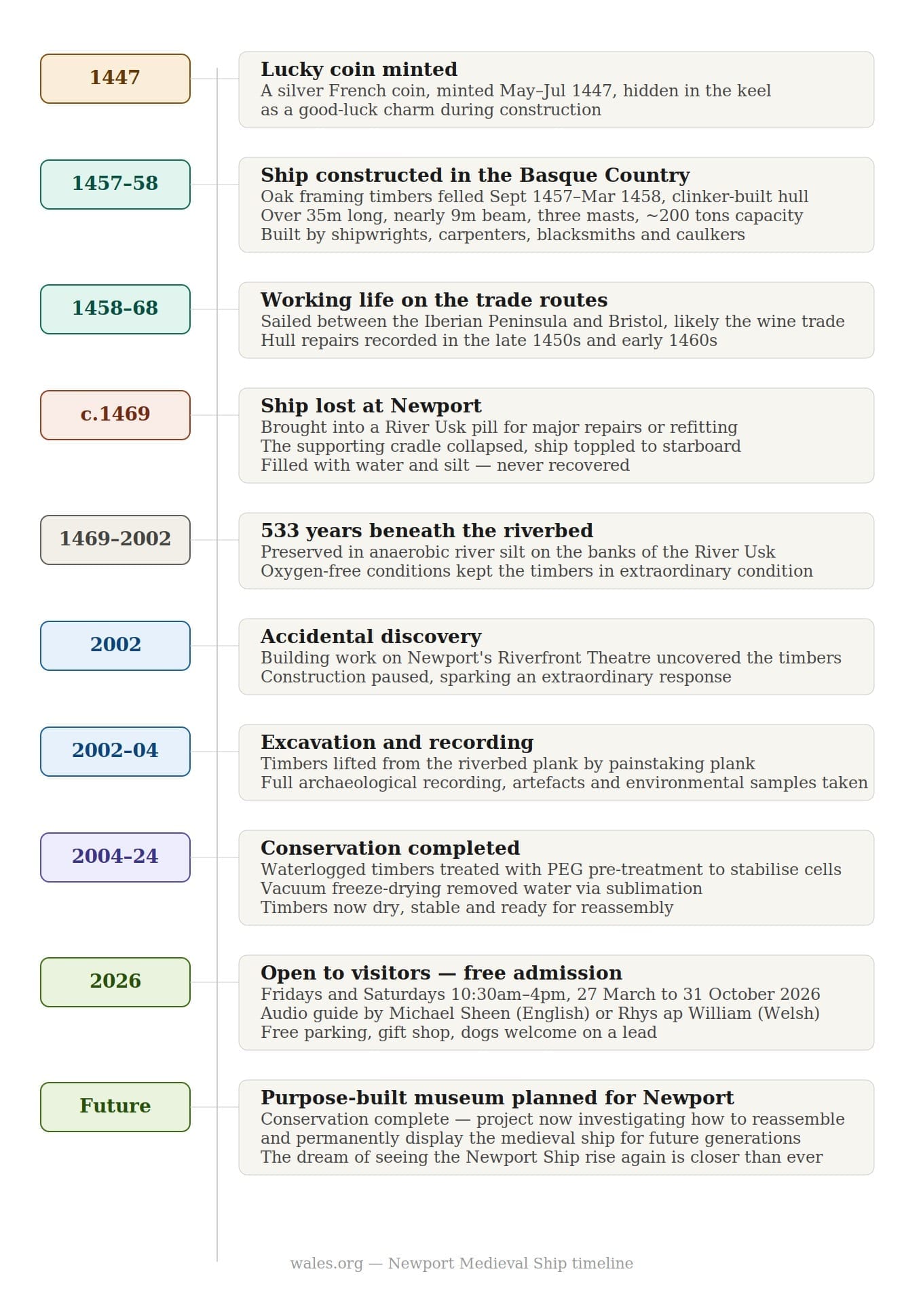
Follow the extraordinary 500-year history of Wales’s premier maritime treasure, tracking its journey from a mid-15th-century Spanish shipyard to its dramatic 21st-century conservation rescue and modern exhibition window.
The history of the Newport Ship at a glance: From historical active trade routes to modern community rescue.
What is the Newport Medieval Ship?
The Newport Ship is a 15th-century clinker-built merchant vessel. It was constructed around 1457–58 in the Basque Country of northern Spain, where dendrochronology — the science of tree-ring dating — has confirmed the oak hull planks were harvested after 1449 and the framing timbers felled between September 1457 and March 1458.
At more than 35 metres in length with a beam of nearly 9 metres, it was a substantial sea-going vessel capable of carrying around 175 tons of cargo. It had three masts, a clinker-built hull (meaning overlapping planks fastened to each other and reinforced by large internal framing timbers), and the structural integrity to trade across the open Atlantic approaches and into the Bristol Channel.
For roughly a decade, the ship sailed between Lisbon, the Iberian Peninsula, and the ports of western Britain. Newport, sitting at the head of the Severn Estuary on the River Usk, was then a thriving commercial port — and it was here, sometime around 1469, that the ship’s working life came to an abrupt and unhappy end.
Brought into a riverside dock, or “pill”, for major repairs, the ship was supported on a wooden cradle while work was carried out. The cradle collapsed. The vessel toppled onto its starboard side and settled into the riverbed, taking on water and silt. What could be salvaged was taken; the rest was left. River silt slowly buried the wreck, creating the anaerobic, oxygen-free conditions that preserved the timbers in extraordinary detail for the next 533 years.
Key Facts and Dimensions
| Measurement | Detail |
|---|---|
| Overall length | 30.6m (estimated original over 35m) |
| Loaded waterline length | 27.0m |
| Keel length | 21.6m |
| Beam | 8.9m |
| Draught (loaded) | 3.9m |
| Freeboard | 2.5m |
| Cargo capacity | ~175 tons |
| Displacement (loaded) | 392.5 tons |
| Total sail area | 394.7 sq m (main 254.6, fore 63.6, mizzen 76.5) |
| Construction | Clinker-built, axe-shaped oak planking |
| Origin | Basque Country, northern Spain |
| Construction date | c.1457–58 |
| Found | 2002, Newport, South Wales |
How the Ship Was Built
The Newport Ship was constructed using the clinker method — the dominant European shipbuilding tradition of the medieval period. Overlapping planks were split radially from long oak trunks using axes and adzes rather than saws (which, though known, were reserved for selective timbers). Each plank was fastened to its neighbour, and the resulting shell was reinforced internally by large framing timbers.
The workforce would have been considerable: shipwrights, carpenters, blacksmiths, caulkers, and riveters working in a structured, organised yard. A vessel of this size would have taken many months to complete.
Hidden in the keel during construction was a small silver French coin, minted between May and July 1447 — a good-luck charm, tucked into a small rebate in the wood. It remains one of the most evocative finds from the entire excavation.
Where Did the Ship Trade?
The evidence points firmly to the Iberian wine trade. Environmental remains, ceramics, and coin finds all suggest a regular circuit between Portugal, Spain, France, and the British Isles — with Bristol, the dominant port of the Severn Sea, likely at the heart of the route.
Nearly 100 cask staves, heads, and hoops were recovered during excavation — strong circumstantial evidence for wine or other liquid cargo carried in wooden barrels. The ship was also found to carry stone projectiles and what appear to be small wrought-iron breech-loading guns, suggesting it could defend itself — or potentially engage in piracy, which was rampant during the Wars of the Roses.
The ships Columbus sailed across the Atlantic in 1492 were smaller.
How Was the Ship Discovered?
In 2002, archaeologists keeping a watching brief on the construction of Newport’s new Riverfront Theatre and Arts Centre identified ancient timbers in the ground of the former River Usk docks. The exposed timbers were unmistakably a ship — and unmistakably old.
Construction paused. The full archaeological team moved in. What followed was one of the largest and most complex maritime excavations in British history, funded by the Welsh Government and Newport City Council, driven by an outpouring of local enthusiasm that has never really dimmed.
The timbers were lifted plank by plank, recorded in extraordinary detail, and moved into storage. The archaeological evidence gathered during excavation — artefacts, environmental samples, coins, and the ship’s own structural fabric — has since been the subject of ongoing specialist analysis and international scholarship.
How It Compares: Great Medieval Ship Discoveries
| Ship | Country | Built | Discovered | Condition |
|---|---|---|---|---|
| Newport Ship | Wales | c.1457–58 | 2002 | Substantial hull surviving |
| Mary Rose | England | c.1510 | 1982 | Half hull, thousands of artefacts |
| Vasa | Sweden | c.1627 | 1961 | Near complete |
| Viking Ships (Roskilde) | Denmark | 11th century | 1962 | Multiple vessels |
The Newport Ship sits in a unique position: later than the Viking discoveries but earlier than the Mary Rose, it fills a critical gap in our understanding of late medieval European shipbuilding.
Conservation: A Decade of Painstaking Work
Waterlogged archaeological wood presents a particular challenge. When freshly excavated, the timber cells are full of water — the very water that has kept them intact for centuries. Remove it too quickly, or without treatment, and the wood shrinks, cracks, and crumbles.
The Newport Ship timbers underwent a multi-stage conservation process:
- Mechanical cleaning — removing sediment from each plank
- Chemical treatment — removal of soluble iron salts that would otherwise cause long-term degradation
- PEG pre-treatment — Polyethylene Glycol impregnation to protect timber cells
- Vacuum freeze-drying — a process called sublimation removes water as vapour, leaving dry, stable wood
The conservation work is now complete. The timbers are dry, stable, and ready for the next stage.
What Happens Next? The Museum Vision
The ultimate ambition of the Friends of the Newport Ship — the charity that has driven the project for years — is to reassemble the medieval ship in a purpose-built museum in Newport. The conservation is done. The challenge now is engineering: how do you reassemble and permanently display a 15th-century ship whose surviving structure weighs hundreds of tonnes?
The project is investigating structural solutions, and the dream of seeing the Newport Ship rise again in its permanent home is closer than it has ever been.
Visiting the Newport Ship Today
While the permanent museum is being planned, the Newport Ship Centre is open to the public each season. Volunteers from the Friends of the Newport Ship run a welcoming, knowledgeable operation from their base on Queensway Meadows Industrial Estate.
Admission is free. There’s free parking. You can take a guided tour with a volunteer or pick up the audio guide — recorded by actor Michael Sheen in English and by Rhys ap William in Welsh — and explore at your own pace. An animated film tells the story of the ship’s construction and its final journey to Newport.
There is a gift shop, hot and cold drinks, and dogs are welcome on a lead.
Getting There
The Newport Ship Centre is at Unit 20, Estuary Road, Queensway Meadows Industrial Estate, Newport, NP19 4SP. Newport railway station is well served by Great Western Railway and Transport for Wales services from Cardiff, Bristol, and London Paddington, making it easily reachable for a day trip.
Opening hours (2026 season):
Fridays and Saturdays, 10:30am – 4:00pm (last entry 3:45pm)
27 March – 31 October 2026
Staying in Newport
Newport is often overlooked as a base for a short break, but it sits in a genuinely useful position — close to the Brecon Beacons National Park (Bannau Brycheiniog), the Wye Valley, and the Vale of Usk. If you’re planning a visit to the ship, consider spending a night or two and exploring the surrounding area.
Find Hotels and Accommodations in Newport
Browse the interactive map below to track real-time accommodation options near the Newport Ship Centre and the surrounding region.
Frequently Asked Questions
Is the Newport Medieval Ship free to visit?
Yes. Admission to the Newport Ship Centre is free, though donations are warmly welcomed. The Friends of the Newport Ship are a registered charity (No. 1105449) and rely on visitor support.
When is the Newport Ship open?
The Ship Centre is open Fridays and Saturdays from 10:30am to 4:00pm (last entry 3:45pm), from 27 March to 31 October 2026.
How old is the Newport Ship?
The ship was built around 1457–58 in the Basque Country of northern Spain, making it approximately 567–568 years old. It pre-dates the Mary Rose by around 50 years.
Is the Newport Ship the oldest ship in Wales?
It is the oldest substantial ship hull surviving in Wales, and one of the oldest in Europe from this period of maritime history.
Can you see the actual ship timbers at Newport?
Yes. The surviving timbers are housed at the Newport Ship Centre and can be viewed during opening hours, either on a guided volunteer tour or via the audio guide.
Is the Newport Ship suitable for children?
Absolutely. The animated film, audio guide, and hands-on volunteer-led tours make it an engaging visit for older children and teenagers with an interest in history, archaeology, or adventure.
Is there parking at the Newport Ship Centre?
Yes, there is free parking on site.
Will the Newport Ship ever be reassembled?
That is the ultimate goal of the Friends of the Newport Ship. Conservation of the timbers is now complete, and the project is actively investigating how to reassemble the ship in a purpose-built museum in Newport.
Support the Friends of the Newport Ship
The entire project — the excavation, the conservation, the visitor centre, and the vision of a permanent museum — has been sustained by community passion and charitable support. You can become a Friend of the Newport Ship, make a donation, or volunteer your time. Visit newportship.org for more.

Pembrokeshire-born travel writer and founder of Wales.org. Born in Haverfordwest, now based in Hertfordshire — covering Welsh castles, national parks, festivals and family staycations across all 22 Welsh counties.