

The Heart of Wales Line: Britain’s Most Scenic Train Journey
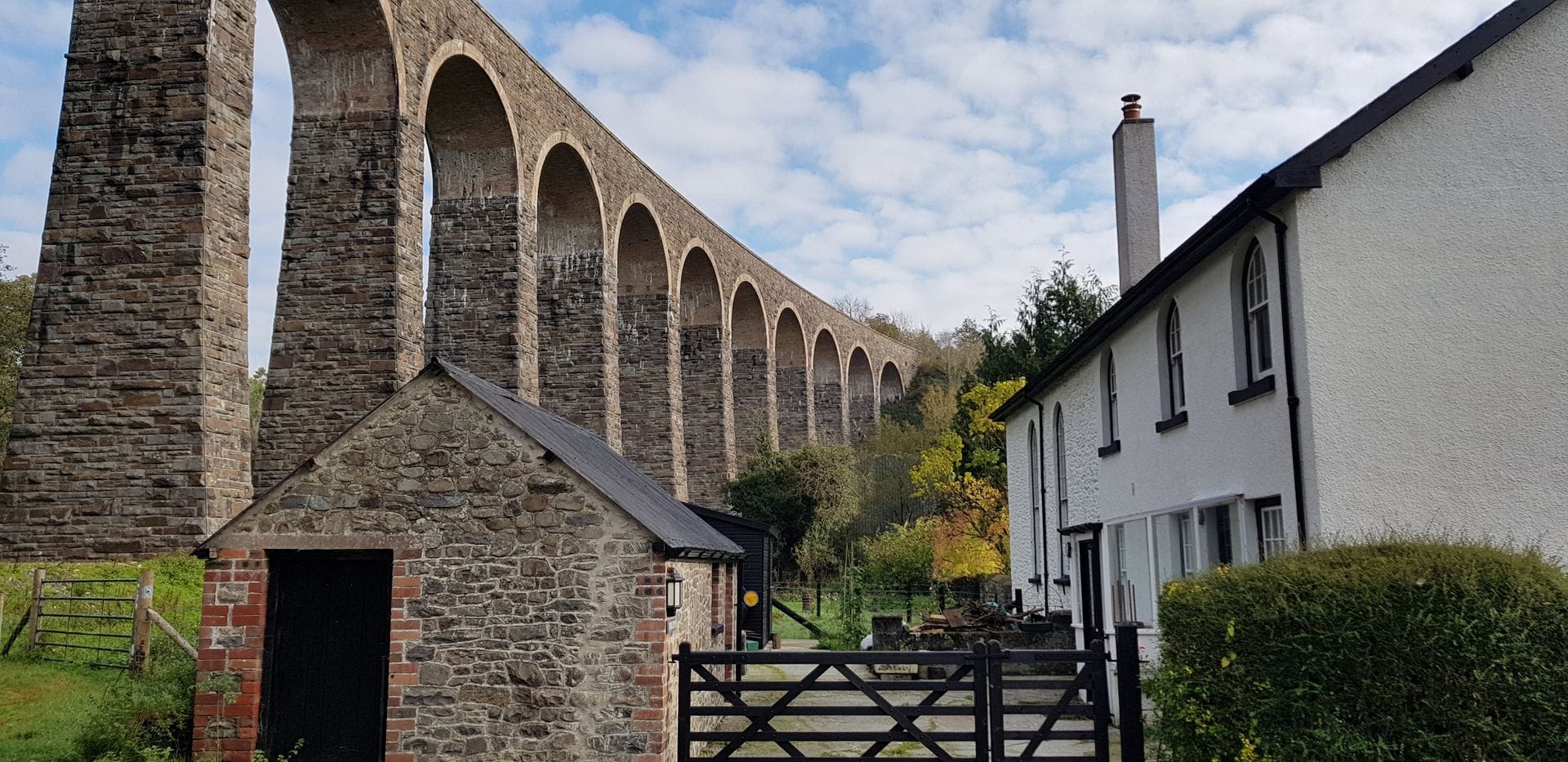
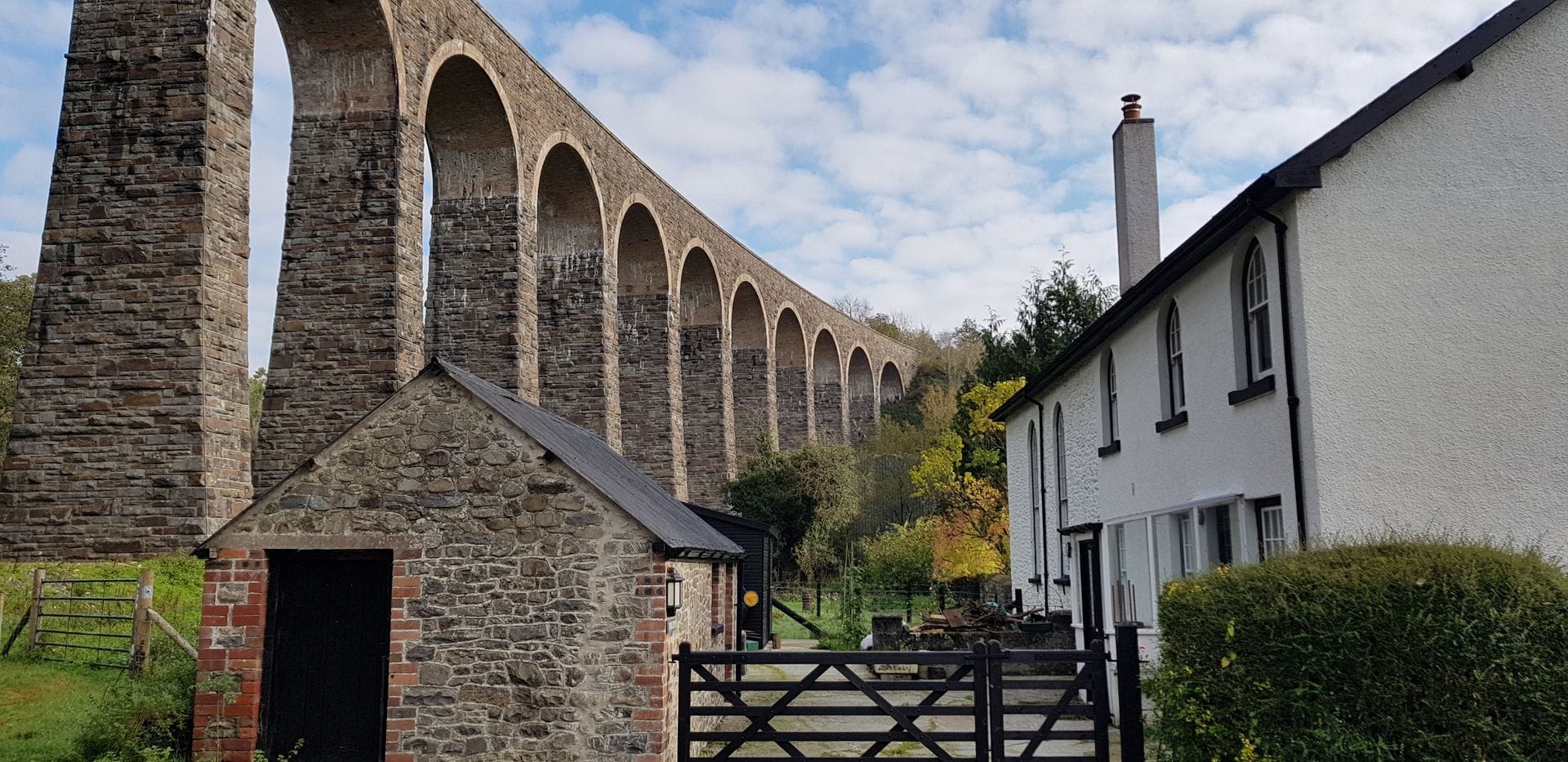
The impressive Cynghordy Viaduct towering over the surrounding buildings at Llanfair-ar-y-bryn.
The Heart of Wales Line is a 121-mile rural railway between Swansea and Shrewsbury, passing through Carmarthenshire, Powys and Shropshire on its way across the Cambrian Mountains. Operated by Transport for Wales, it is widely regarded as one of the most scenic train journeys in Britain — the line crosses 18 viaducts, passes through three significant tunnels, climbs to the most geographically remote railway station in Wales, and runs alongside the Tywi, Bran and Irfon valleys. A full one-way journey takes around four hours; the Heart of Wales Circular Day Ranger ticket allows unlimited hop-on, hop-off travel for one full day. The line runs every day of the year apart from Christmas Day.
This guide covers the full route station by station, the key scenic highlights to watch for from the carriage window, the best places to stop off for a day or overnight, how to book tickets at the cheapest rate, and how to combine the railway with the parallel 141-mile Heart of Wales Line Trail walking route. All information has been verified against Transport for Wales, Network Rail and the Heart of Wales Line Community Rail Partnership as of June 2026.
Planning this trip? Ask Branwen, our free AI trip planner →
At a Glance: The Heart of Wales Line
- Route: Swansea to Shrewsbury, 121 miles via Llanelli, Llandeilo, Llandovery, Llanwrtyd Wells, Llandrindod Wells, Knighton and Craven Arms
- Operator: Transport for Wales
- Frequency: 4 to 5 services per day each way Monday to Saturday; 2 services each way on Sundays
- Journey time: Approximately 4 hours end to end
- Best ticket: Heart of Wales Circular Day Ranger — unlimited hop-on, hop-off on the full Cardiff Central – Swansea – Shrewsbury circular route, valid one day
- Best scenic section: Llandovery to Llandrindod Wells, crossing Cynghordy Viaduct and Sugar Loaf Tunnel
- Most remote station: Sugar Loaf (Powys) — the most geographically isolated railway station in Wales
- Concessions: Welsh concessionary travel pass holders ride free 1 October to 31 March
Why the Heart of Wales Line is Special
The Heart of Wales Line was built in stages between the 1850s and 1868 by a succession of small Welsh railway companies — the Knighton Railway, the Central Wales Railway, the Central Wales Extension Railway, the Vale of Towy Railway and the Llanelly Railway — before being absorbed into the London and North Western Railway, which used the route to reach Swansea. The whole line has been single track since 1972 under a Light Railway Order, the engineering remains substantially Victorian, and the route survives almost intact through the closures of the 1960s Beeching cuts, saved by local advocacy and the recognition that the railway was the only viable transport link to many of the rural communities it serves.
For visitors, this combination of preserved Victorian engineering, genuine rural remoteness and an everyday timetable means the Heart of Wales Line offers something that no heritage steam railway can match: it is a working scenic railway, used by locals as well as tourists, and a Day Ranger ticket gives a complete trans-Wales journey for less than the price of a single supermarket weekly shop.
For preserved heritage railways operated by enthusiast volunteers — Ffestiniog, Talyllyn, Welsh Highland, Vale of Rheidol and others — see our guide to the most picturesque steam railways in Wales.
The Route, Stop by Stop
The full Heart of Wales Line has 29 stations between Swansea and Shrewsbury. Many are request stops where you must signal the driver to stop the train. Below are the most important stations, working from south to north.
Swansea (SWA) to Llanelli (LLE)
The journey begins at Swansea High Street, sharing track with the main South Wales line as far as Llanelli (about 30 minutes). Llanelli is the formal junction where Heart of Wales services branch off from the main line and head north into the Tywi Valley.
Llandeilo (LLL) — Tywi Valley gateway
Llandeilo is the first proper Heart of Wales destination — a small market town on the River Tywi with independent food shops, the National Botanic Garden of Wales nearby, and Dinefwr Park (a National Trust deer park with a medieval castle). Worth a stop of several hours or a full day.
Llandovery (LLV) — Victorian market town
Llandovery (population around 2,800) sits at the foot of the Cambrian Mountains and the gateway to the wildest section of the line. The town has a ruined Norman castle, a striking statue of Welsh prince Llywelyn ap Gruffudd Fychan, several independent cafés, the Heart of Wales Whisky Distillery, and quick access to the Brecon Beacons National Park.
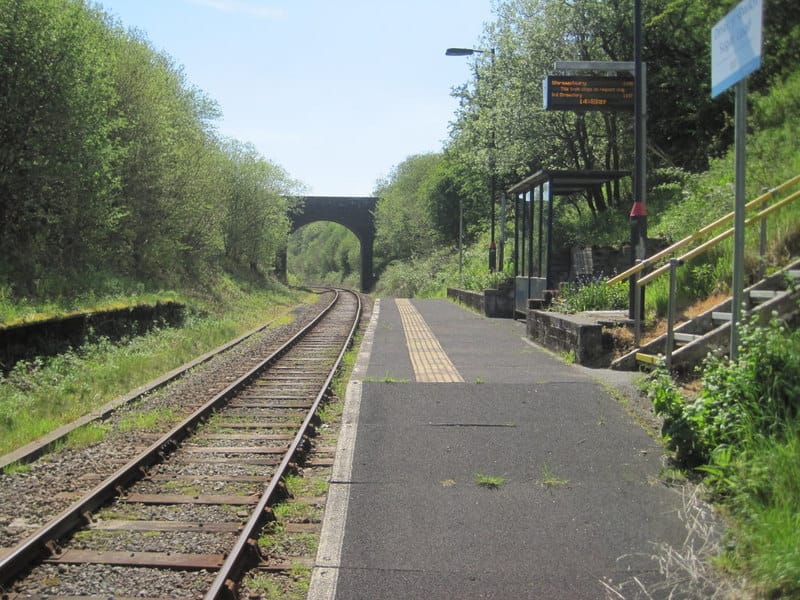
Sugar Loaf station — the most geographically remote railway station in Wales, served by request stop only.
Cynghordy (CYN) and Sugar Loaf (SUG) — the scenic high point
Between Llandovery and Llanwrtyd Wells the line climbs into the Cambrian Mountains and crosses its most famous feature. The Cynghordy Viaduct is a Grade II listed 18-arch viaduct carrying the line on a gentle curve across the Afon Bran valley, 102 feet (31 metres) high and 850 feet (260 metres) long. It was built from sandstone and brick between 1867 and 1868 and underwent a £3.5 million Network Rail restoration completed in recent years. Just north of Cynghordy station the line enters the 1,000-yard (910-metre) Sugar Loaf Tunnel, approached by gradients as steep as 1 in 60. Sugar Loaf station itself sits at the northern end of the tunnel and is the most geographically remote railway station in Wales — opened 1868, originally built to serve cottages occupied by railway workers, now used mostly by walkers heading for the Sugar Loaf hill (326 metres) just to the south. The station is a request stop.
Llanwrtyd Wells (LNW) — Britain’s smallest town
Llanwrtyd Wells (population around 850) is officially Britain’s smallest town and the venue for the annual World Bog Snorkelling Championships, held each August. The town also hosts the Man v Horse Marathon (June) and the Real Ale Wobble (November). Beyond the eccentricity it is a charming Victorian spa town with good independent food and quick access to the Mynydd Epynt uplands.
Llandrindod Wells (LLO) — Victorian spa town
Llandrindod Wells is the largest town in central Powys and was Wales’s principal Victorian spa resort. The town centre retains substantial Victorian architecture including the Pump Room, the Rock Park gardens, and the Victorian-era National Cycle Museum. Llandrindod is the main interchange and operational centre on the line, with the most frequent service.
Knighton (KNI) — on Offa’s Dyke
Knighton (Welsh: Tref-y-Clawdd, “the town on the dyke”) sits directly on the line of Offa’s Dyke, the 8th-century earthwork built by King Offa of Mercia to mark the English-Welsh border. The town is the official halfway point on the 177-mile Offa’s Dyke Path national trail and home to the Offa’s Dyke Centre. Worth a stop of several hours.
Craven Arms (CRV) — Shropshire Hills gateway
Craven Arms in Shropshire is the northern Welsh interchange — the line continues to Shrewsbury but Craven Arms is where the Heart of Wales Line joins the Manchester to South Wales mainline. The town is home to the Secret Hills Discovery Centre, the gateway to the Shropshire Hills Area of Outstanding Natural Beauty.
Shrewsbury (SHR) — northern terminus
Shrewsbury is a historic English market town on the River Severn, with one of the best-preserved medieval and Tudor town centres in Britain. The station functions as a major regional interchange, providing direct connections to Birmingham, Manchester, and Crewe, alongside connecting services to London Euston.
The Best Tickets to Buy
Heart of Wales Circular Day Ranger
This is the best-value ticket on the line. The Circular Day Ranger covers the full circular route between Cardiff Central, Swansea, Llandrindod Wells, Craven Arms, Shrewsbury and back to Cardiff Central, in either direction. It is valid for one full calendar day with unlimited hop-on, hop-off travel. Adult fares are typically around £44 — significantly cheaper than buying a series of point-to-point tickets and far cheaper than the equivalent journey on any named heritage railway. Available with Two Together, 16-25, 26-30, Senior, Disabled Persons and Veterans Railcard discounts. Buy from any staffed Transport for Wales station or from the conductor onboard at unstaffed stations.
Advance singles
Released approximately 12 weeks in advance and limited in number. If your dates are fixed, advance singles between Swansea and Shrewsbury offer the cheapest way to do the full line in one direction. Book through Transport for Wales or Trainline.
Welsh concessionary travel
If you hold a Welsh concessionary travel pass issued by a Welsh local authority, you can travel free on the Heart of Wales Line between 1 October and 31 March. Pass holders cannot use the scheme for journeys wholly between Shrewsbury and Bucknell or between Llanelli and Swansea (these stretches use shared track with non-eligible services), but the central Welsh section is entirely covered.
Best value Day Ranger strategy: Buy the Circular Day Ranger from Cardiff Central, take the train to Swansea (45 minutes), pick up the Heart of Wales service to Shrewsbury (around 4 hours with two short station breaks at Llandovery and Llandrindod Wells), then catch a direct Transport for Wales service back to Cardiff via Newport (about 2 hours 15 minutes). Total journey time around 8 hours; you’ll see the full line and complete a Welsh circumnavigation on a single ticket.
What to See From the Train
Cynghordy Viaduct (between Llandovery and Cynghordy)
The signature engineering feature of the line. The viaduct is 102 feet high and 850 feet long, with 18 semi-circular sandstone arches lined with brick. It curves gently across the Bran Valley and was completed in 1868 by the Central Wales Extension Railway. Sit on the left-hand side of a northbound train (right-hand side southbound) for the best valley views.
Sugar Loaf Tunnel (between Cynghordy and Sugar Loaf)
1,000 yards (910 metres) long, completed 1868, and approached on both sides by gradients of 1 in 60 — among the steepest sustained climbs on the British mainline network. The tunnel marks the watershed between the southern (Tywi/Bran) and northern (Irfon) catchments.
Knucklas Viaduct (north of Knighton)
The second great viaduct on the line. The Knucklas Viaduct is a 13-arch Grade II listed structure crossing the Heyope valley near Knucklas, complete with castellated stone towers at each end — built in 1864 in a deliberately romantic style. Visible from the train on the right (southbound) approach to Knighton.
Red kites
Red kites are visible from the train across most of the central section between Llandovery and Knighton, with the Mid-Wales reintroduction programme having made this one of the densest populations in Europe. The Gigrin Farm Red Kite Centre near Rhayader, just off the line from Llandrindod, hosts daily public feeding sessions at 2pm in winter and 3pm in summer, when 300 to 600 birds typically gather. Worth a half-day stop from Llandrindod Wells.
Tywi, Bran and Irfon valleys
The route follows three major river valleys in turn — the Tywi from Llanelli to Llandovery, the Bran across the Cynghordy crossing, and the Irfon from Llanwrtyd Wells onward. Each valley has its own character: the Tywi is the broad pastoral lowland, the Bran is the dramatic gorge, the Irfon is the upland watercourse winding through open moor.
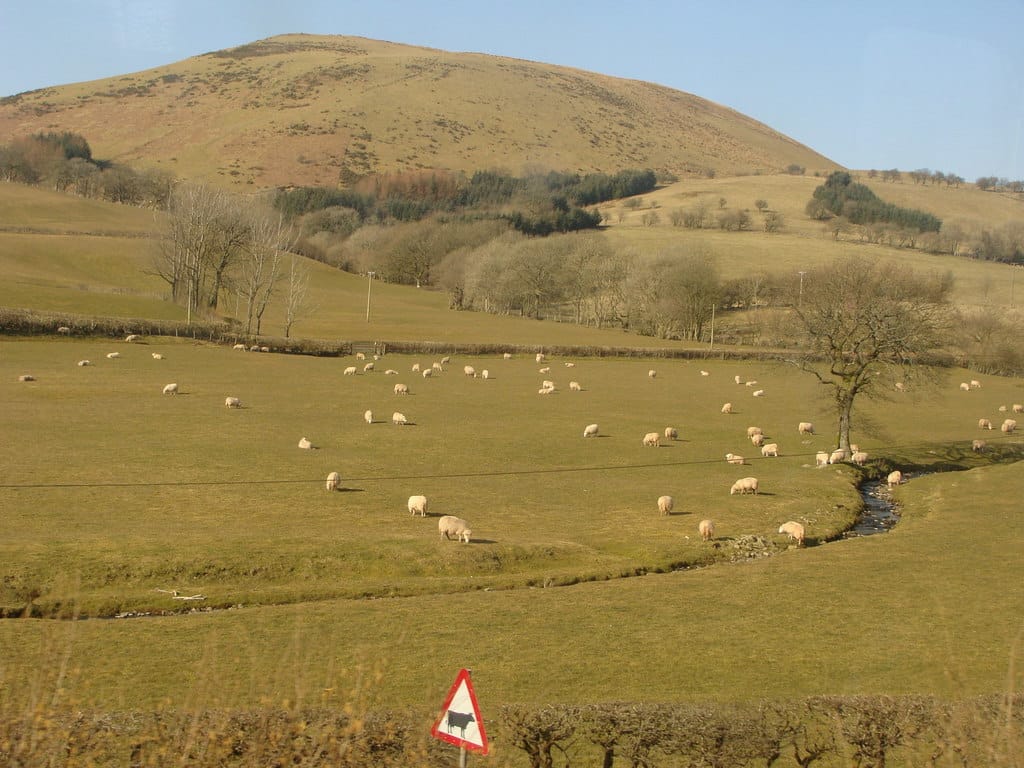
A flock of sheep grazing by the Nant y Cae stream, as seen from the Heart of Wales railway line.
Best Places to Stop Off
For a one-day trip
If you have only one day and want to see the most scenic section without the full 8-hour circular, the recommended pattern is Swansea to Llandrindod Wells and back. The return journey takes about 5 hours including a 2-hour lunch break at Llandrindod. You cover Cynghordy Viaduct, Sugar Loaf Tunnel and the Bran/Irfon valleys but skip the slightly less dramatic northern section to Shrewsbury.
For two days with an overnight
The best two-day combination is to break the trip at Llandrindod Wells, stay overnight in a Victorian-era hotel in the spa town, then continue to Shrewsbury the following morning. Llandrindod has more accommodation than any other town directly on the line.
For walkers — the Heart of Wales Line Trail
The 141-mile Heart of Wales Line Trail is a long-distance walking route that broadly follows the railway between Craven Arms in Shropshire and Llanelli in Carmarthenshire. The trail is designed specifically so that walkers can use the train to return to the start of their next stage, or to break a multi-day walk into manageable sections. See the Heart of Wales Line Community Rail Partnership for the full set of station walks.
Where to Stay Near the Line
The best bases for a Heart of Wales Line trip are the towns directly on the route. Llandeilo and Llandovery in the south, Llanwrtyd Wells in the middle, and Llandrindod Wells and Knighton in the north all have a good range of independent hotels, B&Bs and self-catering cottages. For a luxury rural base near the line, the wider Powys countryside has some of the best country hotels and shepherd’s hut glamping in Wales.
Find Hotels and Cottages Along the Heart of Wales Line
Browse the interactive map below to see real-time hotel and cottage prices in Llandovery, Llanwrtyd Wells, Llandrindod Wells, Knighton and the wider Mid Wales countryside — perfect for planning a multi-day rail journey or a walking-and-train holiday.
Booking tip: Llandrindod Wells has the largest concentration of accommodation directly on the line and the best evening food scene. Llanwrtyd Wells is busiest in early August (Bog Snorkelling Championships) and June (Man v Horse Marathon) — book months ahead for those dates if you want to stay in the town itself.
How to Plan a Heart of Wales Trip
The classic day trip
The classic Heart of Wales day trip is a full circular journey using the Heart of Wales Circular Day Ranger. Start at Cardiff Central, take the early Transport for Wales service to Swansea (about 1 hour). Board the Heart of Wales service to Shrewsbury (about 4 hours, including 2 to 3 short station stops). Take the direct Transport for Wales service from Shrewsbury back to Cardiff via Newport (about 2 hours 15 minutes). Total round trip is around 8 hours, all on one ticket.
Two-day route
Break the journey overnight at Llandrindod Wells (the most accommodation, best food scene), Llandovery (smaller, more independent) or Llanwrtyd Wells (Britain’s smallest town). The natural break point is roughly halfway through the route. With an overnight you can take time at the scenic central section and visit the Gigrin Farm red kite feeding from Llandrindod.
Walking-and-train holiday
The 141-mile Heart of Wales Line Trail can be walked in 12 to 14 days end to end, or broken into shorter sections of two to three days each using the train as a return service. The Community Rail Partnership website has station-by-station walking notes for each section.
When to Travel the Heart of Wales Line
The line operates year-round (closed Christmas Day only). Each season offers something different:
- Spring (April–May): Lambs in the fields, fresh green throughout the valleys, daffodils along the line. Quietest period for visitor numbers.
- Summer (June–August): Longest days, fullest service frequency, best weather odds. Llanwrtyd Wells events draw crowds in June and August. Pre-book Llandrindod accommodation.
- Autumn (October–November): Spectacular autumn colour through the Bran and Irfon valleys. The Welsh concessionary pass is valid from 1 October — pass holders ride free.
- Winter (December–February): Bare landscapes, low light, possible snow on the Cambrian Mountains. Concessionary travel still valid until 31 March. Best for photographers but check engineering works — winter is when most major maintenance happens.
Engineering work alert: Heart of Wales Line maintenance is concentrated in autumn and winter weekends. Always check National Rail Enquiries for the date of travel — rail replacement buses are common on the central section during planned closures and can add several hours to the journey.
Onward Journeys From Both Ends
At the southern end, Swansea connects directly to Cardiff (45 minutes), Bristol (2 hours via Newport), London Paddington (around 3 hours direct), and the West Wales line to Pembrokeshire (Carmarthen, Whitland, Pembroke Dock, Milford Haven, Fishguard Harbour). The Swansea Bay coastal walk and the swansea-bay area are within easy reach.
At the northern end, Shrewsbury connects to Birmingham (1 hour), Manchester Piccadilly (1 hour 15 minutes), Crewe (45 minutes for connections to Liverpool, Glasgow and London Euston), and Cardiff via Newport (2 hours 15 minutes direct).
Frequently Asked Questions: The Heart of Wales Line
How long is the Heart of Wales Line?
The Heart of Wales Line is a 121-mile rural railway between Swansea and Shrewsbury, passing through Carmarthenshire, Powys and Shropshire. It is single track for almost its entire length, calls at 29 stations, and is operated seven days a week by Transport for Wales. A full journey from Swansea to Shrewsbury takes around 4 hours.
Is the Heart of Wales Line worth doing?
Yes. The Heart of Wales Line is widely regarded as one of the most scenic train journeys in Britain. The route crosses the 18-arch Cynghordy Viaduct, passes through the 1,000-yard Sugar Loaf Tunnel, calls at Sugar Loaf, the most geographically remote railway station in Wales, and runs alongside the Tywi, Bran and Irfon valleys. Red kites are visible from the train across most of the central section. It is one of the cheapest scenic railway journeys in Britain compared with named heritage routes.
How much does the Heart of Wales Line cost?
A single Swansea to Shrewsbury ticket costs approximately £45 to £55 standard return depending on the day and time. The Heart of Wales Circular Day Ranger is the best-value option for a full day of exploring, covering the entire circular route from Cardiff Central via Swansea, Llandrindod Wells, Craven Arms and Shrewsbury, valid for one full day. Welsh concessionary travel pass holders ride free between 1 October and 31 March. Children under 5 travel free; under 16s ride at half price.
What is the most scenic part of the Heart of Wales Line?
The 30-mile central section between Llandovery and Llandrindod Wells is the most spectacular. This stretch crosses the Cynghordy Viaduct (102 feet high, 850 feet long, 18 arches, built in 1868), climbs through the Sugar Loaf Tunnel (1,000 yards long, with gradients up to 1 in 60), and calls at Sugar Loaf station, the most geographically remote railway station in Wales. The Bran Valley and the Cambrian Mountains uplands beyond are visible throughout.
How many trains run on the Heart of Wales Line each day?
The Heart of Wales Line runs four to five services per day in each direction Monday to Saturday, with two services in each direction on Sundays. The service is operated by Transport for Wales using Class 150 and Class 153 diesel multiple units. The line is single track throughout (except a few miles at the southern end) and many stations are request stops, requiring passengers to signal the driver to stop. Always check the live timetable on Transport for Wales before travelling.
Can you stop off along the Heart of Wales Line?
Yes — the Heart of Wales Circular Day Ranger ticket allows unlimited hop-on, hop-off travel within one calendar day on the full circular route. The best places to stop off are Llandeilo (independent shops, Dinefwr Park, gateway to the Tywi Valley), Llandovery (Victorian market town with castle ruins), Llanwrtyd Wells (Britain’s smallest town and bog snorkelling championship venue), Llandrindod Wells (Victorian spa town), Knighton (on Offa’s Dyke Path) and Craven Arms (the Shropshire Hills gateway).
How do I book Heart of Wales Line tickets?
Standard tickets, advance fares and the Heart of Wales Circular Day Ranger are available through Transport for Wales (tfw.wales), National Rail Enquiries, Trainline, or directly at staffed station ticket offices. At unstaffed stations, tickets can be bought from the train conductor onboard. Advance fares (released approximately 12 weeks ahead) offer the cheapest single-journey prices. The Day Ranger is bought as a flat-rate ticket at any staffed station or onboard.
More Welsh Travel Guides

Pembrokeshire-born travel writer and founder of Wales.org. Born in Haverfordwest, now based in Hertfordshire — covering Welsh castles, national parks, festivals and family staycations across all 22 Welsh counties.