

Stargazing in Wales: The Best Dark Sky Spots and Reserves
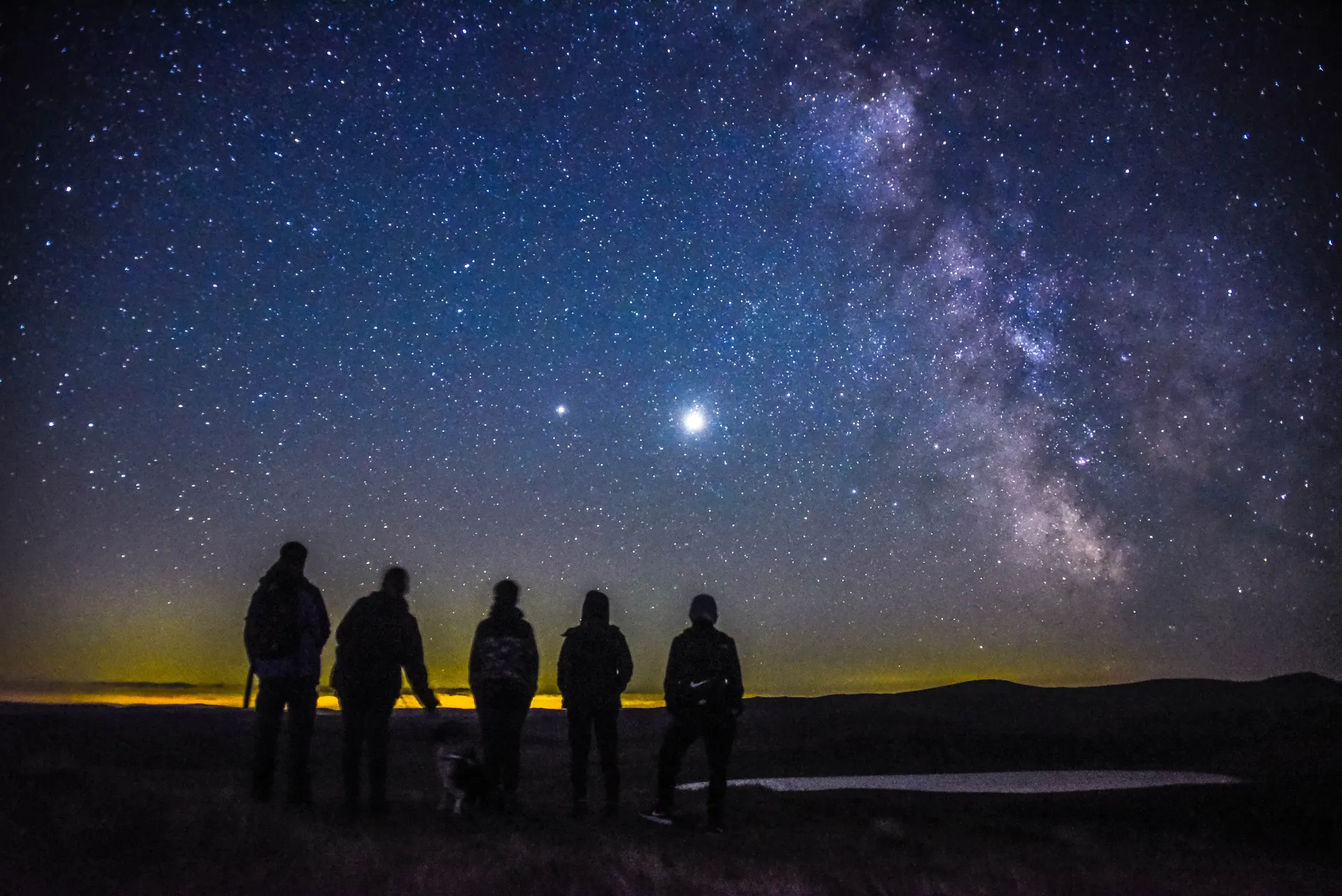
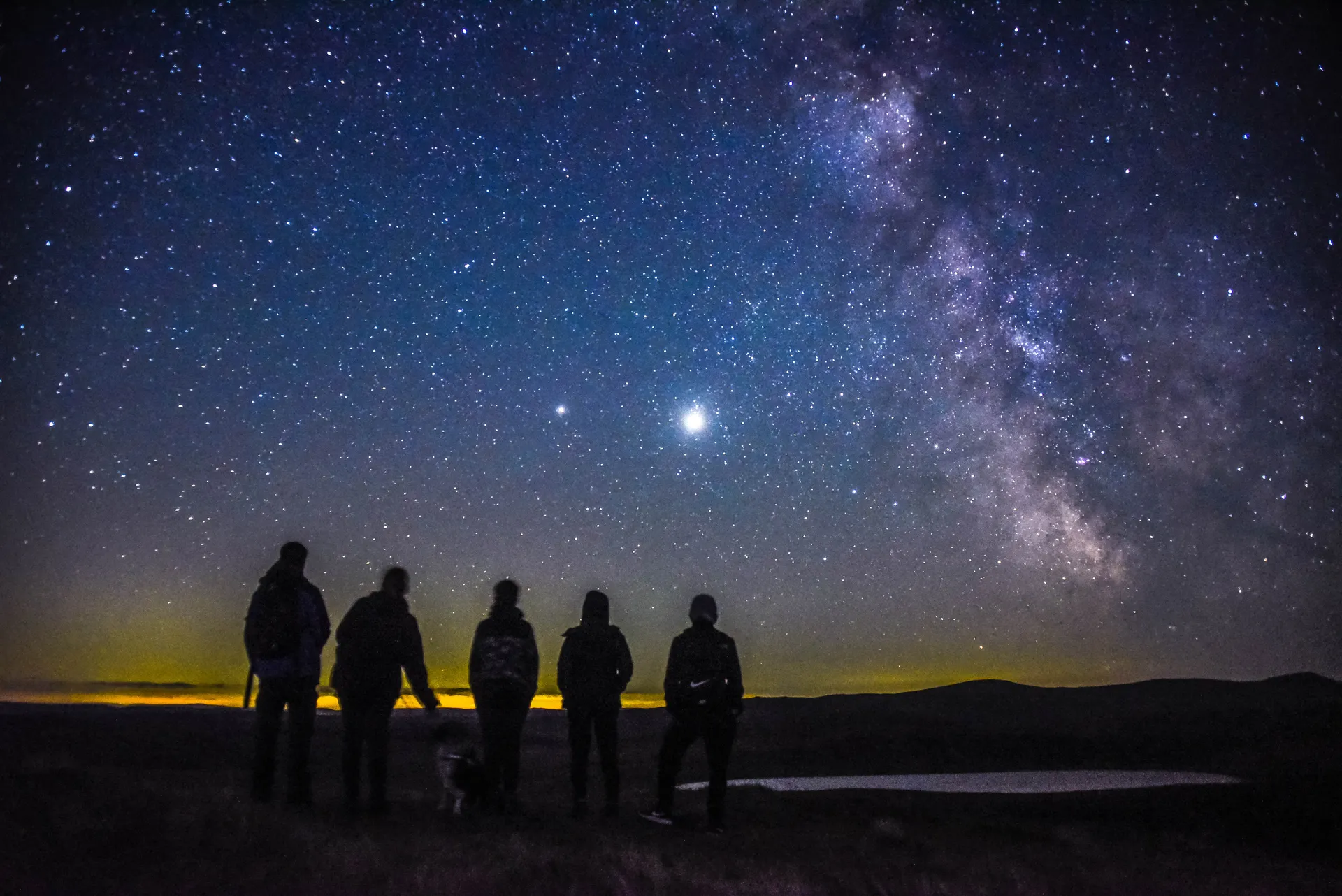
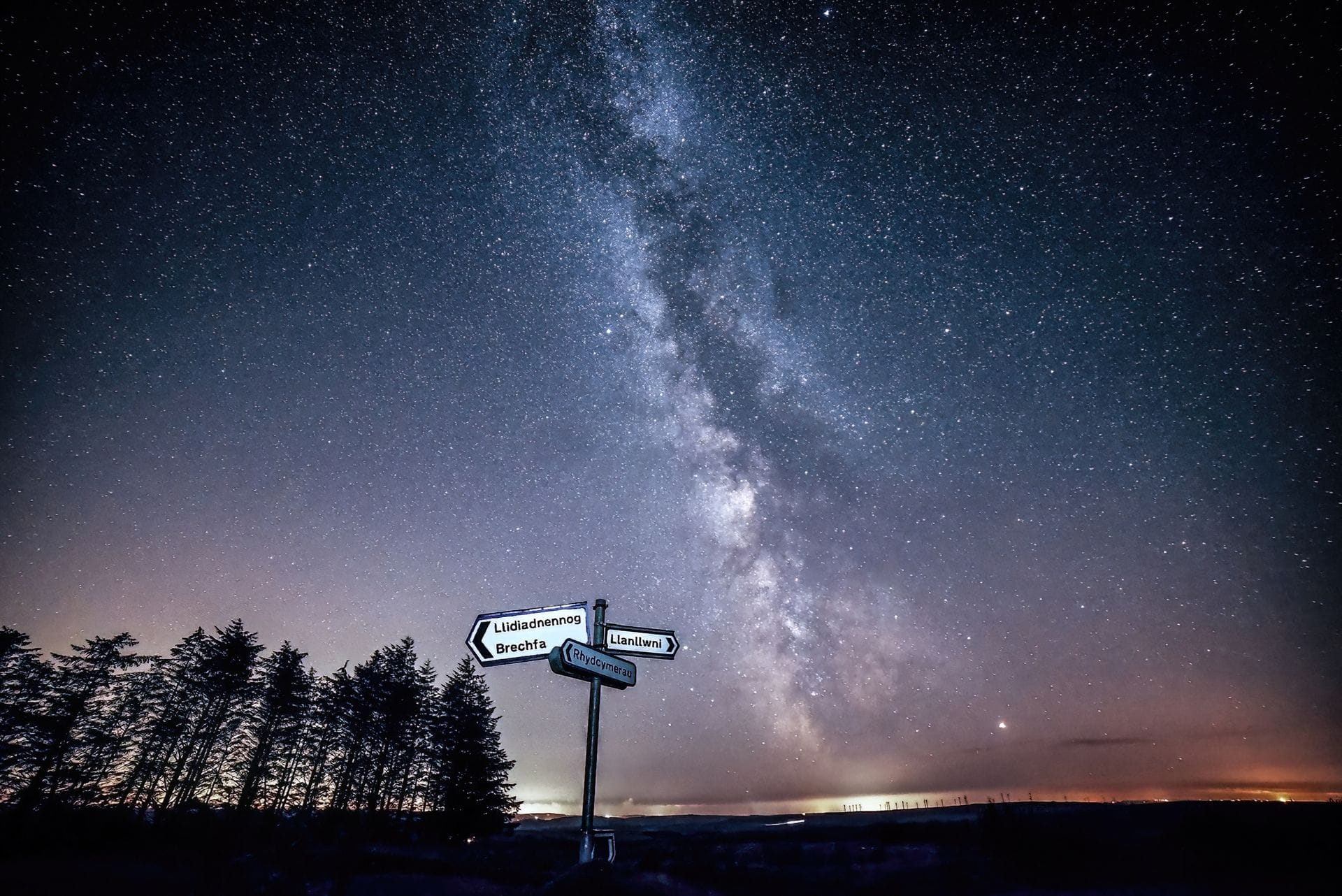
The Milky Way above Eryri — one of two International Dark Sky Reserves in Wales.
Wales is, by one measure, the best country in the world for stargazing. Around 18 percent of Wales now sits under certified dark-sky protection — proportionally more than any other country on Earth. Five separate areas hold formal dark-sky designations from DarkSky International, and together they cover the long spine of upland and rural Wales from Bardsey Island in the west to the Welsh Borders in the east.
This guide covers all five designated areas, the best individual stargazing sites within each one, the times of year and times of night that work best, what you can see with the naked eye versus with binoculars or a telescope, and how to plan a stargazing trip — including practical advice on clothing, photography and guided experiences. Everything has been verified against the official park authority sources as of May 2026.
Planning this trip? Ask Branwen, our free AI trip planner →
At a Glance: Stargazing in Wales
- Best months: October to March (long, dark nights)
- Best time of night: One hour after sunset for the Milky Way; two hours after for the deepest darkness
- Best moon phase: Four to five days either side of a new moon
- Equipment needed: None for naked-eye stargazing. Binoculars (10×50) recommended. Warm clothing essential year-round
- Darkest single site: Ynys Enlli (Bardsey Island) — Europe’s first International Dark Sky Sanctuary
- Most accessible darkness: Usk Reservoir, Bannau Brycheiniog (free car park, walk straight out onto the dam)
- Best for families and beginners: Bannau Brycheiniog National Park Visitor Centre at Libanus — regular guided events
- Best photographic spot: Llynnau Cregennen on the slopes of Cadair Idris — twin lakes mirror the night sky
Why Wales Punches So Far Above Its Weight
Three things combine to make Welsh skies extraordinary. The first is geography: the mountainous spine running down the centre of the country — from Eryri through the Cambrian Mountains to Bannau Brycheiniog — is sparsely populated, with whole valleys containing no permanent settlements and therefore almost no light pollution. The second is policy: park authorities and Welsh Water have spent more than a decade upgrading streetlights to low-impact, shielded LED designs, both inside and around the designated reserves. The third is recognition: DarkSky International has now awarded Wales five separate certifications, which collectively cover almost a fifth of the country.
For visitors, this means that you can drive less than two hours from a major city — Cardiff, Swansea, Liverpool, Manchester — and reach skies dark enough to see the Milky Way with your naked eye. The same is not true in most of England. Wales sits in a genuinely unusual position: a developed country with some of the most accessible dark skies anywhere in the world.
The Five Designated Dark-Sky Areas of Wales
1. Bannau Brycheiniog (Brecon Beacons) — International Dark Sky Reserve, 2013
The first dark-sky designation in Wales and the fifth in the world. Bannau Brycheiniog became an International Dark Sky Reserve on 19 February 2013, recognising the exceptional darkness of the park’s open moorland and reservoir landscapes despite its proximity to Cardiff and Swansea — on a clear night the Milky Way is visible from spots less than an hour from either city.
The four Dark Sky Discovery Sites within the park each have car parking and good night-sky horizons:
- Usk Reservoir — widely regarded as the darkest spot in the entire park. Free car parking, and you can walk straight out onto the dam itself. Best for seeing the Milky Way running directly overhead in summer and autumn.
- Llangorse Lake — the largest natural lake in South Wales. Open eastern horizon, good for moonrise photography.
- Pontsticill Reservoir — easy access from Merthyr Tydfil; the Brecon Mountain Railway terminus.
- Crai Reservoir — quieter than Usk, in the western half of the park.
The National Park Visitor Centre at Libanus (near Brecon) hosts regular guided stargazing events with Dark Sky Wales, including an inflatable planetarium for cloudy nights. The on-site Brecon Beacons Observatory has a 12-inch Dobsonian telescope available for visitor use during scheduled sessions.
2. Eryri (Snowdonia) — International Dark Sky Reserve, 2015
Wales’s largest dark-sky area by surface, covering more than 2,000 square kilometres of protected terrain. Eryri became an International Dark Sky Reserve in December 2015, recognised by DarkSky International as one of the darkest places remaining in southern Britain. The park’s combination of high mountains and uninhabited interior valleys gives a remarkable depth of darkness once you’re more than ten minutes’ walk from any village.
Specific stargazing locations to head for:
- Llyn Geirionydd — a tree-lined lake in the Gwydyr Forest near Trefriw. Considered by many local astronomers to offer the clearest dark-sky views in the entire park. Has a car park with toilets.
- Llynnau Cregennen — twin lakes on the slopes of Cadair Idris. Reflections of the night sky in the still waters make this one of the most photogenic stargazing spots in Britain.
- Llyn y Dywarchen — a small lake in the Nantlle valley with very low surrounding light.
- Bwlch y Groes (the Pass of the Cross) — a high mountain road between Dinas Mawddwy and Llanuwchllyn at 545m elevation. Unrestricted 360° horizon. Famously cold even in summer — wrap up.
- Llyn Llydaw — accessed via the Miners’ Track from Pen y Pass. Fully walkable, suitable for younger families and stargazers with mobility considerations.
Eryri has its own team of Dark Sky Rangers who lead seasonal guided night walks. Walks are advertised on the park authority’s website and book up quickly in autumn and winter.
3. Elan Valley — International Dark Sky Park, 2015
The only International Dark Sky Park in Wales, and the only privately-owned Dark Sky Park in the world. Elan Valley sits roughly midway between Eryri and Bannau Brycheiniog and covers 45,000 acres (70 square miles) of reservoirs, moorland and woodland owned by Dŵr Cymru Welsh Water. The estate gained the designation in early 2015 — a few months before Eryri — and works actively to keep its skies dark, including adapting its own street lamps to minimise light pollution.
The Elan Estate’s combination of large open reservoirs and surrounding hills gives some of the most reliable wide-horizon stargazing in Wales. Particularly good spots:
- Caban Coch Reservoir — the most accessible, with parking close to the dam.
- Claerwen Reservoir — further into the estate, darker and quieter.
- The Elan Valley Visitor Centre — runs astronomy weekends in autumn and winter, with telescopes provided.
Note that several hundred square kilometres of equally dark sky exist outside the formally-designated estate boundary — the surrounding Cambrian Mountains are some of the most lightly-populated land in southern Britain.
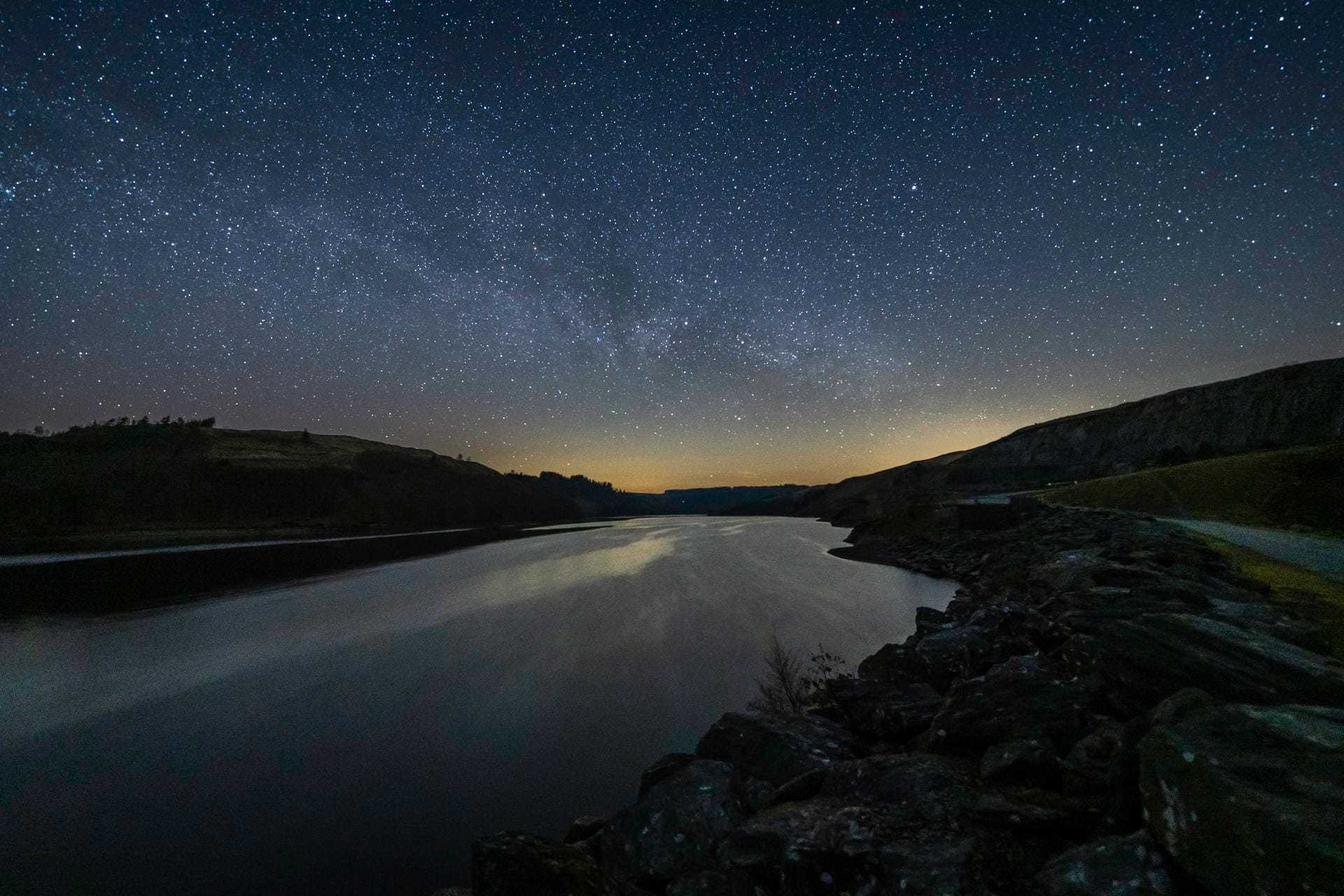
Elan Valley — the only privately-owned International Dark Sky Park in the world.
4. Ynys Enlli (Bardsey Island) — International Dark Sky Sanctuary, 2023
The newest and most prestigious designation in Wales. Ynys Enlli — Bardsey Island in English — became Europe’s first International Dark Sky Sanctuary in 2023. Sanctuary status is the most exclusive dark-sky category, awarded only to extraordinarily remote sites with negligible light pollution and long-term monitoring data to prove their darkness. Few places in the world hold it.
Enlli sits two miles off the tip of the Llŷn Peninsula. The island’s own shape blocks light from the mainland, and it has no permanent street lighting. The result is one of the few places in Europe where the sky overhead retains close to true astronomical darkness even at the horizon.
Visiting Enlli takes commitment. The island is reached by boat from Porth Meudwy near Aberdaron, sailings are tide-dependent and weather-restricted, and overnight stays must be arranged through the Bardsey Island Trust. There are no shops, no street lighting, no light pollution at all. For serious stargazers and astrophotographers it’s a unique destination — for casual visitors, the mainland reserves are more practical.
5. Presteigne and Norton — International Dark Sky Community, 2024
Wales’s most recent dark-sky designation. The small Powys town of Presteigne and the neighbouring village of Norton, on the Welsh-English border, became an International Dark Sky Community in 2024. Community status requires the town itself to commit to strict lighting standards — every streetlight, every business, every home meets a published dark-sky lighting code.
This is different from a reserve or sanctuary: it’s not a wilderness designation but a recognition of how an inhabited town can live alongside dark skies. Presteigne is now one of the few towns in Britain where you can walk out of a pub and see the Milky Way directly overhead.
Other Dark-Sky Destinations Beyond the Designated Areas
Around 18 percent of Wales sits under formal dark-sky protection, but the real percentage of genuinely dark territory is much higher. Several non-designated areas offer stargazing as good as anywhere in Britain:
- The Cambrian Mountains — particularly around Llyn Brianne Reservoir, Tregaron Bog, and the remote chapel of Soar y Mynydd. Most of this area sits between the formal designations and is functionally as dark.
- The Llŷn Peninsula — head for Porthor (Whistling Sands) or the car park at Mynydd Mawr, Uwchmynydd. Low population density and clear sea horizons.
- The Pembrokeshire Coast Path — sections between St Davids and Strumble Head offer some of the best coastal stargazing in Wales. Look for the National Trust beaches of Penbryn and Cwmtydu, both Dark Sky Discovery Sites.
- The Clwydian Range and Dee Valley National Landscape — Loggerheads Country Park and the summit of Moel Famau both offer excellent dark skies, accessible from Liverpool and Chester.
- The Llanerchaeron estate — a National Trust property in Ceredigion with reliable dark-sky access on the coast.
When to Go Stargazing in Wales
The best months
October through March is the prime stargazing window in Wales. The nights are long, the sky reaches full astronomical darkness for hours, and the Milky Way’s brightest sections are well-positioned in the evening sky. Summer nights in Wales — north of 51° latitude — never reach true astronomical darkness; the sky remains in deep twilight throughout June and July.
If you have to choose a single time, late October through early November gives the best balance: long dark hours, mild enough temperatures to stand still outside without freezing, and the autumn Milky Way still high in the south after sunset.
The best moon phase
Plan around the new moon. The four or five nights either side of a new moon give the darkest possible skies — moonlight is the single biggest source of unavoidable sky glow even in a dark-sky reserve. A full moon, by contrast, washes out the Milky Way completely. Most park authority stargazing events are scheduled for new-moon weekends; check the calendar before booking accommodation.
The best time of night
Astronomical darkness begins about 90 minutes after sunset, once the sun is more than 18° below the horizon. Most casual stargazers find that the hour either side of midnight gives the best experience, when the sky is fully dark and the Milky Way’s densest regions are highest. Allow 20 minutes outside to let your eyes adapt to darkness — avoid looking at any phone screen during this time, or use a red-filtered torch app that preserves dark adaptation.
What You Can See
With the naked eye
The Welsh dark skies allow you to see, on a clear night:
- The Milky Way as a clearly defined band running across the sky, with structure visible in the Cygnus and Sagittarius regions
- All five naked-eye planets (Mercury, Venus, Mars, Jupiter, Saturn) when they’re above the horizon
- The major constellations in full — Orion, the Plough, Cassiopeia, Cygnus and so on
- Meteor showers at their best — particularly the Perseids in August (though Welsh summer nights are short) and the Geminids in December
- The Andromeda Galaxy as a faint smudge — the most distant object visible to the naked eye, 2.5 million light years away
- Around 2,000 individual stars on a moonless night, compared to 30-50 in a city centre
With binoculars
Standard 10×50 binoculars dramatically expand what you can see:
- The four Galilean moons of Jupiter — visible as tiny pinpricks beside the planet
- Star clusters like the Pleiades and the Beehive, resolved into individual stars
- Detail on the Moon — craters, mountain ranges, the seas
- The Andromeda Galaxy as a clear oval rather than a smudge
- Many more meteor trails than the naked eye can detect
Where to Stay for a Stargazing Trip
The most rewarding stargazing trips combine darkness with comfort. Look for accommodation in or near one of the designated areas — many Welsh hotels, cottages and glamping sites within the reserves market themselves as dark-sky-friendly, with reduced exterior lighting and good outdoor viewing space. Short breaks in Wales work well as stargazing weekends — two or three nights gives you enough chances to wait out cloudy evenings.
Find Hotels and Cottages in Wales’s Dark Sky Areas
Browse the interactive map below to see real-time hotel and cottage prices in Eryri, Bannau Brycheiniog, the Elan Valley and the Llŷn Peninsula — perfect for planning a stargazing weekend.
Glamping for stargazers: Many Welsh glamping pods and lodges sit in remote locations specifically chosen for their dark skies. Glamping in Wales works particularly well for stargazing because you can be outside and warm at the same time. Snowdonia glamping pods and stays with hot tubs in North Wales are particularly suited.
Practical Tips for First-Time Welsh Stargazing
Star trails above Bannau Brycheiniog — the first International Dark Sky Reserve in Wales.
Check the weather first
Wales is famously wet. A perfect stargazing night needs not just clear skies but also good “seeing” — stable atmospheric conditions without low cloud or high-altitude turbulence. The Met Office cloud cover forecast is the most reliable predictor; check the cloud-cover percentage for your specific site, not just the regional forecast. Astronomy-specific apps like Clear Outside (free) give “astronomy seeing” ratings that combine cloud cover, transparency and stability.
Dress for far colder than you think
You will be standing or sitting still in the dark for hours. Welsh nights are typically 3 to 7°C colder than the daytime maximum, with significant wind chill on exposed hilltops. Layer up: thermal base layer, fleece mid-layer, windproof outer shell. Wear a hat and gloves even in summer. A flask of hot tea or coffee transforms the experience.
Bring a red torch (or use a red app)
White torchlight ruins your night vision instantly and takes 20 minutes to recover from. Red light preserves dark adaptation almost completely. Cheap red-filter LED torches are available everywhere, or use a free app like “Night Vision” or “Red Light Filter” on your phone. Keep your phone brightness at its lowest setting and only use it briefly.
Download an offline stargazing app
Mobile data coverage in Wales’s darkest spots is famously patchy. Download a stargazing app that works offline — Stellarium Mobile (free) and SkySafari (paid) both work without signal once installed. Both let you point your phone at the sky and identify what you’re looking at.
Plan for cloudy nights
Even in the best months, expect to lose 30-50 percent of nights to cloud cover. The professional astronomy advice is “always plan for two nights” — if you have a single fixed night booked, you may simply get unlucky. Two or three consecutive nights in dark-sky country gives a much higher chance of at least one clear period.
Guided Stargazing Experiences in Wales
If you’re new to astronomy, a guided session pays for itself. Three options that consistently deliver:
- Dark Sky Wales — runs events across all three main reserve areas (Bannau Brycheiniog, Eryri, Elan Valley). Telescopes provided. Bookable through the relevant park authority visitor centres.
- Bannau Brycheiniog National Park Visitor Centre at Libanus — regular drop-in evening sessions, including inflatable planetarium nights for cloudy weather. Family-friendly and excellent for first-timers.
- Elan Valley Astronomy Weekends — held several times per year in autumn and winter, combining accommodation packages with multiple guided night sessions.
For inspiration on combining stargazing with the wider Welsh experience, see our guides to Bannau Brycheiniog (Brecon Beacons), Eryri (Snowdonia), and Powys — the latter covering the Elan Valley and the Presteigne dark-sky community.
Frequently Asked Questions: Stargazing in Wales
Why is Wales so good for stargazing?
Around 18 percent of Wales now sits under certified dark-sky protection — proportionally more than any other country in the world. The country has two International Dark Sky Reserves (Bannau Brycheiniog and Eryri), one International Dark Sky Park (Elan Valley), one International Dark Sky Sanctuary (Ynys Enlli, Europe’s first), and one International Dark Sky Community (Presteigne and Norton). Combined with low population density across mid and west Wales, this gives the country some of the darkest accessible skies in Britain.
Where is the darkest sky in Wales?
The darkest measurable skies in Wales are above Ynys Enlli (Bardsey Island) off the Llŷn Peninsula, which became Europe’s first International Dark Sky Sanctuary in 2023. Sanctuary status is the strictest dark-sky designation available, awarded only to extremely remote sites with negligible light pollution. On the mainland, the western half of Bannau Brycheiniog National Park (particularly the Usk Reservoir Dark Sky Discovery Site) and the Cambrian Mountains around Llyn Brianne are widely regarded as the darkest accessible spots.
What is the best time of year to go stargazing in Wales?
The best months for stargazing in Wales are October through March, when the nights are long, dark, and the Milky Way is visible after sunset. Winter (December to February) offers the longest dark hours but the coldest temperatures. Late autumn and early spring give the best balance of darkness, clearer skies and milder weather. Summer nights are too short and never reach full astronomical darkness in Wales. The new-moon period (the four to five days either side of a new moon) is best regardless of month.
What dark sky designations does Wales have?
Wales has five dark sky designations from DarkSky International: Bannau Brycheiniog National Park (International Dark Sky Reserve, awarded 2013 — the fifth in the world); Eryri National Park (International Dark Sky Reserve, 2015); Elan Valley Estate (International Dark Sky Park, 2015 — the only privately-owned Dark Sky Park in the world); Ynys Enlli or Bardsey Island (International Dark Sky Sanctuary, 2023 — Europe’s first); and Presteigne and Norton in Powys (International Dark Sky Community, 2024).
Do I need a telescope to go stargazing in Wales?
No — most of what makes Welsh dark skies special is visible to the naked eye. From the darker sites you can see the Milky Way clearly, all the major constellations, meteor showers, and around 2,000 individual stars on a clear night. A pair of standard 10×50 binoculars dramatically increases what you can see (Jupiter’s four largest moons, the Andromeda Galaxy, deep-sky star clusters). Telescopes add specific detail but aren’t needed for a first visit.
Are there guided stargazing tours in Wales?
Yes. Dark Sky Wales runs guided sessions across all three main reserve areas with telescopes provided. Bannau Brycheiniog National Park Visitor Centre at Libanus hosts regular astronomy events with Dark Sky Wales, including inflatable planetarium sessions for cloudy nights. Eryri (Snowdonia) National Park has its own Dark Sky Rangers who lead seasonal night walks. Elan Valley runs astronomy weekends in autumn and winter. Many local hotels and cottages can arrange private tours.
More Welsh Travel Guides

Pembrokeshire-born travel writer and founder of Wales.org. Born in Haverfordwest, now based in Hertfordshire — covering Welsh castles, national parks, festivals and family staycations across all 22 Welsh counties.