

Raglan Castle: Britain’s Last Great Medieval Fortress
Raglan Castle 2026: Everything You Need to Know Before You Visit
Ready to visit? Book your Raglan Castle tickets directly with Cadw — booking online guarantees a 5% saving on the gate price.
Raglan Castle (Castell Rhaglan) is often called the last great medieval castle built in Britain — a fortress-palace raised a century and a half after the main age of castle-building, designed as much to impress as to intimidate. Built by a Welsh knight and completed by his son, who went on to become one of the most powerful men in Britain, Raglan later held out through one of the longest sieges of the Civil War before its deliberate destruction. This complete guide covers everything you need for a 2026 visit — tickets, opening times, parking, transport, accessibility and what to see.
Planning this trip? Ask Branwen, our free AI trip planner →
Raglan Castle history: a fortress built to impress
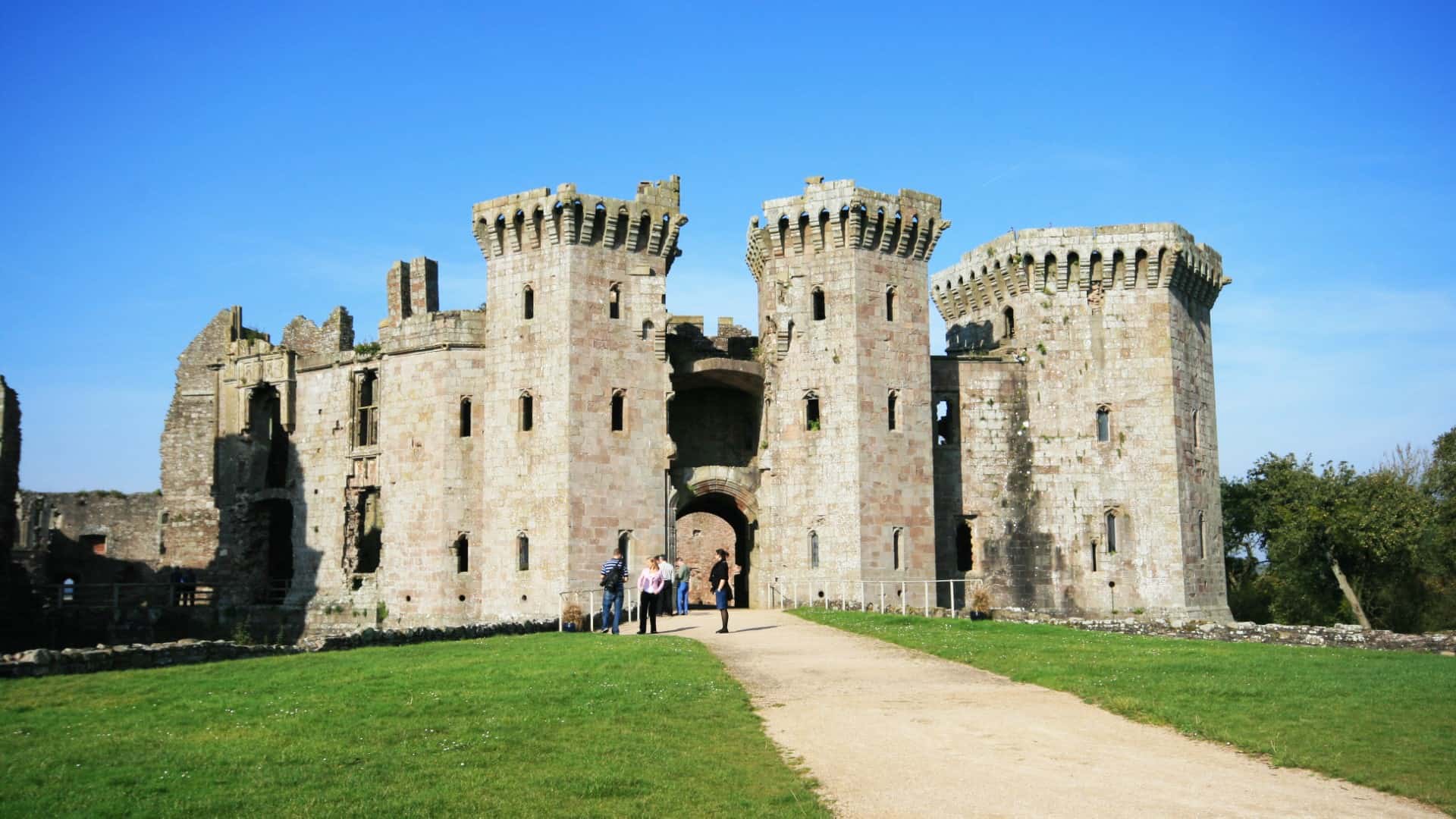
Raglan’s story begins with Sir William ap Thomas, known as the “Blue Knight of Gwent” for the colour of his armour, who built the moated Great Tower that still dominates the site in 1435. His son, Sir William Herbert, who became Earl of Pembroke, later added the gatehouse with its distinctive flared “machicolations” — stone arches designed to let defenders drop missiles on attackers below.
Raglan came around 150 years after the main heyday of British castle-building, and it shows: this was a fortress-palace designed as much to impress visitors as to withstand a siege. Under successive Earls of Worcester, it was transformed into a magnificent country seat, complete with a fashionable long gallery and one of the finest Renaissance gardens in Britain.
That grandeur came at a cost during the Civil War. Despite a garrison of 800 men and one of the longest sieges of the entire conflict, Raglan fell to Parliamentary forces and was deliberately “slighted” (partially destroyed) to prevent its further military use. Among the treasures looted at the time was a piece of Tudor wooden panelling — remarkably, it was rediscovered in a cow shed in the 1950s and is now proudly displayed in the visitor centre.
For wider context on Wales’s castle-building history, see our guide to how many castles there are in Wales.
The Star of Abergavenny
Behind Raglan’s building history is a remarkable woman: Gwladys ferch Dafydd Gam, second wife of Sir William ap Thomas and Lady of Raglan Castle. Her father, Dafydd Gam, was killed at the Battle of Agincourt in 1415, and Gwladys herself was celebrated by the Welsh poet Lewys Glyn Cothi as “Seren-y-fenni”, the Star of Abergavenny, for her beauty and influence. She was later compared to the legendary Queen Marcia for her discretion and political influence, and her son, William Herbert, went on to become one of the most powerful figures of the Wars of the Roses.
Gwladys is currently the subject of Cadw’s Women Through the Ages campaign, and a new statue of her is due to arrive at Raglan Castle in the summer of 2026.

Raglan Castle tickets & prices 2026
You can purchase tickets on arrival or book online to save 5% — online ticket prices are non-refundable. Book directly with Cadw here.
| Ticket category | Price |
|---|---|
| Adult | £10.40 |
| Family (2 adults + up to 3 children) | £33.30 |
| Family (1 adult + up to 3 children) | £22.90 |
| Senior (65+) | £9.30 |
| Junior (5–17) / Student | £7.20 |
| Official members | FREE |
| Under 5s | FREE |
| Disabled visitor & companion | FREE |
Last entry is 30 minutes before the gates close. Raglan Castle is closed on 24, 25 and 26 December and 1 January.
Raglan Castle opening times
| Period | Opening hours |
|---|---|
| 1 March – 30 June | 09:30 – 17:00 |
| 1 July – 31 August | 09:30 – 18:00 |
| 1 September – 31 October | 09:30 – 17:00 |
| 1 November – 28 February | 10:00 – 16:00 |
| 24–26 Dec, 1 Jan | Closed |
Last admission is always 30 minutes before closing.
Explorer Pass: best value for multi-castle visits
If your trip includes several castles, a Cadw Explorer Pass usually pays for itself. It covers entry to all of Cadw’s staffed heritage sites, including Raglan, Chepstow, Caerphilly, Caernarfon, Conwy, Beaumaris and Harlech.
See our Caernarfon Castle guide for the current 3-day and 7-day Explorer Pass prices, which apply across all Cadw sites including Raglan.
Discounts & concessions
£1 Universal Credit tickets
Raglan Castle offers £1 tickets to visitors in receipt of qualifying Universal Credit or other named benefits, bookable in advance on the official Cadw website only. Children under 5, and disabled visitors with a companion, don’t need tickets at all.
Blue Light Card & military veterans
Blue Light Card holders and HM Armed Forces personnel and veterans get a 10% discount at the gate on production of valid ID. This isn’t available on online bookings — pay in person to claim it, or weigh it against the 5% online booking saving depending on which is worth more for your group.
Group rates
Groups of 15 or more visiting together receive a 10% party-rate discount, provided one payment covers the whole group. Coach drivers bringing a group party can enter free on the day.
Raglan Castle parking, postcode & directions
Sat-nav postcode: NP15 2BT. There’s a free on-site car park within the castle grounds, on a grassed surface, with space for around 120 cars — note there’s no dedicated accessible parking bay, so plan accordingly if this affects your visit. Two Type 2 (22kW) EV charging points are available in the car park, with charges applying for use.
By road: via the A40, signposted to Raglan.
Getting to Raglan Castle
Raglan is the most rural of the castles in this series, with the least direct public transport links.
By bus
The nearest useful bus link runs from Monmouth, around 11km (7 miles) away, via route 60 between Newport and Monmouth, running roughly every 2 hours daily.
By train
The nearest railway station is Abergavenny, around 9 miles (14km) away on the Welsh Marches Line. From the station, it’s a short walk to a bus stop, then a bus toward Raglan (Castle Turn), followed by a short walk to the castle — check Transport for Wales’ own Raglan Castle travel page for current times, which also details a 2-for-1 Cadw entry offer for rail travellers. Newport, around 30km (19 miles) away, is the nearest station with direct InterCity connections if you’re arriving from further afield.
By car
Via the A40, signposted to Raglan. See parking details above.
By bike
National Cycle Network Route 423 passes within 1km of the castle.
From the Wye Valley
Raglan sits close to the Wye Valley & Vale of Usk, making it a natural stop alongside Chepstow Castle and Tintern Abbey on a wider tour of the region.
What to see inside Raglan Castle
The Great Tower
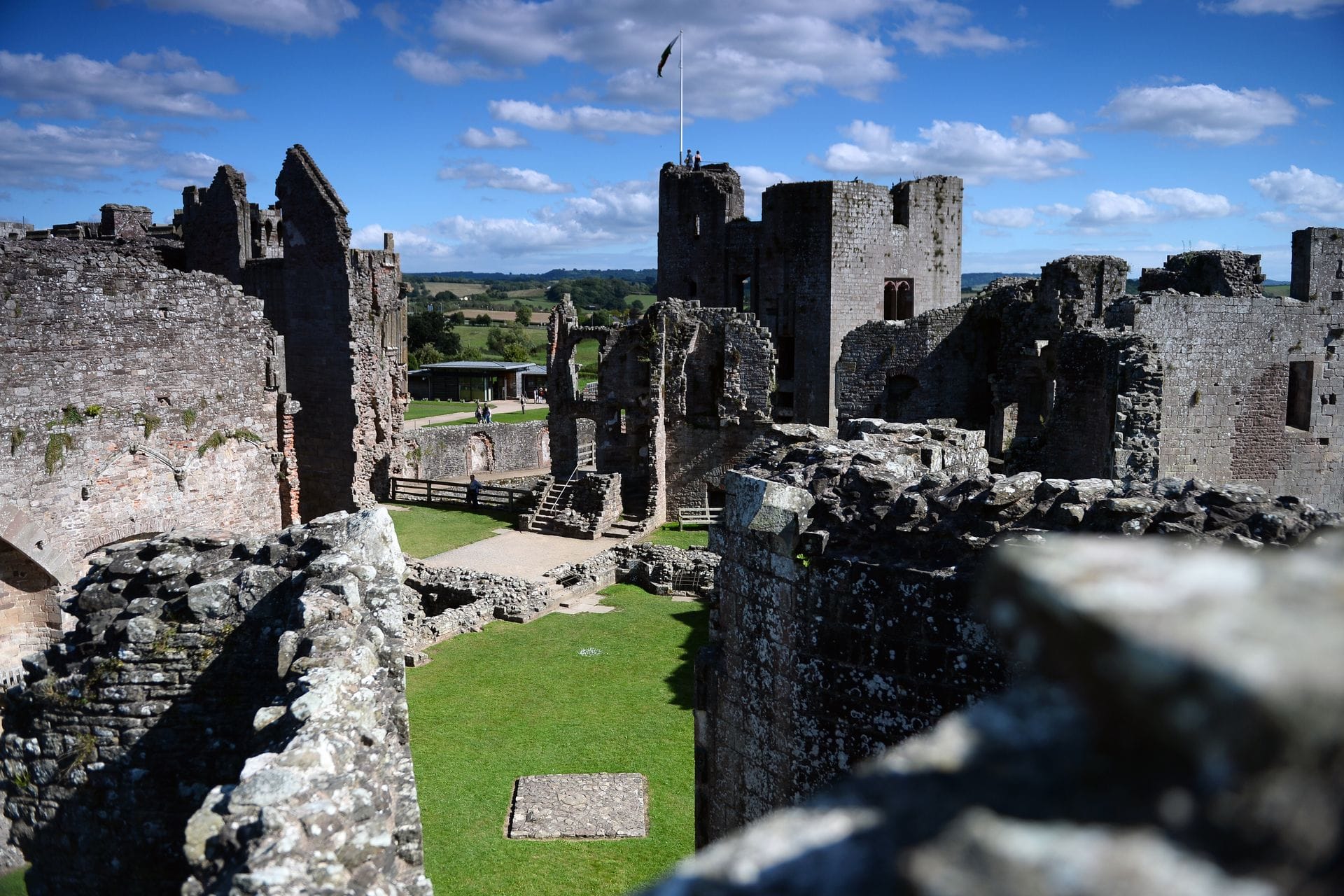
Also known as the Yellow Tower of Gwent, this hexagonal tower stands apart from the main castle, surrounded by its own moat — a stronghold within a stronghold, built by Sir William ap Thomas in 1435.
The Great Gatehouse
William Herbert’s addition, with its distinctive flared machicolations for dropping missiles on attackers, marks the formal, defended entrance to the castle proper.
The Fountain Court and Pitched Stone Court
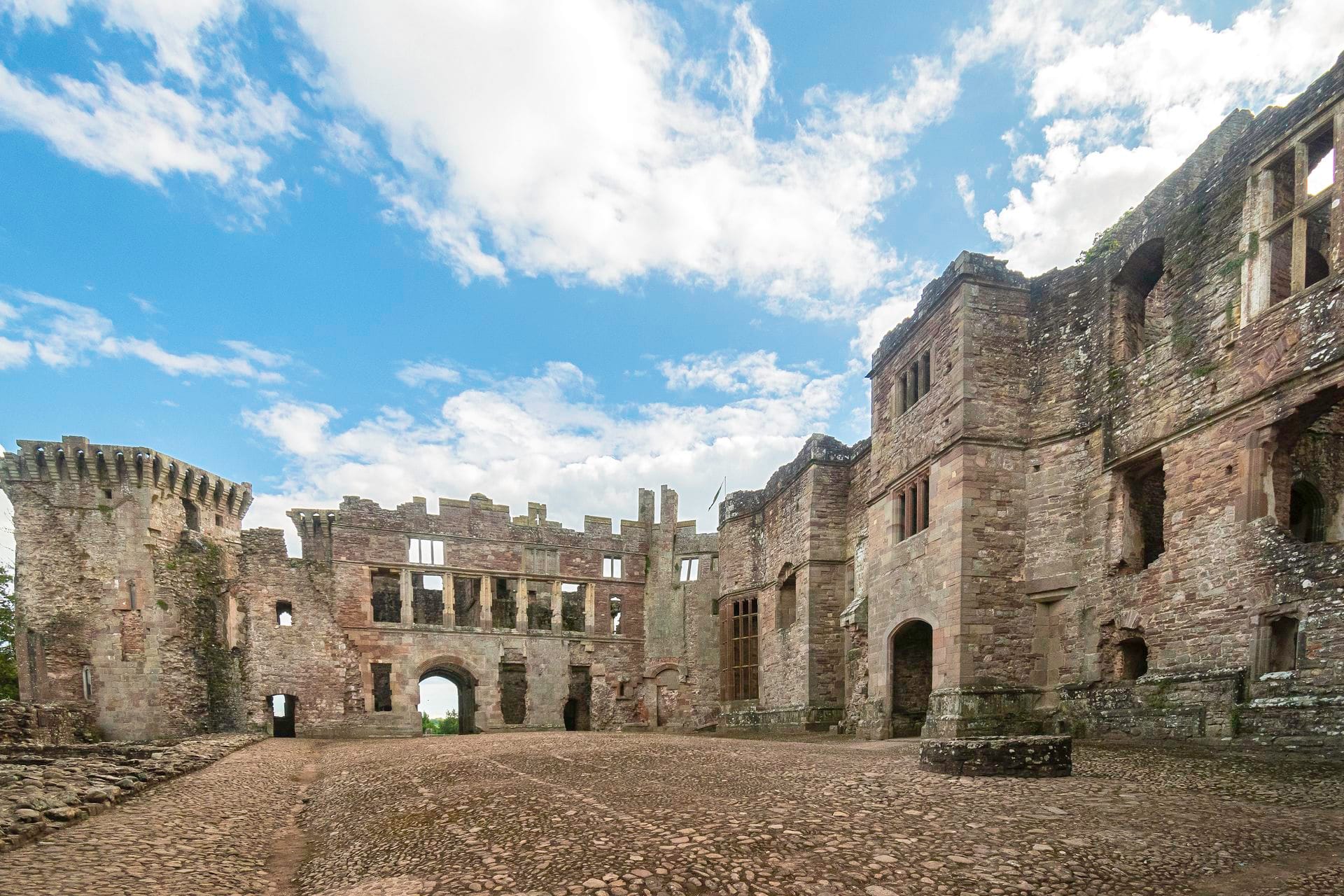
These two courtyards give a real sense of Raglan’s dual identity as both fortress and Renaissance palace, with decorative stonework and the remains of what was once a fashionable long gallery.
The Great Hall
Note the uneven cobbled stones underfoot here, a genuine hazard for pushchairs and wheelchairs — but also a reminder that this was once a working medieval space rather than a museum piece.
The garden terraces
The remains of terraced gardens at the rear of the castle hint at what was once one of the finest Renaissance gardens in Britain.
Events at Raglan Castle 2026
Raglan doesn’t run a standing daily guided tour, but hosts a strong calendar of dated events, including the popular Raglan Castle Odyssey, a living history weekend with the Worcester Reenactors bringing centuries of the castle’s history to life across the site — no advance booking required for this event.
Check Cadw’s events calendar before travelling, since dates and availability change through the year.
What else to do near Raglan: nearby attractions & cafés
White Castle
Around 5.69 miles away, this early Cadw site offers a glimpse of the castle-building style that would later be perfected in Edward I’s great Welsh fortresses.
Monmouth Castle
A ruined castle with genuine royal history, around 6.38 miles from Raglan.
Chepstow Castle
See our Chepstow Castle guide for Britain’s oldest surviving stone fortress, a short drive away in the Wye Valley.
Cafés & refreshments
The independently run Raglan Castle Café, around a 5-minute walk from the castle, is not owned or managed by Cadw — check their Facebook page or call ahead for current opening times.
Dogs & accessibility
Is Raglan Castle dog friendly?
Dogs on short leads are welcome to access the ground floor levels of the site. Please don’t let dogs eat any vegetation around the site, some of which can be poisonous.
Accessibility
Cadw rates the terrain at Raglan Castle as Level 3, Moderate, with limited wheelchair access. Specific access notes:
- Surface: Lawns, gravelled and cobbled areas throughout the site, with several steps and no step-free route to much of the interior.
- Great Hall: Uneven cobbled stones can be genuinely difficult for pushchairs and wheelchairs.
- Rear path: Can be muddy in wet weather, with several short flights of steps.
- Tower and viewing platform steps: In good condition, with handrails provided — these can be wet in poor weather.
- Fall-from-height risk: Particularly around the moat and the bowling green, which overlooks the lower paths and moat — supervise children closely near these edges.
- Mobility scooters: The uneven, gravelled and cobbled surface can be challenging — check suitability before your visit, or contact Cadw in advance.
- Hearing loop: A portable induction loop is available on site.
- Parking: No dedicated accessible parking bay in the on-site car park.
See Cadw’s own Raglan Castle access guide for full detail, or contact the site directly ahead of your visit: 03000 252239 / RaglanCastle@gov.wales.
Where to stay near Raglan Castle
The village of Raglan and the wider Monmouthshire countryside offer a good range of country inns, farmhouse B&Bs and holiday cottages, with easy access to both the Wye Valley and Brecon Beacons for a longer stay.
Book your Raglan Castle break
Find hotels, cottages and B&Bs within easy reach of Raglan Castle.
Monmouthshire holiday cottages →For wider recommendations, see our guides to the Wye Valley & Vale of Usk and short breaks in Wales.
Visitor tips for Raglan Castle
- Book online for the 5% discount if you already know when you’re visiting.
- Bring a car if at all possible — Raglan has the weakest public transport links of any castle in this series.
- Wear sturdy shoes for the uneven cobbles in the Great Hall and the muddy rear path in wet weather.
- Allow 1.5 to 2 hours for a thorough visit.
- Combine with Chepstow Castle and Tintern Abbey for a fuller day exploring the Wye Valley’s history.
- Check the Cadw events calendar before travelling — the Raglan Castle Odyssey living history weekend is a highlight if the dates line up with your visit.
- Keep children away from the moat and bowling-green edges — Cadw specifically flags these as fall-from-height risk areas.
Frequently asked questions about Raglan Castle
How much do Raglan Castle tickets cost in 2026?
Adult £10.40, Junior (5–17) and Student £7.20, Senior (65+) £9.30, Family (2 adults + up to 3 children) £33.30, Family (1 adult + up to 3 children) £22.90. Children under 5, official members and disabled visitors with a companion enter free. Booking online saves 5%; Blue Light Card holders and HM Armed Forces personnel and veterans get a 10% discount at the gate instead (not available online).
What are Raglan Castle’s opening times?
09:30–17:00 from March to June and September to October; 09:30–18:00 in July and August; 10:00–16:00 from November to February. Last entry is 30 minutes before closing. Closed 24–26 December and 1 January.
Why is Raglan called the last great medieval castle in Britain?
Raglan was built around 150 years after the main era of British castle construction, begun in 1435 by Sir William ap Thomas and expanded by his son William Herbert. Rather than pure military necessity, it was designed as a fortress-palace intended to impress as much as to defend, complete with a fashionable Renaissance garden and long gallery.
Who was the Star of Abergavenny?
Gwladys ferch Dafydd Gam, known as “Seren-y-fenni” or the Star of Abergavenny, was the second wife of Sir William ap Thomas, builder of Raglan’s Great Tower, and Lady of Raglan Castle. Her father died at the Battle of Agincourt, and her son William Herbert became a major figure in the Wars of the Roses. Cadw’s Women Through the Ages campaign is currently spotlighting her story, with a new statue due to arrive at the castle in summer 2026.
Is Raglan Castle dog friendly?
Dogs on short leads are welcome on the ground floor levels of the site.
Is Raglan Castle wheelchair accessible?
Access is limited. Cadw rates the terrain as Level 3, Moderate, but notes uneven cobbled stones in the Great Hall, several steps with no step-free alternative, and no dedicated accessible parking bay in the on-site car park. A portable hearing loop is available, and disabled visitors with a companion enter free.
How do I get to Raglan Castle without a car?
Public transport is limited but workable. The nearest railway station is Abergavenny, around 9 miles (14km) away, with an onward bus toward the castle. A bus also runs from Monmouth, around 11km (7 miles) away, via the roughly two-hourly route 60.
How long should I spend at Raglan Castle?
Most visitors spend 1.5 to 2 hours exploring the Great Tower, gatehouse, courtyards and garden terraces.
Explore more Welsh castle & heritage guides

Pembrokeshire-born travel writer and founder of Wales.org. Born in Haverfordwest, now based in Hertfordshire — covering Welsh castles, national parks, festivals and family staycations across all 22 Welsh counties.