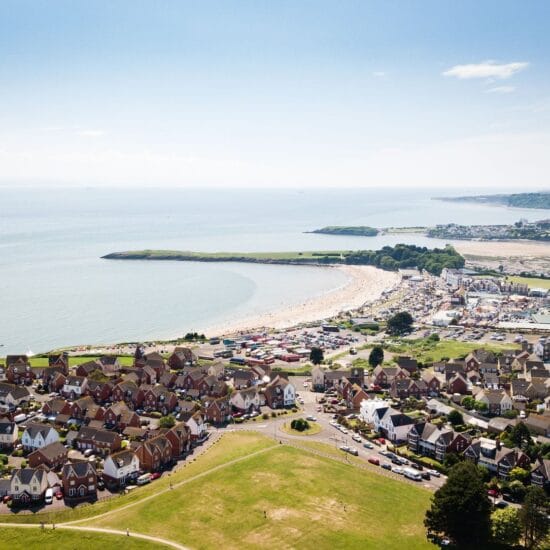


St Davids: Britain’s Smallest City Visitor Guide

The iconic St Davids Cathedral, beautifully constructed from purple Cambrian sandstone and nestled within a scenic, sheltered green valley. Crown Copyright – Naomi Llewellyn
St Davids is the smallest city in Britain. Located at the westernmost tip of Wales inside the Pembrokeshire Coast National Park, it has a population of around 1,800 and a city status granted because of its 12th-century cathedral, built on the site of the original 6th-century monastery founded by St David, Wales’s patron saint. The city was stripped of its status in the 19th century, then officially reinstated by Queen Elizabeth II in September 1994. Today, St Davids is a working cathedral city no larger than a village, surrounded on three sides by dramatic Atlantic coastline, pristine sandy beaches, and the Pembrokeshire Coast National Park.
This guide covers the top things to do, the wildlife boat trips to Ramsey Island, where to eat and stay, how to get there, and which sections of the surrounding coast path are worth combining into a longer visit. All information was verified in May 2026 from the official Cathedral, Cadw, RSPB, and Pembrokeshire Coast National Park sources.
Planning this trip? Ask Branwen, our free AI trip planner →
At a Glance: St Davids
- Where it is: Westernmost tip of Wales, inside the Pembrokeshire Coast National Park
- Population: Around 1,800 (the smallest city in Britain)
- City status: Reinstated by Royal Charter on 16 September 1994
- Top sights: St Davids Cathedral, the Bishop’s Palace ruins, Ramsey Island, Whitesands Bay, St Non’s Chapel
- How to get there: A487 from Haverfordwest. Approximately 2 hours 45 minutes from Cardiff, 5 hours 30 minutes from London
- How long to stay: Two nights for the main sights; three or four to explore the wider peninsula
- Best time to visit: May, June, and September for the balance of weather, opening hours, and lower crowds
The Top Things to Do in St Davids
1. St Davids Cathedral
The cathedral is the reason the city exists. Built between the late 12th and early 14th centuries on the site of St David’s original 6th-century monastery, it sits in a sheltered green valley beside the River Alun, hidden from view until you walk down the final flight of steps. Constructed from a distinctive purple Cambrian sandstone quarried locally, it is considered one of the finest examples of Early Gothic architecture in Britain.
Highlights inside include the painted oak nave ceiling, the sloping medieval floor (which rises noticeably from west to east), the shrine of St David, and the rare 13th-century stained glass in the choir. Entry is free, with a suggested donation. The Cathedral Treasury houses gold and silver liturgical objects spanning a thousand years.
Why a pilgrimage destination: In the medieval period, two pilgrimages to St Davids were considered equal to one to Rome. The tradition remains, with the Pilgrim’s Way still walked from Llanddewi Brefi in Ceredigion to St Davids Cathedral during major Welsh saints’ days.
2. The Bishop’s Palace
Directly opposite the cathedral, on the far bank of the River Alun, stand the ruins of the Bishop’s Palace. The structure dates from the 14th century and was largely the work of Bishop Henry de Gower between 1328 and 1347. At its height it was one of the grandest medieval bishop’s residences in Britain, with a great hall, parapets, a wheel window, and an elaborate carved arcaded parapet that remains in part today.
The palace was abandoned in the 16th century and stripped of its lead in the 18th. It is now managed by Cadw, with entry around £6 for adults. The site is open year-round with reduced winter hours. The combination of cathedral and palace ruins, seen together from the surrounding hill paths, is one of the most photographed historic views in Wales.
3. Wildlife Boat Trip to Ramsey Island
Ramsey Island sits just over a mile offshore from St Davids and is an RSPB Nature Reserve with some of the highest sea cliffs in Wales. The island supports breeding peregrines, choughs, kittiwakes, guillemots, and a large Atlantic grey seal colony that pups on the remote beaches in late summer.
Access is by ferry only, operated by Thousand Islands Expeditions from St Justinian harbour. The company holds the sole landing rights granted by the RSPB. Ferries run from 1 April to 31 October, with morning sailings at 10am and noon and a 4pm return. A full landing day costs around £32 for adults, less for RSPB members.
Several other wildlife trips operate from the same harbour, including the Thousand Islands Adventure (a one-hour high-speed boat trip around the island), Skomer puffin trips between May and July, dolphin and whale watching, and sunset Manx shearwater trips in late summer. See our guide to wildlife watching in Wales for more on Pembrokeshire’s marine wildlife season.
Book Boat Trips & Wildlife Tours
Browse guided boat trips, wildlife tours and things to do around St Davids and the wider Pembrokeshire coast — including Ramsey Island crossings, dolphin watching and coastal experiences.
This page contains affiliate links. If you book through them, Wales.org earns a small commission at no extra cost to you.
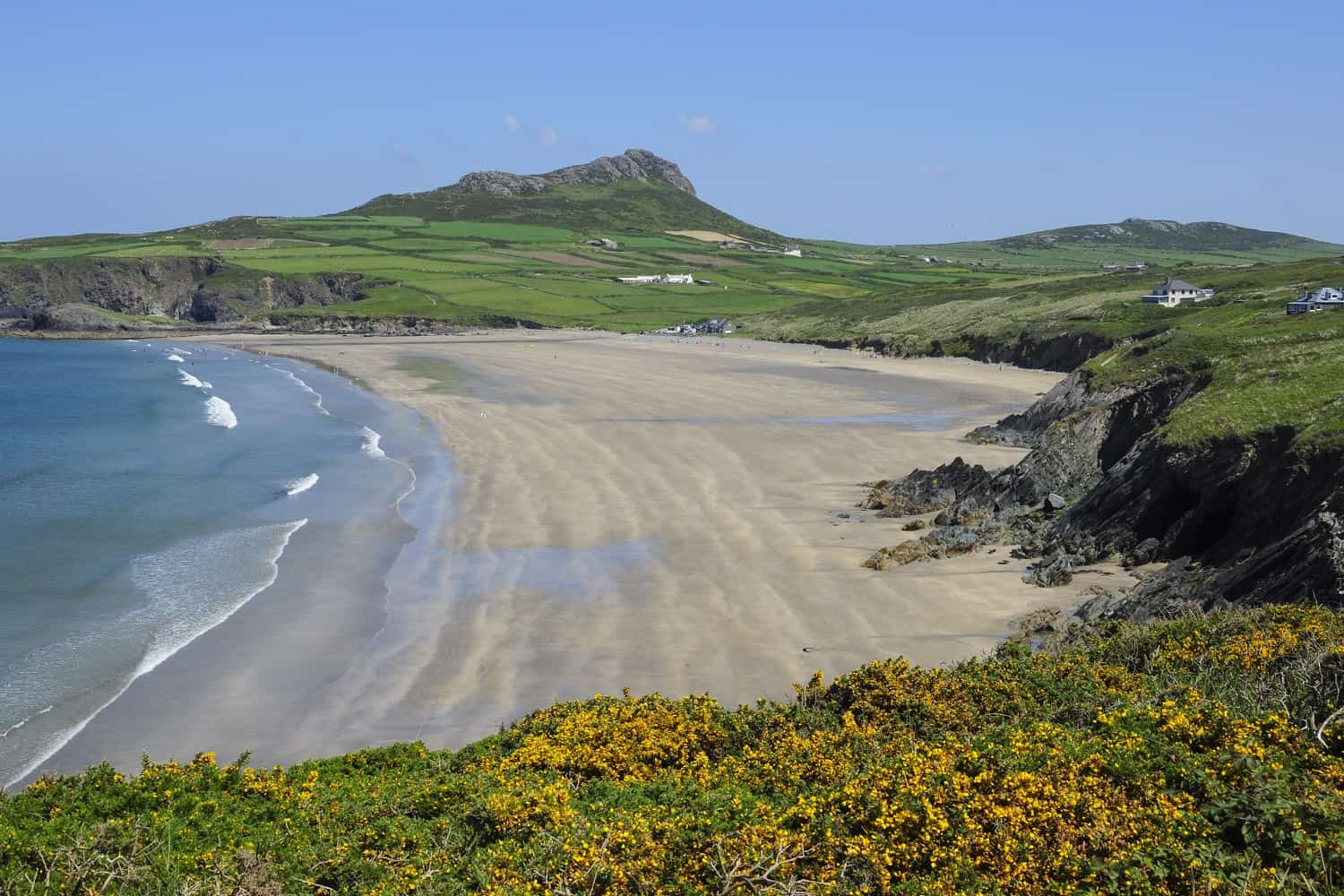
The breathtaking sweep of Whitesands Beach (Porth Mawr) near St Davids, celebrated as one of Pembrokeshire’s premier sandy bays and surf destinations under the watchful peak of Carn Llidi.
4. Whitesands Bay
Whitesands (Porth Mawr) is the closest beach to St Davids and one of the finest surf beaches in Wales. A long arc of pale sand at the foot of low cliffs, it holds a Blue Flag and is patrolled by seasonal RNLI lifeguards from May to September. The waves work for both beginner and experienced surfers, and several local surf schools operate equipment hire and lessons from the car park area.
At low tide the beach extends substantially, exposing rock pools at the northern end. The Pembrokeshire Coast Path runs the full length of the bay and continues around the headland to St Davids Head, which offers some of the most dramatic clifftop walking in west Wales.
5. The Pembrokeshire Coast Path Around St Davids Head
The St Davids Peninsula contains some of the most rewarding sections of the entire 870-mile Wales Coast Path. Three sections to consider:
- St Justinian to Whitesands Bay (3.5 miles): passes Carn Llidi and the Iron Age fort on St Davids Head. Moderate effort, excellent sea views, finishes at the surf beach.
- Caerfai Bay to St Non’s Chapel and Porthclais (3 miles round trip): a short circular walk taking in three small bays, the ruined chapel marking St David’s traditional birthplace, and the medieval harbour at Porthclais.
- Whitesands to Abereiddy and the Blue Lagoon (8 miles linear): a longer day walk along cliffs and coves to the spectacular flooded slate quarry known as the Blue Lagoon, location of the Red Bull Cliff Diving World Series.
6. St Non’s Chapel and Holy Well
A 20-minute walk south of the city centre on the clifftop above St Non’s Bay, the ruins of St Non’s Chapel mark the traditional birthplace of St David. The chapel was built in the 13th century on what is believed to have been an earlier 6th-century site. The adjacent holy well is still visited by pilgrims and is said to have curative properties. The walk passes Goat Street and gives some of the best free coastal views in St Davids.
7. Oriel y Parc Gallery and Visitor Centre
The combined Pembrokeshire Coast National Park Visitor Centre and gallery sits at the entrance to the city on the Haverfordwest road. The Class A landscape gallery hosts rotating exhibitions in partnership with Amgueddfa Cymru — National Museum Wales, featuring works that depict the Pembrokeshire coast across the centuries. The visitor centre has free maps, public toilets, parking, and the start of the Celtic Coaster shuttle bus that circles the peninsula in summer.
Where to Stay in St Davids
Accommodation in St Davids ranges from small boutique hotels in the city centre to coastal self-catering cottages and farm stays on the surrounding peninsula. The compact city has fewer than ten hotels, and rooms book up months in advance for summer weekends and Welsh school holidays. Booking by April is recommended for July and August. For visitors wanting more options, the wider Pembrokeshire coast around Solva, Newgale, and Mathry is within 15 minutes by car.
Find Hotels and Cottages in St Davids and Pembrokeshire
Browse the interactive map below to see real-time prices for hotels, B&Bs, and self-catering cottages in St Davids, the surrounding peninsula, and the wider Pembrokeshire coast.
Camping option: The St Davids Peninsula has some of the best coastal campsites in Wales, including several with direct beach or cliff access. See our guide to the eight idyllic camping sites by the sea in St Davids for detailed pitch-by-pitch recommendations.
Food and Drink in St Davids
The city boasts excellent traditional pubs alongside a strong cluster of independent restaurants, cafés, and seafood shacks. Notable picks include:
- The Bench: speciality ice cream parlour and pizzeria on High Street, locally owned and a long-running favourite.
- Cwtch: Welsh fine dining restaurant on High Street, focusing on seasonal Pembrokeshire produce.
- Blas at Twr y Felin: AA Rosette restaurant inside the Twr y Felin Hotel, a former windmill converted to a contemporary art hotel.
- The Really Wild Emporium: foraged food specialists with a small shop and tasting events.
- The Bishops: a popular pub-restaurant on Cross Square serving traditional Welsh food.
- The Shed at Porthgain: a 20-minute drive away, this seafood shack on the historic Porthgain harbour is regularly voted one of the best fish and chip restaurants in Wales.
Welsh Food Tours – Really Wild Emporium’s St Davids foraging walks
Really Wild Emporium runs guided coastal foraging walks around St Davids alongside its shop and tasting events. For all 8 verified Welsh food tour operators with 2026 pricing, see our complete guide to Welsh Food Tours.
Day Trips from St Davids
Solva
A 10-minute drive east on the A487, Solva is a small harbour village with a working tidal harbour, colourful Georgian cottages, an excellent independent food scene, and the historic Solva Woollen Mill just up the road at Middle Mill—the oldest working wool mill in Pembrokeshire. Combine with a walk along the harbour to Solva Head for views across the bay.
Cheese lovers, don’t miss Caerfai Farm. A small organic farm shop an easy stroll from St Davids’ cathedral, selling cheese made on site. See our complete guide to the Welsh Cheese Trail for this and 6 other verified producers across Wales.
Welsh Wool Mills & Textile Heritage – 5 working mills worth visiting
Solva Woollen Mill, mentioned above, is Pembrokeshire’s oldest working wool mill and free to visit. See our complete guide to Welsh Wool Mills & Textile Heritage for this and four other genuinely working mills across Wales.
Porthgain and the Blue Lagoon
The hamlet of Porthgain, 8 miles north-east, was an industrial harbour shipping slate and brick across the Atlantic in the 19th century. The harbour buildings remain and now house The Shed restaurant, an art gallery, and the Sloop Inn. The neighbouring Abereiddy beach contains the Blue Lagoon, a flooded former slate quarry now used for swimming, coasteering, and as host for the Red Bull Cliff Diving World Series.
Skomer Island Puffin Trips
Boat trips to Skomer Island, 20 miles south by sea from St Davids, run from Martin’s Haven on the Marloes Peninsula between April and October. Skomer hosts one of the largest Atlantic puffin colonies in the UK, with around 35,000 breeding pairs visible at close range from May to July. Day landings book up months in advance through the Pembrokeshire Islands Boat Trips system.
Pembrokeshire Coast National Park Interior
The eastern Pembrokeshire Coast National Park stretches into the Preseli Hills, the ancient mountains from which the inner bluestones of Stonehenge were quarried around 3000 BC. The drive to Foel Drygarn, the largest hillfort in west Wales, takes about an hour from St Davids and gives a different side of Pembrokeshire from the coastal scenery.
How to Get to St Davids
By car
St Davids is reached via the A487 coastal road. From Cardiff, the journey is approximately 2 hours 45 minutes via the M4 to Carmarthen, then the A40 and A487. From London, allow around 5 hours 30 minutes via the M4. From Birmingham, allow a solid 4 hours 30 minutes via the M50 and South Wales A-roads. Parking in St Davids is at Oriel y Parc visitor centre or Merrivale Car Park, both pay-and-display.
By train and bus
The nearest railway stations are Haverfordwest (15 miles east) and Fishguard Harbour (16 miles north). Both have direct services from Cardiff and London Paddington. Regular bus services connect both stations to St Davids; the 411 from Haverfordwest is the most frequent. Total London to St Davids journey time by train and bus is around 5 hours 30 minutes.
The Celtic Coaster shuttle
The Celtic Coaster (route 403) is a summer-season shuttle bus that loops around the St Davids Peninsula, calling at the cathedral, Whitesands Bay, St Justinian, Caerfai Bay and Porthclais. It runs daily from late May to late September and is the easiest way to walk linear sections of the coast path without a second car. Tickets are bookable on the bus.
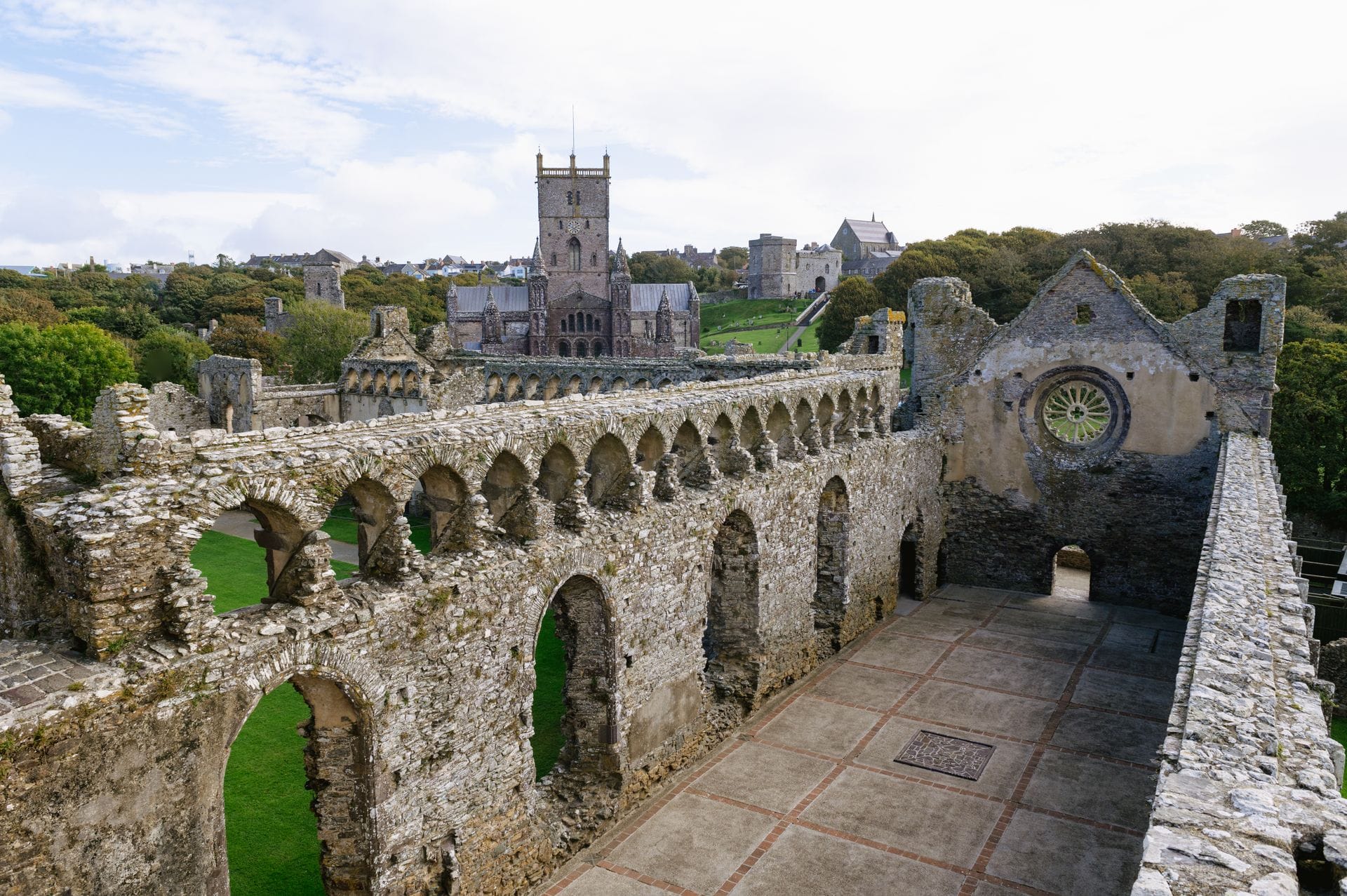
The Bishop’s Palace ruins sit directly opposite the cathedral across the River Alun.
St Davids Beyond the Cathedral
The St Davids peninsula has been continuously inhabited since the Neolithic period. Iron Age forts ring the headlands, particularly Castell Heinif and Carn Llidi. The peninsula is a designated National Landscape with strict planning controls that have kept it free from large-scale modern development. Welsh-speaking communities remain strong in the wider area, with bilingual signage standard throughout. Many independent businesses operate as social enterprises or cooperatives, reflecting the strong local culture that surrounds the cathedral.
Frequently Asked Questions: St Davids
Why is St Davids called a city?
St Davids is officially Britain’s smallest city. It holds city status because of its cathedral, which was built on the site of the 6th-century monastery founded by St David, Wales’s patron saint. The settlement lost its city status in the 19th century when the requirements changed, then regained it on 16 September 1994 when Queen Elizabeth II reinstated the designation by Royal Charter. Its population of around 1,800 makes it smaller than most British villages.
What are the best things to do in St Davids?
The five must-do attractions in St Davids are: visiting St Davids Cathedral, exploring the ruined Bishop’s Palace, taking a wildlife boat trip to Ramsey Island RSPB Nature Reserve, surfing or relaxing at Whitesands Bay, and walking a section of the Pembrokeshire Coast Path. The compact city centre also has independent galleries, the Oriel y Parc visitor centre, and St Non’s Chapel, which marks the traditional birthplace of St David.
Is St Davids worth visiting?
Yes. St Davids combines a magnificent 12th-century cathedral, dramatic ruined Bishop’s Palace, pristine sandy beaches within a few miles, world-class wildlife on Ramsey Island, and a thriving food scene of independent restaurants and seafood shacks. The Pembrokeshire Coast National Park surrounds it on three sides. Two nights is enough to cover the city and main sights; three or four nights opens up the wider St Davids Peninsula and the Pembrokeshire Coast Path.
How do I get to St Davids?
By car, St Davids is reached via the A487 from Haverfordwest. The journey from Cardiff takes approximately 2 hours 45 minutes; from London it is around 5 hours 30 minutes. The nearest railway stations are Haverfordwest (15 miles east) and Fishguard Harbour (16 miles north). Regular bus services connect both stations to St Davids; the 411 from Haverfordwest is the most frequent. The Celtic Coaster shuttle bus circles the St Davids Peninsula in summer, useful for car-free coastal walks.
How do I visit Ramsey Island from St Davids?
Ramsey Island is reached by ferry from St Justinian, about 2 miles west of St Davids. Thousand Islands Expeditions holds the sole landing rights granted by the RSPB. The ferry runs daily from 1 April to 31 October, with morning sailings at 10am and noon, returning at 4pm. Adult tickets cost around £32, with reduced rates for RSPB members. The crossing takes 20 minutes. Booking ahead is essential, particularly in summer.
What is the best time of year to visit St Davids?
May, June, and September give the best balance of mild weather, lower crowds, and full attraction opening. July and August are warmest but busiest, with accommodation and restaurant booking essential several months ahead. Ramsey Island ferries run April to October, with Skomer puffin trips at their peak from late May to mid-July. The cathedral and Bishop’s Palace are open year-round. Winter offers atmospheric coastal walks and very quiet streets, though some restaurants and seasonal businesses close.
How long do you need in St Davids?
A full day covers the cathedral, Bishop’s Palace, the city centre and a short stretch of the coast path. Two nights allows time for a Ramsey Island day trip and an afternoon at Whitesands Bay. Three to four nights opens up the wider St Davids Peninsula, including Porthgain, Abereiddy, the Blue Lagoon and more challenging sections of the Pembrokeshire Coast Path.
Wildlife Boat Tours in Wales – Ramsey, Skomer, offshore wildlife
St Justinian harbour (2 miles from St Davids) is one of Wales’s best departure points for wildlife trips – Ramsey Sound tidal races, Skomer puffin landings, offshore Grassholm gannet colonies, whales and dolphins. For every verified 2026 operator with pricing and seasonal timings, see our complete guide to Wildlife Boat Tours in Wales.
More Pembrokeshire and West Wales Guides

Pembrokeshire-born travel writer and founder of Wales.org. Born in Haverfordwest, now based in Hertfordshire — covering Welsh castles, national parks, festivals and family staycations across all 22 Welsh counties.