
100+ Welsh Phrases Every Visitor Should Know
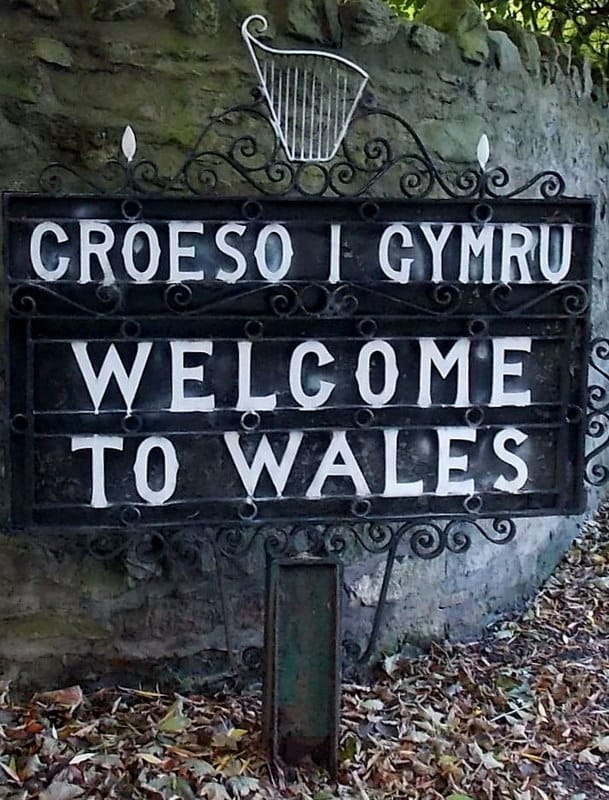
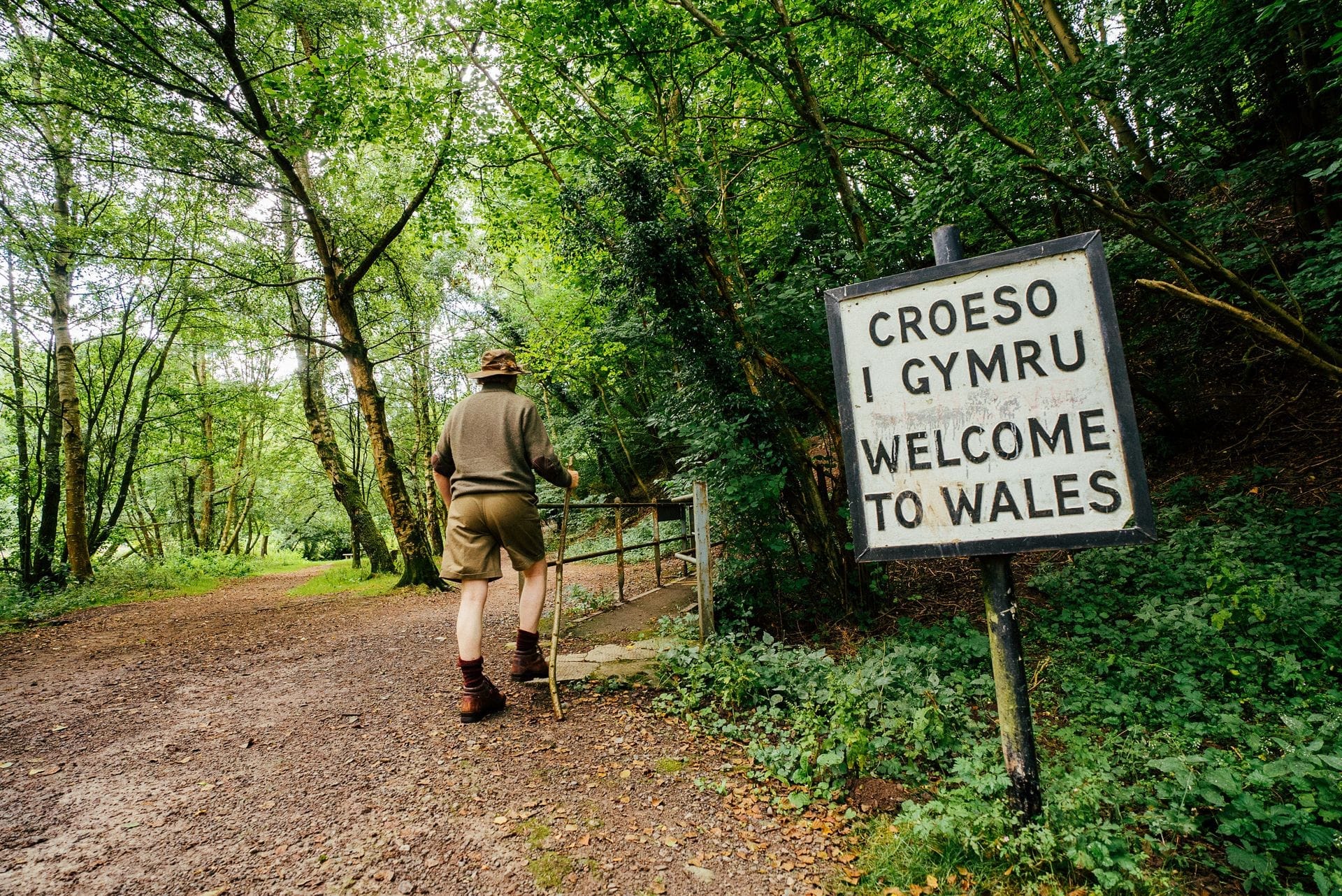
A traditional bilingual sign welcoming visitors at the Welsh border. Every road, government building and public sign in Wales is bilingual by law. © Copyright Jaggery
Welsh (Cymraeg) is spoken by approximately 828,500 people in Wales — around 27% of the population aged three and over, according to the Welsh Government’s Annual Population Survey to September 2025. It is one of the oldest living languages in Europe, part of the Celtic Brittonic family, and the first official language of Wales alongside English. You do not need to be fluent to make a good impression. In Welsh cafes, castles, pubs and shops, using even a handful of basic phrases earns instant warmth from locals — because Welsh speakers know that most visitors don’t try. This guide covers the essential phrases to know for a first visit, complete with pronunciation notes, regional differences between North and South Wales, and cultural context so you understand what you’re saying.
The Welsh alphabet is entirely phonetic. Once you know how the letters sound, you can read any Welsh word aloud correctly. For a full sound-by-sound primer, see our companion guide on how to pronounce Welsh place names. This guide focuses on the practical spoken phrases — greetings, thanks, directions, food and drink, emergencies, and cultural expressions — that a visitor will actually use. All Welsh spellings and translations have been verified against the Welsh Language Commissioner’s guidance and Say Something in Welsh’s phrase library as of July 2026.
Planning this trip? Ask Branwen, our free AI trip planner →
At a Glance: Welsh for Visitors
- Language name: Cymraeg (kum-RAH-ig)
- Speakers in Wales: ~828,500 (26.9% of population, as of 2025)
- Highest concentrations: Gwynedd (73.4%), Isle of Anglesey (61.8%), Carmarthenshire (~40%)
- Alphabet: 29 letters, entirely phonetic — read the letters, get the sound
- Four main dialects: Gwyndodeg (NW), Powyseg (Mid), Dyfedeg (SW), Gwenhwyseg (SE)
- Most useful phrase: Diolch (DEE-olkh) — thank you
- Official status: First official language of Wales, protected under the Welsh Language (Wales) Measure 2011
- Government target: 1 million Welsh speakers by 2050 under the Cymraeg 2050 strategy
The 10 Essential Phrases Every Visitor Should Know
If you only learn ten Welsh phrases before your trip, learn these. They cover 90% of everyday visitor interactions.
| English | Welsh | Pronunciation |
|---|---|---|
| Hello | Helo | hello |
| Hi / How are you? | Shwmae (S) / Sut mae? (N) | shoo-my / sit my |
| Good morning | Bore da | BOR-eh dah |
| Good evening | Noswaith dda | NOS-why-th thah |
| Thank you | Diolch | DEE-olkh |
| Thank you very much | Diolch yn fawr | DEE-olkh un vowr |
| Please | Os gwelwch yn dda | oss GWEL-ookh un thah |
| Yes | Ie / Do | yeh / doh |
| No | Na / Naddo | nah / NA-tho |
| Goodbye | Hwyl | hoo-il |
On “yes” and “no”: Welsh does not have single fixed words for yes and no — the answer depends on the question. Ie and Na are the closest general-purpose answers, but native speakers often mirror the verb of the question (“Do you speak Welsh?” → “I speak” rather than “yes”). Visitors are never expected to get this right — ie and na work fine.
The Seven Sounds That Trip Up Visitors
Welsh has a small number of distinctive sounds not found in English. Get these right and every phrase you attempt will sound convincingly Welsh. For a fuller sound-by-sound guide including regional variation, see our Welsh pronunciation guide.
| Letter | Sound | English example |
|---|---|---|
| Ll | Voiceless “hl” — tongue in the “l” position, blow air over the sides | No English equivalent — think “hl” |
| Dd | Voiced “th” | “th” in “this” |
| Th | Unvoiced “th” | “th” in “thin” |
| Ch | Throaty “kh” | “ch” in Scottish “loch” |
| F | Always sounds like English “v” | “v” in “van” |
| Ff | Sounds like English “f” | “f” in “fun” |
| W | Vowel, sounds like “oo” | “oo” in “book” |
Greetings and Basic Conversation
Beyond the essentials above, these are the phrases you will use most in social situations.
| English | Welsh | Pronunciation |
|---|---|---|
| Welcome | Croeso | KROY-so |
| Welcome to Wales | Croeso i Gymru | KROY-so ee GUM-ree |
| Good afternoon | Prynhawn da | prin-HOWN dah |
| Goodnight | Nos da | nohs dah |
| See you later | Wela i chi wedyn | WEL-ah ee khee WED-in |
| How are you? | Sut wyt ti? (informal) | sit oo-it tee |
| How are you? (formal/plural) | Sut ydych chi? | sit UD-ikh khee |
| I’m fine, thanks | Da iawn, diolch | dah YOWN, DEE-olkh |
| What’s your name? | Beth ydy dy enw di? | beth UD-ee duh EN-oo dee |
| My name is… | …ydw i | … UD-oo ee |
| Nice to meet you | Braf cwrdd â chi | brahv koorth ah khee |
| Excuse me / Sorry | Esgusodwch fi | es-gis-OD-ookh vee |
| Do you speak English? | Ydych chi’n siarad Saesneg? | UD-ikh kheen SHAR-ad SICE-neg |
| I don’t speak Welsh | Dwi ddim yn siarad Cymraeg | dwee thim un SHAR-ad kum-RAH-ig |
| I’m learning Welsh | Dwi’n dysgu Cymraeg | dween DUS-ghee kum-RAH-ig |
Formal vs informal: Welsh distinguishes between ti (informal you, singular, for friends and family) and chi (formal you, or plural you, for strangers, older people, or groups). As a visitor, defaulting to chi is polite and safe. Native speakers will not correct you for using chi in an informal situation, but might smile at a small ti-usage misstep.
Food, Drink and the Pub
These are the phrases you will use across cafes, restaurants and pubs — anywhere someone might take an order.
| English | Welsh | Pronunciation |
|---|---|---|
| Cheers / Good health | Iechyd da | YEH-chid dah |
| Menu, please | Y fwydlen, os gwelwch yn dda | uh VWOID-len, oss GWEL-ookh un thah |
| A pint of beer, please | Peint o gwrw, os gwelwch yn dda | paint oh GOO-roo, oss GWEL-ookh un thah |
| A cup of tea | Cwpanaid o de | cwp-AN-eyed oh deh |
| Coffee | Coffi | CO-fee |
| Water | Dŵr | doohr |
| Milk (North) | Llefrith | LLEV-rith |
| Milk (South) | Llaeth | LLY-eth |
| Bread | Bara | BA-rah |
| Cheese | Caws | cowss |
| Butter | Menyn | MEN-in |
| Fish | Pysgod | PUS-god |
| Meat | Cig | keeg |
| Lamb | Cig oen | keeg oyn |
| The bill, please | Y bil, os gwelwch yn dda | uh bill, oss GWEL-ookh un thah |
| Delicious | Blasus | BLAS-iss |
Traditional Welsh foods worth knowing by their Welsh names:
- Picau ar y maen (PIK-eye ar uh MINE) — Welsh cakes, small griddle-baked cakes with currants.
- Bara brith (BA-rah BREETH) — literally “speckled bread”, the traditional Welsh fruit tea bread.
- Cawl (kow-l) — the traditional Welsh lamb and root vegetable stew.
- Bara lawr (BA-rah lowr) — laverbread, Welsh seaweed puree.
- Caws pobi (cowss POE-bee) — Welsh rarebit, cheese on toast done properly.
Getting Around
For directions, transport and finding your way. See our Wales by Train guide for the full rail network context.
| English | Welsh | Pronunciation |
|---|---|---|
| Where is…? | Ble mae…? | bleh my |
| How much is it? | Faint yw e? | vine-t you eh |
| Train station | Gorsaf drenau | GOR-sav DREN-eye |
| Bus stop | Arhosfa bws | ar-HOSS-vah booss |
| Toilets | Toiledau | toy-LED-eye |
| Men (toilet) | Dynion | DUN-yon |
| Women (toilet) | Merched | MER-khed |
| Open | Ar agor | ar AG-or |
| Closed | Ar gau | ar guy |
| Left | Chwith | khweeth |
| Right | Dde | thee |
| Straight ahead | Yn syth ymlaen | un seeth um-LINE |
| Entrance | Mynedfa | mun-ED-va |
| Exit | Allanfa | ath-LAN-va |
| Ticket | Tocyn | TOK-in |
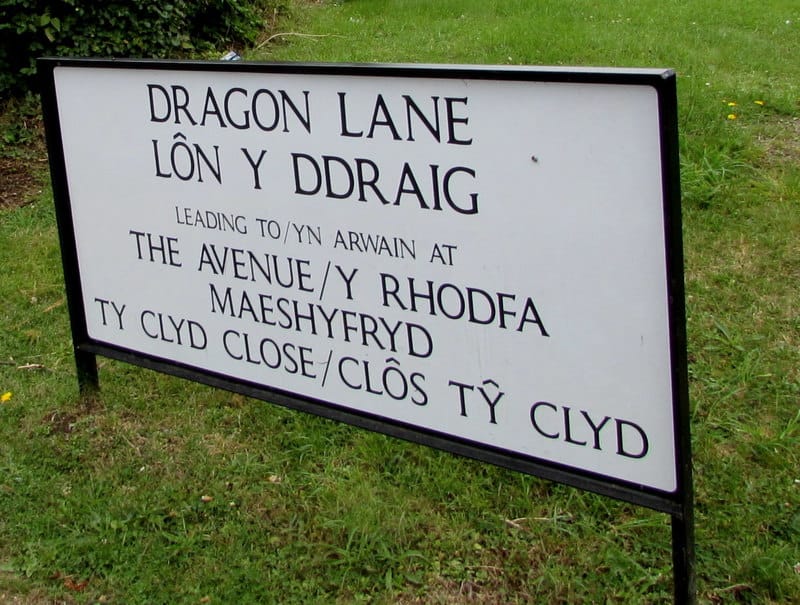
A typical bilingual street sign in Wales, displaying directions and street names in both English and Welsh. © Copyright Jaggery
North vs South Wales: The Words That Actually Differ
Written Welsh is standardised across the country. Everyday spoken Welsh differs significantly by region — sometimes to the point of good-natured argument between speakers. The most famous debate on Twitter in 2020, dubbed “#MilkWars” by users, was over whether milk should be called llaeth or llefrith. Neither side won.
| Meaning | North Wales | South Wales |
|---|---|---|
| Milk | Llefrith (LLEV-rith) | Llaeth (LLY-eth) |
| Grandmother | Nain (nine) | Mam-gu (mam-gee) |
| Grandfather | Taid (tide) | Tad-cu (tad-kee) |
| Fox | Llwynog (LLOO-i-nog) | Cadno (CAD-no) |
| Hi (informal) | Sut mae? (sit my) | Shwmae? (shoo-my) |
| Now | Rŵan (ROO-an) | Nawr (nowr) |
| Out | Allan (ATH-lan) | Mas (mahs) |
| Boy | Hogyn (HOG-in) | Bachgen (BAKH-gen) / Crwt (croot) |
| Girl | Hogan (HOG-an) | Merch (mairkh) |
Wales has four traditional dialect regions studied by linguists:
- Gwyndodeg — North West, spoken in Anglesey, Gwynedd and west Conwy. The dialect of the Kingdom of Gwynedd.
- Powyseg — Central Wales, spoken across Powys and northern mid-Wales.
- Dyfedeg — South West, spoken in Ceredigion, Pembrokeshire and Carmarthenshire. Named after the Iron Age Demetae tribe and the Kingdom of Dyfed.
- Gwenhwyseg — South East, spoken in the Valleys, Newport and eastern Cardiff. Marked by distinctive vowel changes (cae → cê).
All four are mutually intelligible. Standard Welsh, taught in schools and used in broadcasting, sits above them all.
Emergencies and Practicalities
The phrases you hope not to need, but should know just in case.
| English | Welsh | Pronunciation |
|---|---|---|
| Help! | Help! | help |
| I need a doctor | Rwyf angen meddyg | rooiv ANG-en METH-ig |
| Call the police | Ffoniwch yr heddlu | FON-yookh uhr HETH-lee |
| I’m lost | Rwyf ar goll | rooiv ar goth-ll |
| Hospital | Ysbyty | USS-but-ee |
| Fire | Tân | tahn |
| Ambulance | Ambiwlans | AM-byoo-lans |
| I don’t understand | Dwi ddim yn deall | dwee thim un DEE-ath-ll |
| Can you help me? | Allwch chi fy helpu i? | ATH-look-h khee vuh HELP-ee ee |
Emergency numbers: Dial 999 for police, fire or ambulance in Wales (the UK’s equivalent of 911). 112 also works. Non-emergency police: 101. NHS medical advice: 111. Operators speak both English and Welsh.
Numbers and Days
Welsh numbers use two systems: the traditional vigesimal (base-20) system, and a modern decimal system used in schools and everyday counting.
| English | Welsh | Pronunciation |
|---|---|---|
| One | Un | een |
| Two | Dau | dye |
| Three | Tri | tree |
| Four | Pedwar | PED-war |
| Five | Pump | pimp |
| Six | Chwech | khwekh |
| Seven | Saith | syth |
| Eight | Wyth | ooith |
| Nine | Naw | now |
| Ten | Deg | deg |
Days of the Week
| English | Welsh | Pronunciation |
|---|---|---|
| Monday | Dydd Llun | deeth lleen |
| Tuesday | Dydd Mawrth | deeth mowrth |
| Wednesday | Dydd Mercher | deeth MER-kher |
| Thursday | Dydd Iau | deeth yai |
| Friday | Dydd Gwener | deeth GWEN-er |
| Saturday | Dydd Sadwrn | deeth SAD-oorn |
| Sunday | Dydd Sul | deeth seel |
Cultural Phrases Every Visitor Should Recognise
These phrases appear on signs, at events, and in songs across Wales. Recognising them adds real depth to your visit.
| English meaning | Welsh | Where you’ll see it |
|---|---|---|
| Wales for ever | Cymru am byth | Rugby matches, sports events, patriotic signage |
| Welcome to Wales | Croeso i Gymru | Every border road entering Wales |
| My country / My land | Fy ngwlad | The Welsh national anthem: Hen Wlad Fy Nhadau (Land of My Fathers) |
| Long live Wales | Oes byth i Gymru | Traditional patriotic phrase |
| Cheers / Good luck / Farewell | Pob lwc | Wishes and farewells |
| The Land of Song | Gwlad y Gân | Traditional cultural description of Wales |
| Land of My Fathers | Hen Wlad Fy Nhadau | The Welsh national anthem |
The Welsh National Anthem: First Line
The Welsh national anthem, Hen Wlad Fy Nhadau (Land of My Fathers), is one of the most stirring national anthems in the world — sung with real force at rugby internationals. The famous opening line is:
“Mae hen wlad fy nhadau yn annwyl i mi” (my hen wlad vuh n-HAD-eye un AN-noil ee mee)
“The land of my fathers is dear to me”
If you find yourself at the Principality Stadium in Cardiff for a Wales rugby match, you will hear 74,500 people sing this. Standing respectfully — even without joining in — is customary.
Welsh Beyond Wales: Y Wladfa in Argentina
Welsh is spoken in only two places in the world outside the UK with continuous community use. The most remarkable is Y Wladfa (uh WLAD-va, “The Colony”) in the Chubut Province of Patagonia, Argentina. Welsh settlers arrived in 1865 hoping to preserve their language and culture from English influence, and their descendants still speak Welsh today.
Between 1,500 and 5,000 people in Chubut still speak Welsh, concentrated in the towns of Gaiman, Trelew and Trevelin. Welsh-medium schools, Nonconformist chapels, tea houses (a Patagonian Welsh institution) and an annual Eisteddfod festival all continue. Patagonian Welsh has developed its own dialect over 160 years — recognisable but distinct from Welsh spoken in Wales, with Spanish loanwords and slightly different pronunciation.
Welsh in Everyday Life in Wales
What you will see and hear
Wales is officially bilingual. In practice, that means:
- All road signs are bilingual. Welsh place names are given first in the west and north; English first in the east and Cardiff. Both are always present.
- Government forms, public services and NHS Wales are fully bilingual — you can request Welsh-language services anywhere in Wales.
- All Welsh public schools teach Welsh as either the primary medium of instruction (Welsh-medium schools, growing in number) or as a compulsory subject through age 16.
- S4C is the Welsh-language television channel, running documentaries, drama, sport and children’s programming in Welsh.
- Radio Cymru is the BBC’s Welsh-language radio station.
- The Senedd (the Welsh Parliament in Cardiff Bay) operates bilingually. Simultaneous translation is provided during debates.
Where you’ll hear Welsh in daily conversation
The concentration of Welsh speakers varies enormously by region. You’ll hear Welsh spoken casually in shops, pubs and cafes most often in:
- Gwynedd (73.4% of population) — including Caernarfon, Bangor, Porthmadog, and much of the Llŷn Peninsula and Eryri.
- Isle of Anglesey (61.8%) — including Beaumaris, Amlwch and inland villages.
- Carmarthenshire (~40%) — inland market towns particularly.
- Ceredigion — Aberystwyth (a university town where you’ll hear Welsh in cafes and pubs) and surrounding villages.
In Cardiff, Newport and Swansea, everyday conversation is usually in English, but bilingual signage is universal and Welsh is often heard in schools, government offices and cultural venues.
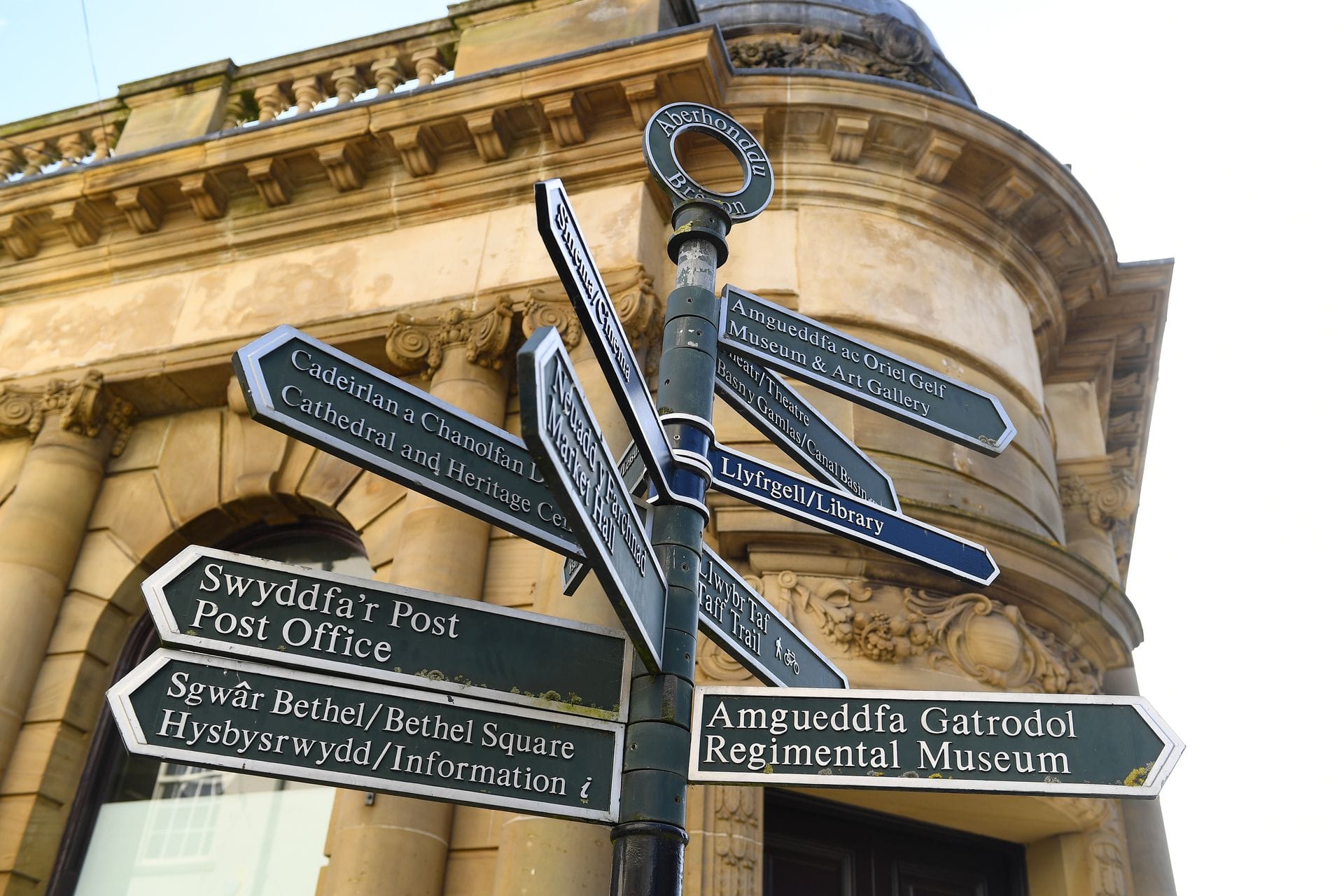
A bilingual directional signpost in the historic town of Brecon, pointing visitors to local landmarks in both Welsh and English. © Crown copyright Cymru Wales 2026
How to Learn Welsh as a Visitor or Beyond
If your Welsh trip sparks a longer interest, the language is more accessible than most learners assume. Three free or low-cost resources worth knowing:
- Duolingo Welsh — the free app has a strong Welsh course, one of Duolingo’s most-completed languages. Good for foundational vocabulary and basic grammar.
- Say Something in Welsh — the SSiW audio course, widely regarded as the fastest way to develop conversational Welsh. Uses a spaced-repetition speaking method rather than reading and writing.
- BBC Bitesize Welsh — free structured lessons at multiple levels.
Wales also runs one of the world’s most established adult Welsh-learner programmes through the National Centre for Learning Welsh, with in-person and online courses across every level.
Cultural Etiquette Around the Welsh Language
A few small things that Welsh speakers will notice:
- Try, don’t apologise. A bad attempt at Welsh is far better received than a “sorry, I only speak English”. Most Welsh speakers switch to English happily if that’s easier for you.
- Do not compliment a Welsh person on speaking such good English. This is a common mistake by first-time American visitors. English is one of the two native languages of the country. See our Wales for Americans guide for context.
- Attempt Welsh place names. The single most-appreciated thing a visitor can do. See our pronunciation guide for the full rules.
- Don’t call Welsh “a dialect”. Welsh is a distinct language, older than English, part of the Celtic Brittonic family, and unrelated to English at the structural level.
- The abbreviation “Cymru” is not “Wales” translated — it is the original Welsh name for the country. “Wales” is the English exonym derived from an Old English word meaning “foreigner”, originally applied by Anglo-Saxons to the Britons they encountered. Welsh people have always called their country Cymru.
Frequently Asked Questions: Welsh Language Phrases
How do you say hello in Welsh?
The standard Welsh greeting is ‘Helo’ (pronounced hello) or ‘Shwmae’ (shoo-my), which is the informal way to say hi in South Wales. In North Wales the equivalent is ‘Sut mae?’ (sit my?). More formal alternatives include ‘Bore da’ for good morning (BOR-eh dah), ‘Prynhawn da’ for good afternoon (prin-HOWN dah) and ‘Noswaith dda’ for good evening (NOS-why-th thah). None of these require you to speak fluent Welsh — attempting even one earns a warm response from Welsh speakers.
What does Diolch mean in Welsh?
Diolch means thank you in Welsh. It is pronounced DEE-olkh, with the ‘ch’ as a throaty sound like the ‘ch’ in the Scottish ‘loch’ or German ‘Bach’. For emphasis you can say ‘Diolch yn fawr’ (DEE-olkh un vowr), meaning thank you very much, or ‘Diolch yn fawr iawn’ (DEE-olkh un vowr YOWN), meaning thank you very much indeed. Diolch is one of the most useful single Welsh words for visitors — using it at cafes, shops, taxis and hotels always gets a smile.
How do you say cheers in Welsh?
The Welsh toast is ‘Iechyd da’ (pronounced YEH-chid dah), which literally means good health. It is used in exactly the same context as the English cheers — before drinking with company. In pubs across Wales this is a warmly received phrase from visitors and works from Cardiff to Caernarfon regardless of North or South dialect.
Is Welsh hard to learn?
Welsh has a reputation for being difficult, but the fundamentals are more approachable than most learners expect. The alphabet is entirely phonetic — once you learn the sounds, you can read any Welsh word correctly. The main challenges are the double-consonants (ll, dd, ff, ch), which do not exist in English, and the mutation system where the first letter of a word changes depending on grammar. For basic conversational phrases at a Welsh cafe, pub or castle, none of the complex grammar matters. Learning ten phrases takes less than an hour.
Do Welsh people speak Welsh in shops and restaurants?
It depends on where in Wales you are. In North Wales, particularly Gwynedd (73% Welsh speakers) and Anglesey (62%), you will often hear Welsh spoken in shops, cafes and pubs. In parts of Carmarthenshire and Ceredigion in the west, Welsh is also common in daily use. In Cardiff, Newport, Swansea and most of South East Wales, everyday transactions are usually in English but Welsh signage is universal and staff often speak both languages. Every part of Wales officially operates bilingually — road signs, government forms and public information are always in both languages.
What is the difference between North Welsh and South Welsh?
North and South Welsh share the same written standard, but everyday spoken vocabulary and pronunciation differ significantly. Milk in North Wales is llefrith, in South Wales llaeth. Grandmother in the North is Nain (pronounced ‘nine’), in the South Mam-gu (mam-gee). Grandfather is Taid (‘tide’) in the North, Tad-cu (‘tad-kee’) in the South. There are four traditional dialect regions: Gwyndodeg (North West), Powyseg (Mid/Powys), Dyfedeg (South West), and Gwenhwyseg (South East). Standard Welsh, used in broadcasting, government and schools, is understood everywhere.
Can I use Welsh in Argentina?
Yes — Welsh is spoken in the Chubut Province of Patagonia in Argentina, home to the Welsh colony known as Y Wladfa (The Colony), founded in 1865 by Welsh settlers seeking to preserve their language and culture. Between 1,500 and 5,000 people in Chubut still speak Welsh today. The towns of Gaiman, Trelew and Trevelin are the strongholds of Patagonian Welsh, with Welsh-medium schools, chapels, tea houses and an annual eisteddfod festival. It is one of only two places in the world outside the UK where Welsh has continuous community use.
More Welsh Travel Guides

Pembrokeshire-born travel writer and founder of Wales.org. Born in Haverfordwest, now based in Hertfordshire — covering Welsh castles, national parks, festivals and family staycations across all 22 Welsh counties.